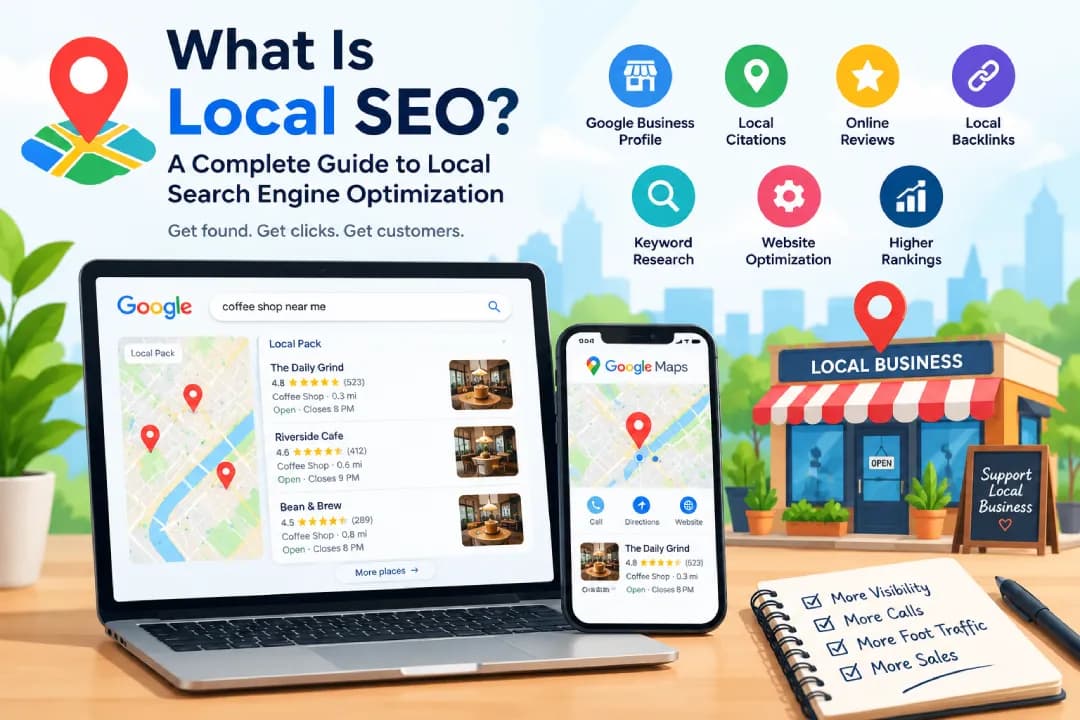
Local SEO (local search engine optimization) is the process of improving your business's visibility in Google and other search engines when people look for products or services near them. It works by optimizing your Google Business Profile, local citations, reviews, and website content so your business appears in the map pack, Google Maps, and local search results. If you serve customers in a specific city, neighborhood, or service area, local SEO is how those customers find you.
This guide explains the basics, shows how local rankings work, and walks through a practical, step-by-step approach you can follow yourself or use to judge an agency's work. Furthermore, If you're new to SEO, start with our guide to search engine optimization to understand the fundamentals before exploring local search strategies.
Table of contents13 sections
What Is Local SEO? (Definition & Overview)
Local SEO Meaning in Plain Language
Local SEO means making it easy for nearby people to find, trust, and contact your business online. When someone searches for a plumber, a dentist, or a coffee shop, Google tries to show the most relevant businesses close to that person. Local search marketing is the work you do to earn one of those spots.
Think of it as the online version of having a visible shop front on the right street, with accurate opening hours and good word of mouth.
How Local SEO Differs From Traditional SEO
Traditional SEO focuses on ranking web pages in organic search, usually for a broad audience. Local SEO adds a location layer. Google weighs where the searcher is, where your business is, and how well-known your business looks in that area.
In practice, that means local SEO relies on things standard SEO often ignores: a verified business profile, consistent name, address, and phone details across the web, and reviews from real customers. If you have ever wondered about the difference between SEO and local SEO, this is it. One targets topics and pages, the other targets places and proximity.
Key Entities Involved: Google Business Profile, Local Pack, and Local SERPs
Three things matter most. Your Google Business Profile (formerly Google My Business) is the free listing that powers your presence on Search and Maps. The local pack, sometimes called the map pack, is the block of three businesses with a map that appears above many organic results. Local SERPs are the full results pages that mix the pack, organic listings, ads, and sometimes AI-generated summaries.
Examples of Local Search Queries and Search Intent
Local queries come in several forms:
- Explicit location: "boiler installation in Leeds" or "coffee shop Lincoln Park"
- Near me: "dentist near me open now"
- Implied location: "emergency plumber" or "best pizza" (Google assumes you want something close)
- Voice and conversational: "where can I get my phone screen fixed today?"
Most of these carry strong buying intent. The person usually wants to call, get directions, or visit soon.
Why Local SEO Matters for Businesses
Increased Visibility in Google Maps and the Local Pack
For many local searches, the map pack takes up most of the first screen on a phone. If you are not there, you are easy to miss. Appearing in the pack and in Google Maps puts your name, rating, and contact buttons in front of people who are ready to act.
Attracting Nearby Customers and Driving Foot Traffic
Local searchers are often close by and in a hurry. A coffee shop owner doesn't need a million visitors from across the country. They need people within a few miles who can walk in today. Local SEO is built for exactly that, and it tends to bring visits, calls, and booking requests rather than casual browsing.
Building Trust Through Reviews and Online Presence
People judge local businesses quickly. Star ratings, recent reviews, clear photos, and accurate hours all signal that a business is real and reliable. A consistent presence across Google, Bing, and industry directories reinforces that impression.
Local SEO vs. National and International SEO: When Each Applies
Local SEO fits businesses that serve a defined area, such as restaurants, clinics, tradespeople, and law firms. National SEO suits companies selling to a whole country, like ecommerce brands without physical locations. International SEO adds language and regional targeting. Many businesses need a mix. An online store with one showroom, for instance, can use local SEO for ecommerce to support the showroom while running national campaigns for the rest.
Benefits of Local SEO for Leads, Calls, and Conversions
The main benefits of local SEO are practical: more calls, more direction requests, more form submissions, and less reliance on paid ads. Because the traffic is specific and intent-driven, conversion rates are often higher than for broad keywords. It also compounds. Reviews, citations, and good local content keep working long after you publish them.
How Local Search Engine Optimization Works
Google's Local Ranking Factors: Relevance, Distance, and Prominence
Google has said local results rely mainly on three factors. Relevance is how well your profile matches what someone searches for. Distance is how far your business is from the searcher or the location in their query. Prominence is how well-known your business is, based on reviews, links, citations, and general web presence.
You can't change distance much, but you can improve relevance and prominence, and that is where most local SEO efforts go.
The Role of Google Business Profile in Local Rankings
Your profile is the foundation. Categories, services, description, hours, photos, and reviews all feed into how Google understands your business. Industry studies of local ranking factors consistently place profile signals and reviews among the most influential. A weak or half-finished profile makes everything else harder.
How Local Search Results and the Map Pack Are Generated
When someone searches, Google reads the intent, identifies local businesses that fit, and ranks them using relevance, distance, and prominence. It then decides how to display them: a map pack, a list in Maps, or both. Your website content, structured data, and third-party mentions help Google confirm the details it finds in your profile.
Google Local Pack vs. Google Maps vs. Local Finder
The local pack is the short list of three businesses shown on the main results page. Clicking "More places" opens the Local Finder, a longer list of results. Google Maps is the standalone app and site where people search directly. They draw on the same business data but can show slightly different rankings, so check all three when you track visibility.
Local Pack Rankings vs. Organic Search Rankings
Local pack rankings depend heavily on your profile, proximity, and reviews. Organic rankings depend more on your website's content, links, and technical quality. You can rank in one and not the other. A strong website helps both, which is why the two should be handled together rather than separately.
Why Local Rankings Vary by Searcher Location
Google personalizes local results by where the searcher is standing. Someone two streets away may see a completely different order than someone across town. That is why checking rankings from your own office can be misleading. Grid-based rank trackers show how visibility shifts across an area, which gives a more honest picture.
How AI-Powered Search Is Changing Local Business Discovery
AI-generated summaries and conversational search tools now pull from business profiles, reviews, and website content to recommend places. The details are still evolving, but the practical lesson is steady: accurate profiles, clear service pages, and genuine reviews give AI systems better material to work with. Businesses with messy or contradictory information are less likely to be surfaced.
Core Components of a Local SEO Strategy
A good local SEO strategy is not one tactic. It is a set of connected pieces: your profile, listings, keywords, website, technical health, reviews, links, content, and competitor awareness. Here is how each one fits.
Google Business Profile (GBP) Optimization
How to Claim, Verify, and Maintain Your Google Business Profile
Search for your business name on Google or Maps. If a listing exists, claim it. If not, create one through Google Business Profile. Google will ask you to verify, usually by video, phone, email, or postcard, depending on your business type. Once verified, keep the profile active by updating hours for holidays, adding new photos, and responding to reviews.
Business Name, Address, and Phone Number (NAP) Accuracy
Your NAP details should match your website and every listing exactly. Use your real business name as it appears on signage and legal documents, without extra keywords. Small differences such as "Street" versus "St." or a changed phone number can create confusion for both customers and search engines.
Choosing the Right Primary and Secondary Business Categories
Your primary category is one of the strongest relevance signals you control. Pick the one that describes your core business, not a broad umbrella. Then add secondary categories for real, additional services. A useful trick is to look at the categories your top-ranking competitors use. Many tools and browser extensions display them.
Categories, Attributes, and Business Description
Attributes, such as "wheelchair accessible," "outdoor seating," or "women-led," help customers decide and give Google extra context. Write your business description in plain, honest language. Explain what you do, who you serve, and where. Skip keyword lists and promotional claims, since they can cause problems.
Services, Products, Business Hours, Photos, Posts, and Q\&A
Fill in every section that applies. List services and products with short descriptions, keep hours accurate, and upload real photos of your premises, team, and work. Posts are useful for offers, news, or events. Q\&A features have been changing on Google, so check what your profile currently offers and keep any answers accurate and helpful.
Add each service or product individually rather than listing everything in one line. Name it the way customers search for it, add a short description that answers a real question (what is included, who it suits, rough pricing if you can), and make sure it fits your chosen categories. A "boiler repair" service under a plumbing category tells Google far more than a vague "home services" entry.
Google Business Profile Eligibility for Storefront and Service-Area Businesses
Google allows profiles for businesses that meet customers face to face, either at a physical location or by traveling to them. Storefronts show their address. Service-area businesses, like mobile mechanics or cleaners, can hide their address and list the areas they serve. Virtual offices, PO boxes, and fake addresses are not allowed and can lead to suspension.
Managing Duplicate, Suspended, or Inaccurate Business Profiles
Duplicates split your reviews and confuse customers, so request removal or merging through Google's tools. If your profile is suspended, read the reason carefully, fix the underlying issue, and submit a reinstatement request with accurate documentation. Inaccurate information, whether added by users or by Google, can be corrected through the suggest-an-edit option or directly in your dashboard.
Ownership problems are just as common. If a former employee or agency still controls your profile, request access through Google's ownership process rather than creating a duplicate. Give team members and agencies the lowest access level that lets them do their job, and use the manager role instead of sharing a login. Check your profile regularly for unauthorized edits, because suggested changes from users can quietly alter your hours or phone number.
Local Citations and Business Listings
What Local Citations Are and Why They Matter
A local citation is any online mention of your business name, address, and phone number. Citations help search engines verify that your business exists and where it operates. Consistent citations support prominence and reduce the risk of wrong details showing up.
Structured vs. Unstructured Local Citations
Structured citations appear in organized directories such as Yelp, Bing Places, or Apple Business Connect. Unstructured citations are mentions in blog posts, news articles, or social posts. Both help, but structured ones are easier to control while unstructured ones often carry more trust.
Best Business Directories for Local Citation Building
Start with the major platforms: Google Business Profile, Bing Places, Apple Business Connect, Yelp, Facebook, and data aggregators in your country. After that, add well-regarded directories relevant to your area. Quality matters more than volume. A handful of accurate, trusted listings beats hundreds of low-value ones.
Maintaining Consistent NAP Information and Fixing Duplicate Listings
Keep a master document with your exact business name, address, phone number, website, and hours. Audit listings every few months. When you find duplicates or outdated entries, claim and correct them first. Only request removal when you can't update them. Moving premises or changing numbers is the moment most inconsistencies appear, so plan the update in advance.
Industry-Specific and Local Directory Listings
Directories tied to your trade or city often matter more than general ones. A law firm may appear in legal directories, a restaurant on review and booking platforms, and a contractor on home-service networks. Local chambers of commerce and city business associations are also worthwhile.
Local Keyword Research and Search Intent
Finding Local Keywords Using Keyword Research Tools
Begin with your core services and add location modifiers. Tools such as Google Keyword Planner, Semrush, and Ahrefs show search volume and variations. Google's autocomplete and "People also ask" boxes are free and surprisingly useful for finding the phrases real customers use.
Using City, Neighborhood, and “Near Me” Keywords
Combine services with cities, districts, and landmarks, for example "emergency plumber in Lincoln Park." For "near me" searches, you can't really optimize for the phrase itself. Instead, strong profile signals and a clear local presence help Google decide you are the near option.
Understanding Local Search Intent
Not every local search means "buy now." Some people want hours, others want prices, reviews, or a how-to guide. Match your page to the intent. A service page should invite contact, while a blog post can answer early-stage questions.
Analyzing Competitor Keywords and Local Search Results
Search your main keywords in an incognito window and note who shows up in the pack and organic results. Study their service pages, titles, and content depth. Competitor analysis tools can reveal keywords they rank for that you don't, which often points to quick opportunities.
Voice Search and Conversational Local Queries
People speaking to a phone or smart speaker ask full questions, like "Which dentist near me is open on Saturday?" Clear FAQs, accurate hours, and plain-language answers on your site make it easier to match these queries.
Keyword Placement Without Keyword Stuffing
Place your main keyword and location in the title tag, headings, opening paragraph, and image alt text where it reads naturally. Then write for people. If a sentence sounds forced when read aloud, rewrite it. Synonyms and related terms do the rest.
On-Page Local SEO
Location Pages and Service-Area Content
If you serve several cities or neighborhoods, give each important one a page with real, useful content: services offered there, local projects, team members, testimonials, and directions. Service-area content should show genuine familiarity with the place.
Creating Unique Landing Pages for Multiple Locations
Each location page needs its own details: unique address and phone number, local photos, staff bios, embedded map, and local reviews. Avoid copying the same text and swapping city names. That approach is easy to spot and rarely performs well.
Title Tags, Meta Descriptions, and Local Business Schema Markup
Write title tags that include the service and location, and meta descriptions that give a clear reason to click. Add LocalBusiness schema markup to share your name, address, hours, and contact details in a format search engines can read easily. Test it with Google's Rich Results Test.
Internal Linking and Website Structure for Local SEO
Link from your homepage and main navigation to key service and location pages. Use descriptive anchor text and keep the structure shallow, so important pages are only a click or two from the homepage. Related blog posts should link back to the relevant service page.
Avoiding Duplicate or Thin Location Pages
Thin pages offer little beyond a city name and phone number. Doorway-style pages made only to catch searches can violate Google's spam policies. If you can't add real value for a location, it is better to cover several areas on one strong page.
Technical SEO Factors That Support Local Rankings
Technical health won't make a weak business rank, but a poor setup can hold back a good one.
Mobile-Friendliness and Responsive Website Design
Most local searches happen on phones. Your site should load cleanly, use readable text, and offer tap-to-call buttons and easy directions.
Page Speed and Core Web Vitals
Slow pages frustrate users. Compress images, limit heavy scripts, and monitor Core Web Vitals (loading, interactivity, and visual stability) in Search Console or PageSpeed Insights.
Website Crawlability, Indexing, and XML Sitemaps
Make sure search engines can find and index your key pages. Submit an XML sitemap through Search Console and check that important pages aren't blocked by robots.txt or noindex tags.
HTTPS and Technical Website Health
Use HTTPS, fix broken links, and keep your site free of malware. These are basics, but they protect trust.
Online Reviews and Reputation Management
Encouraging Customers to Leave Reviews
Ask happy customers directly, soon after the job is done. A short message with a direct review link, sent by text or email, works well. QR codes at the counter help for walk-in businesses.
Responding to Positive and Negative Reviews
Thank people for good reviews in a personal way. For negative ones, stay calm, acknowledge the issue, and offer to resolve it offline. Future customers often read your reply more closely than the complaint itself.
Building a Consistent Customer Review Process
Make review requests part of your routine, such as a follow-up message after each completed order or appointment. A steady trickle looks more natural and works better than a burst once a year.
Review Quality, Quantity, Recency, and Diversity
All four count. Detailed reviews mention specific services. A healthy number builds confidence. Recent reviews show you are active. And reviews on several platforms, not only Google, support a broader reputation.
Fake Reviews, Incentives, and Review Policies
Never buy reviews, write your own, or offer rewards in exchange for them. Google's policies prohibit this, and penalties can include removed reviews or profile restrictions. You also shouldn't selectively gate reviews by asking only happy customers.
Managing Your Online Reputation Across Multiple Platforms
Monitor Google, Facebook, Yelp, and industry sites. Reputation tools can send alerts so you can respond quickly. Consistency in tone across platforms helps.
Local Link Building
Earning Links From Local Businesses, News Sites, and Directories
Links from relevant local sites carry weight. Think local newspapers, community blogs, suppliers, and business associations. Offering useful data, expert comments, or a newsworthy story is more effective than asking for links.
Local Partnerships, Sponsorships, Community Events, and Local PR
Sponsoring a youth team, hosting a workshop, or joining a charity drive often leads to genuine mentions and links. These activities also build real-world reputation, which supports prominence.
Analyzing Competitor Backlinks for Local Link Opportunities
Use a backlink tool to see who links to your top competitors. Local organizations that link to them may be open to linking to you too.
Local Content Marketing and Community Engagement
Creating Useful Content About Local Areas and Communities
Write about topics your customers care about in your area, such as seasonal advice for local weather or neighborhood-specific guides. Local relevance should come from real knowledge, not just city names.
Publishing Local Guides, News, and Event-Related Content
Guides, event roundups, and updates about your involvement in local happenings give people reasons to visit and share your site. Keep the content accurate and updated.
Using Social Media to Support Local Brand Visibility
Social profiles won't directly lift rankings, but they build awareness and give customers another way to reach you. Share photos, offers, and community involvement, and keep your business details consistent.
Local Competitor Analysis
Comparing Competitor Google Business Profiles and Reviews
Look at competitors' categories, services, photos, review counts, ratings, and how often they get new reviews. This shows what it may take to compete in your area.
Finding Competitor Keyword and Content Gaps
Compare your pages with theirs. Which services do they cover that you don't? Which questions do they answer in more detail? Those gaps are your next content tasks.
Comparing Competitor Citations and Backlinks
Check which directories list them and which sites link to them. Closing obvious gaps is usually straightforward and often effective.
How to Do Local SEO: A Step-by-Step Approach
If you are new and want to learn local SEO, follow these steps in order. Each one builds on the last.
Step 1: Audit Your Existing Local Search Presence
Search your business name and main services. Note what appears in the pack, Maps, and organic results. Check your profile, listings, reviews, and website for errors. A free local SEO audit tool can speed this up, but a manual check teaches you a lot. A broader SEO audit for small business can also help identify website issues, content gaps, and technical problems that may affect search visibility.
Step 2: Conduct Local Keyword Research
List your services, add locations, and check variations using keyword tools and autocomplete. Group them by intent and decide which pages will target which terms.
Step 3: Optimize Your Google Business Profile
Claim and verify the profile, choose accurate categories, complete all sections, add photos regularly, and keep hours current. Treat it as a living page, not a one-time setup.
Step 4: Build and Audit Local Citations
Create listings on major platforms and relevant directories using identical NAP details. Then audit existing mentions and correct anything outdated or duplicated.
Step 5: Optimize Your Website and Create Location Pages
Improve titles, headings, and service content. Add schema markup, strengthen internal links, and create genuinely useful location pages. Make sure the site is quick and works well on mobile.
Step 6: Generate and Manage Customer Reviews
Set up a simple process to request reviews after each job and respond to every review within a few days.
Step 7: Build Relevant Local Backlinks and Partnerships
Focus on community involvement, local press, supplier relationships, and useful resources others will want to reference. A few relevant links outweigh many random ones.
Step 8: Track Local Rankings and Measure Performance
Monitor pack and Maps rankings from multiple points in your service area. Pair this with profile insights, Search Console, and analytics data.
Step 9: Analyze Results and Improve Your Strategy
Review what changed after each effort. If calls increased after you added service pages, expand that approach. If a tactic shows nothing after several months, adjust. Local SEO rewards steady refinement.
Local SEO for Different Business Types
Local SEO for Small Businesses
Small business local SEO should start with the essentials: a complete profile, accurate listings, a steady flow of reviews, and a simple website with clear service pages. These alone often make a noticeable difference, especially against competitors who ignore them.
A brand-new business starts with no reviews and no backlinks, so the early goal is to prove you are real. Verify your profile, get listed consistently on the major directories, and ask your first genuine customers for reviews, including friends and early clients who have actually used your service. Local mentions from a chamber of commerce, a supplier, or a community event help build initial authority while the rest catches up.
Local SEO for Multi-Location Businesses
Multi-location businesses need consistency and local flavor at once. Each branch should have its own profile, page, and reviews, while brand details stay uniform.
Managing Multiple Google Business Profiles
Use the bulk management tools in Google Business Profile or a listing management platform. Assign clear ownership for each location and keep an eye on duplicates or unauthorized edits.
Creating Unique Location Pages at Scale
Build a template that includes space for unique content: local staff, photos, testimonials, directions, and community involvement. Fill each page with real information rather than recycled text.
Local SEO for Service-Area Businesses
If you travel to customers, your visibility depends on showing Google where you work and proving you do good work there.
Service-Area Profiles and Geographic Coverage
List the cities or regions you genuinely cover, keeping the list realistic. Create website pages for your main areas, with examples of work done there.
Ranking Without a Public-Facing Storefront
You can rank without a public address, but proximity to the searcher still matters. Strong reviews, detailed service pages, and local mentions help you compete in areas beyond your base.
Local SEO for Restaurants and Hospitality Businesses
Photos, menus, hours, booking links, and reviews are central. Keep seasonal changes updated and respond to feedback quickly. Food and hospitality searches are highly visual and review-driven.
Local SEO for Professional Services and B2B Businesses
Lawyers, accountants, and consultants benefit from detailed service pages, practitioner profiles, and credible reviews. B2B firms should focus on expertise content and industry directories alongside their local presence.
Clinics, law firms, and similar practices often have several practitioners. Give each person a bio page on your website with credentials, specialties, and a link back to the main location page. Individual practitioner profiles on Google are only allowed where they meet eligibility rules, and they should not compete with the main business listing. Keep the business-level profile as your primary asset, and treat individual visibility as a supporting layer.
Local SEO for Franchises and Enterprises
Franchises need central brand governance and local autonomy. Provide location teams with guidelines for profile management, reviews, and local content, and use reporting tools to track every site.
Can a Business Rank Locally Without a Website?
Yes, it is possible. A strong Google Business Profile can appear in the pack even without a site. However, a website gives you more control, more keywords to target, and more trust signals, so it is worth having one.
Local SEO Best Practices and Common Mistakes to Avoid
Best Practices for Sustainable Local Rankings
Keep your information accurate, ask for reviews consistently, publish helpful content, and treat your profile as an active channel. Avoid shortcuts. Local rankings reward businesses that are genuinely visible and well regarded.
Seasonal businesses should prepare before demand peaks. Update hours, services, and photos a few weeks ahead, publish seasonal service pages early so they can be indexed, and mark temporary closures properly instead of letting customers find an unanswered phone. A landscaper, ski shop, or tax preparer will usually see searches rise before the season, so early visibility matters.
Common Local SEO Mistakes That Hurt Visibility
Typical mistakes include ignoring the profile after setup, choosing the wrong categories, neglecting mobile experience, and never checking rankings from different locations.
Inconsistent NAP Information and Duplicate Listings
Outdated phone numbers and old addresses linger online. Regular audits prevent confusion and protect your credibility.
Keyword Stuffing and Unnatural Location Pages
Repeating "best plumber in Chicago" across every line or publishing dozens of near-identical city pages weakens your content and can attract spam filters.
Local SEO Spam and Google Business Profile Guideline Violations
Fake addresses, keyword-padded business names, and fake reviews are common violations. They can lead to suspension, and recovering can take weeks.
Manipulative Link-Building Tactics
Paid link networks and irrelevant directories may look tempting, but they carry risk. Earned, relevant links are safer and more valuable.
Local SEO Beyond Google: Bing and Other Search Platforms
Bing Places, Apple Business Connect, and platforms like Yelp and Facebook also influence discovery. Setting them up takes little time and widens your reach.
Local SEO Tools for Research, Optimization, and Reporting
Local SEO Tools for Rank Tracking and Reporting
Tools such as BrightLocal, Local Falcon, and Semrush's local features offer grid-based rank tracking and client-ready local SEO reporting.
Local Keyword Research and Competitor Analysis Tools
Ahrefs, Semrush, and Google Keyword Planner help with keyword ideas, difficulty, and competitor data. Combine them with manual search checks for a fuller picture.
Citation Management and Listing Audit Tools
Platforms like BrightLocal, Moz Local, and Yext can find inconsistent listings and help correct them. Consider whether you need ongoing management or a one-time cleanup.
Google Search Console for Local Organic Search Performance
Search Console shows which queries and pages bring impressions and clicks, plus indexing issues and Core Web Vitals. It does not report map pack data separately, but it reveals how your site performs in organic search.
Google Analytics 4 for Local Traffic and Conversions
GA4 lets you track visits from your profile, form submissions, and click-to-call events. Set up key events so you can see which pages and sources create leads.
Technical SEO Audit Tools for Local Websites
Screaming Frog, Sitebulb, and the audit features in Ahrefs or Semrush help you find broken links, crawl issues, and slow pages.
When to Use a Local SEO Service or Agency
If you lack time, expertise, or the capacity to manage multiple locations, a local SEO service can help. It also makes sense when competition is strong and DIY efforts have stalled.
Measuring Local SEO Performance and ROI
Tracking Local Rankings and Map Visibility
Monitor your position for key terms across several points in your area. Look at trends over months, not daily swings.
Monitoring Google Business Profile Calls, Clicks, and Directions
Your profile performance data shows how many people called, visited your website, or requested directions. These are some of the clearest indicators of local intent.
Treat this data as a guide, not a final count. A call or direction request shows interest, not a paying customer, and the same person may tap more than once or reach you another way. Some actions may be missed entirely. Compare profile activity with your own records, such as booked jobs or customers who say how they found you.
Measuring Organic Traffic, Leads, and Conversions
Track organic sessions, form submissions, calls, and booked jobs. Call tracking and CRM notes help connect search activity to revenue.
Many local journeys start on a phone and end with a call or booking. Track click-to-call taps and form submissions as key events in GA4, use a separate tracking number or call tracking tool for website calls where appropriate, and add UTM parameters to your profile website link so profile visits show up separately from other organic traffic. This makes it easier to see which mobile searches turn into real appointments.
Tracking Local SEO KPIs and Reporting Progress
Useful KPIs include pack visibility, profile actions, review volume and rating, organic traffic, and conversions. Report monthly and highlight what changed and why.
Local SEO Costs and Hiring an Agency
How Much Does Local SEO Cost?
Costs vary by market and scope. Small businesses often see monthly packages ranging from a few hundred to a couple of thousand dollars, while multi-location or competitive industries cost more. One-time setup or audit projects are usually priced separately. Always ask what is included.
DIY Local SEO vs. Hiring an Agency
DIY costs time and gives you full control. An agency saves time and brings experience but costs money and requires oversight. Many owners start by handling profile and reviews themselves, then bring in help for content, links, and reporting.
Choosing a Local SEO Agency and Evaluating Its Services
Ask for case studies, a clear scope of work, and how they report results. Be cautious about guaranteed rankings, vague deliverables, or pressure to sign long contracts. A good agency explains its approach plainly and gives you access to your own accounts.
Local SEO Checklist
Google Business Profile Checklist
- Claim and verify your profile
- Choose accurate primary and secondary categories
- Complete services, products, hours, and description
- Add real photos regularly
- Respond to reviews and update holiday hours
Website, Citations, and Reviews Checklist
- Mobile-friendly, fast, HTTPS website
- Unique title tags and local service or location pages
- LocalBusiness schema added
- Consistent NAP on all major directories
- A repeatable process for requesting reviews
Local Tracking and Reporting Checklist
- Track rankings from multiple locations
- Review profile calls, clicks, and directions monthly
- Monitor organic traffic and conversions in GA4
- Check Search Console for errors and query trends
- Adjust your plan based on results
Conclusion
Local SEO connects nearby customers with the businesses that serve them. It combines a well-managed Google Business Profile, accurate listings, genuine reviews, useful website content, and steady effort. None of it is complicated on its own, but consistency is what separates businesses that show up from those that don't. Start with an audit, fix the basics, and build from there. Results usually take a few months, yet they tend to last.
FAQs
What Is Local SEO in Simple Terms?
Local SEO is the practice of helping your business appear when people search for services in their area. It focuses on your Google Business Profile, reviews, listings, and local website content.
How Is Local SEO Different From Traditional SEO?
Traditional SEO targets broad rankings for web pages. Local SEO adds location signals and focuses on map results, proximity, and reviews.
Why Is Local SEO Important for Small Businesses?
It puts you in front of people ready to buy nearby, often at a lower cost than ads, and helps you compete with larger brands in your own area.
What Are the Three Main Local SEO Ranking Factors?
Google names relevance, distance, and prominence as the main factors in local results.
What Is the Difference Between Google Maps and the Local Pack?
The local pack is the three-business listing on the search results page. Google Maps is the dedicated map app and site with a broader list of businesses.
How Do I Optimize My Google Business Profile?
Claim and verify it, select accurate categories, fill in every section, add photos, keep hours updated, and respond to reviews.
What Are Local Citations, and Why Do They Matter?
Citations are online mentions of your business name, address, and phone number. They help search engines confirm your details and support your prominence.
How Long Does Local SEO Take to Show Results?
Some improvements, like profile fixes, can show within weeks. Broader gains typically take three to six months or longer, depending on competition.
How Much Does Local SEO Cost?
Costs depend on your market and scope. Monthly services often range from a few hundred to a couple of thousand dollars for small businesses, with higher costs for multiple locations.
Can a Service-Area Business Rank Without a Physical Storefront?
Yes. You can hide your address, list your service areas, and build visibility through reviews and local content, though proximity still influences results.
Are Backlinks and Customer Reviews Important for Local SEO?
Yes. Reviews strongly influence prominence and customer trust, while relevant local backlinks strengthen your website's authority.
Which Tools Are Best for Tracking Local SEO Performance?
Popular options include BrightLocal, Local Falcon, Semrush, Ahrefs, Google Search Console, and Google Analytics 4. The best choice depends on your budget and how many locations you manage.