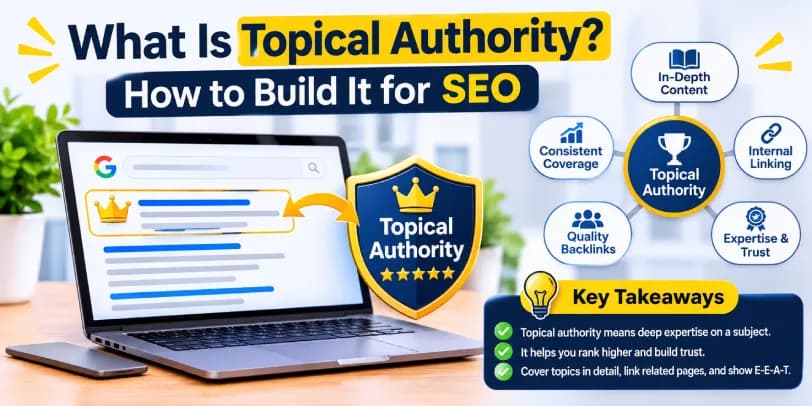
Topical authority is the level of trust and expertise a website earns on a specific subject, based on how completely, accurately, and consistently it covers that subject. A site with strong topical authority usually ranks more easily for related keywords because search engines and AI systems see it as a dependable source on that topic. You build it by covering a subject in depth, linking related pages together, and showing real expertise.
Table of contents12 sections
What Is Topical Authority in SEO?
Topical Authority Definition
Topical authority in SEO describes how credible a site is within one subject area. It is not a single metric you can look up. It is the overall impression created by your content depth, internal linking, author expertise, backlinks, and how often people and other sites reference you on that topic.
Think of a cat food review site that has covered ingredients, life stages, allergies, brands, and feeding guides for years. Search engines can see that it knows the subject well. A general pet blog with one cat food post has a harder time competing.
Topical Authority vs. Domain Authority
Domain authority is a third-party score, such as Ahrefs Domain Rating or Moz Domain Authority, that estimates the strength of a site's backlink profile. Google does not use it. Topical authority is about subject expertise, not link strength.
It helps to think in three layers. Site-wide authority is the general strength and trust of the whole domain, usually reflected in its backlinks and brand. Topic-level authority is how well that site is regarded on one particular subject. Page-level authority is the strength of a single URL, shaped by the links pointing to it, its internal links, and how well it answers the query.
These layers do not always move together. A large news site may have a high domain score but only a thin pet section, so it can lose to a specialist pet site on cat food queries. Meanwhile, a smaller site with deep coverage can outrank a larger one for a narrow subject. A page can also rank well on its own merits without the rest of the site being an authority on anything.
Topical Authority vs. Topical Relevance
Topical relevance asks whether a single page or link matches a subject. Topical authority asks whether your whole site is a trusted source on it. One relevant page is a start. A connected body of quality content is what builds authority.
Topical Authority vs. Topic Clusters
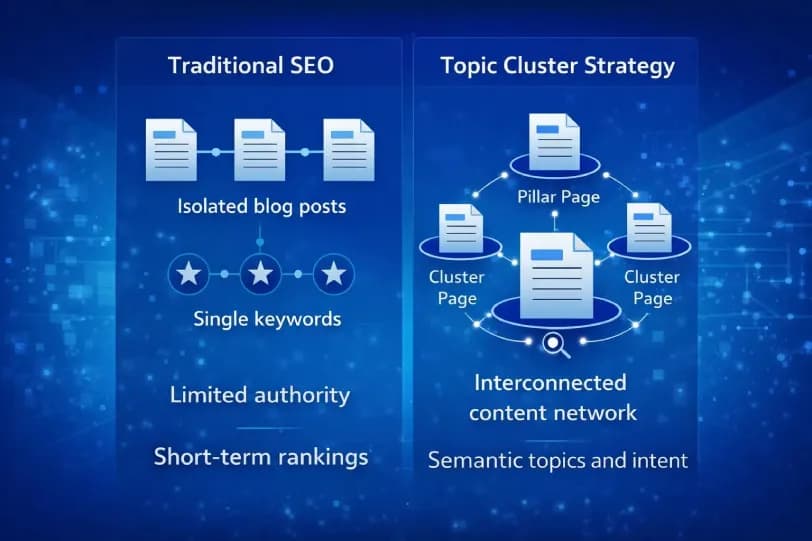
A topic cluster is a content structure: a pillar page linked with supporting pages. Topical authority is the outcome that structure helps create. You can publish clusters and still lack authority if the content is thin or the expertise is missing.
Topics vs. Keywords in Topical SEO
Keywords are the phrases people type. Topics are the broader subjects those phrases belong to. Traditional SEO targeted individual keywords, while topical SEO plans around whole subject areas, so one well-built page can rank for dozens of related queries.
This is also where semantic SEO enters the picture, and the two terms are often mixed up. Semantic SEO is a way of optimizing content: writing around meaning, entities, context, and search intent rather than exact phrases. Topical authority is a result: the site-level credibility you earn on a subject. Semantic SEO is one of the methods that helps you get there, but it is not the same thing. A single page can be beautifully optimized for meaning and still sit on a site that has no real depth on the subject.
Why Is Topical Authority Important for SEO?
How Topical Authority Improves Search Visibility and Organic Traffic
When a site covers a subject thoroughly, new pages on that subject tend to rank faster. Search engines already associate the site with the topic, so they have more context to work with. Over time this compounds into steadier organic traffic.
How Topical Authority Helps Rank for Competitive Keywords
Competitive keywords are hard to win with one strong page. Supporting content around the term signals real expertise, which often makes the difference when two sites have similar backlink profiles.
Building Trust, Credibility, and Brand Recognition
Readers notice when a brand consistently answers their questions well. They come back, search for the brand by name, and recommend it. That recognition also feeds the trust signals Google associates with E-E-A-T.
How Topical Authority Supports Leads, Conversions, and ROI
Visitors who read several helpful articles before reaching a service page arrive better informed. They tend to convert more readily because the content has already answered their doubts.
How Topical Authority Can Reduce Marketing Costs
Authority lowers dependence on paid traffic over time. Content that keeps ranking continues to bring visitors without a per-click cost, though it does require ongoing maintenance.
How Does Google Evaluate Topical Authority?
Google has not confirmed a universal topical authority score. What we can do is separate what Google documents from what SEOs observe in practice. The signals below are widely observed patterns, not confirmed ranking factors.
The Role of E-E-A-T in Topical Authority
E-E-A-T stands for experience, expertise, authoritativeness, and trustworthiness. It is a quality framework used by Google's evaluators, not a direct ranking factor. Even so, the qualities it describes overlap heavily with what makes a site a credible source on a subject.
There is also a source-level side to this. Google's rater guidelines ask evaluators to look at the reputation of a website and its creators, including what independent sources say about them, rather than relying only on what the site says about itself. Google has also said that some of its systems, such as the helpful content system, have used site-wide signals. And its site reputation abuse policy targets third-party content that is published on an established site mainly to borrow its ranking power, which suggests Google pays attention to whether content actually belongs to a source's area of expertise.
None of this proves there is a hidden topical score. It does explain why a focused, well-regarded source tends to perform better on its subject than a site that publishes about everything.
Content Depth, Breadth, and Topical Coverage
Depth means answering a question fully. Breadth means covering the related subtopics around it. Sites that do both tend to perform better across a whole subject area than sites that cover only the popular queries.
Coverage also includes format. Written guides are the foundation, but a topic can be covered more completely when the right questions are answered through video, original images, tutorials, or downloadable resources. We come back to this in the content creation steps below.
How Internal Linking Establishes Topic Relationships
Internal links show search engines which pages belong together and which are most important. Descriptive anchor text and logical structure make those relationships clear.
How Google Understands Topics, Entities, and Semantic Relationships
Google uses semantic search to understand entities, such as people, products, and concepts, and how they connect. Content that mentions the right related entities in a natural way helps search engines place your page within a subject.
How Google Search Evolved Toward Topical Understanding
Search moved from matching exact keywords to understanding meaning, with updates like Hummingbird, RankBrain, and BERT. Algorithm updates since then have kept rewarding helpful, expert content over pages built around keyword repetition.
Core Elements That Build Topical Authority
Comprehensive and Search Intent-Focused Content
Each page should fully satisfy the reason someone searched. If the intent is to learn, teach clearly. If it is to compare, compare honestly. Comprehensive does not mean long for its own sake.
Subject Matter Expertise and Author Credibility
Show who wrote the content and why they are qualified. Author bios, real experience, and accurate sourcing make content more trustworthy to readers and evaluators.
This matters most for Your Money or Your Life topics, such as health, finance, legal, and safety content. Google holds these subjects to a higher standard because inaccurate advice can hurt people. If you cover them, content should be written or reviewed by someone with genuine qualifications, claims should be supported by reliable sources such as clinical guidelines, regulators, or official statistics, and pages should show when they were last reviewed. A disclaimer does not make up for weak expertise. In these niches, publishing a wide range of articles without qualified expertise can work against you, so a narrower scope you can stand behind is usually the better route.
Original Research, Expert Insights, and Information Gain
Information gain means adding something new to the conversation: your own data, a case study, or a practitioner's perspective. Pages that only repeat what already ranks give search engines little reason to prefer them.
First-hand experience deserves its own mention here, because it is easy to fake and easy to spot. Presenting researched information means summarizing what other sources say. Showing first-hand experience means including details that only someone who has done the thing would know: original photos and screenshots, test results, what went wrong, what you would do differently. For example, a page about switching cat foods that rewrites the standard advice is researched. A page that documents an actual transition, including how the cats responded and what changed day by day, shows experience. Only claim experience you really have, and when you lack it, bring in someone who does.
Strategic Internal Linking and Site Architecture
A clear site structure, with related pages grouped and linked sensibly, helps both users and crawlers. Keep important pages within a few clicks of the homepage.
Structure only works if your pages can be found and indexed in the first place. A topic cluster full of pages that Google cannot crawl or chooses not to index will not build much authority. A few basics matter here. Robots.txt controls crawl access, but blocking a page there also stops Google from seeing any noindex tag on it. A noindex directive tells Google to keep a page out of its index, so use it deliberately and never leave it on a page you want to rank. Canonical tags point Google to the preferred version of similar pages, though Google treats them as a strong hint rather than a command. XML sitemaps help Google discover your URLs, but they do not guarantee indexing. The Page indexing report in Search Console shows which pages are indexed and why others are not.
Topically Relevant Backlinks and External Citations
Links from sites in your subject area carry more contextual meaning than random ones. Quality backlinks and citations from respected publications support your credibility, though they do not replace strong content.
Consistent Content Quality and Publishing
Regular, reliable publishing shows a site is active and committed to its subject. Consistency of quality matters more than frequency.
Brand Voice and Brand-Topic Associations
When your brand name appears repeatedly alongside a subject, in articles, podcasts, and mentions, that association strengthens. A recognizable voice makes it easier for people to remember you for that topic.
How to Build Topical Authority: Step-by-Step
Step 1: Choose Your Core Topic and Define Its Scope
Pick a subject you can cover better than most competitors, and decide where its boundaries are. A narrower scope is easier to complete and win.
Identify Your Target Audience and Niche
Know who you are writing for and what they need to learn. A tightly defined niche, such as cat food for sensitive stomachs, is easier to own than all of pet care.
Prioritize Topics by Relevance and Ranking Potential
Rank topics by how closely they connect to your business and how realistic it is to rank for them. Traffic potential and keyword difficulty help here.
Step 2: Conduct Keyword, Search Intent, and Entity Research
Good research tells you what to write and in what order.
Identify Seed Keywords and Related Subtopics
Start with a short list of seed keywords. Use a keyword tool to expand them into related terms, subtopics, and a full keyword list.
Analyze Informational, Commercial, and Transactional Search Intent
Look at what currently ranks to understand intent. Informational queries want answers, commercial ones want comparisons, and transactional ones are ready to buy.
Discover Entities, Long-Tail Queries, and Audience Questions
Check People Also Ask, forums, and community discussions to find real questions. Reddit threads and Quora answers often show the wording people actually use.
Step 3: Create a Topical Authority Map
What Is a Topical Authority Map?
A topical authority map, also called a topic map, is a plan of every subtopic, question, and page needed to cover a subject. It works as a blueprint for your content.
How to Structure Pillar Pages and Supporting Subtopics
Place a broad pillar page at the center and connect narrower supporting pages around it. Each supporting page answers one specific question.
How to Organize Topics Around the Buyer Journey
Group topics by awareness, consideration, and decision stages. This ensures readers always find a next step.
How to Prioritize and Schedule Your Content Map
Start with topics that are easiest to win and most valuable to your business. Then schedule the rest in a realistic publishing calendar.
Step 4: Build Topic Clusters and Content Silos
Organize Pillar Pages, Cluster Pages, and Supporting Content
The pillar covers the subject broadly. Cluster pages go deep on individual aspects, and each links back to the pillar and to relevant siblings.
Define Page Roles and Avoid Overlapping Search Intent
Give every page one clear job. If two pages answer the same question, they compete with each other.
Not all overlap is a problem, though. Two pages can discuss related concepts without competing. A guide to grain-free cat food and a guide to choosing food for sensitive stomachs will naturally mention some of the same ingredients, yet they serve different questions. The harmful kind of overlap happens when two pages aim to satisfy the same search intent, so that Google has to choose between near-identical answers. A good test is to ask what the reader wants to do after landing on each page. If the answer is the same, the pages probably need to be merged or separated more clearly.
Connect Informational and Commercial Pages
Link helpful educational content to related service or product pages where it makes sense for the reader.
Step 5: Identify and Fill Topical Content Gaps
Analyze Competitor Topic Coverage
Review which subtopics competitors cover that you do not. A content gap tool in Ahrefs or Semrush makes this faster.
Find Missing Questions and Search Intent Gaps
Sometimes a page exists but fails to answer the real question. Compare your content with what ranks and look for missing angles.
Use Google Search Console to Identify Content Opportunities
Search Console shows queries where you already get impressions but low clicks. These are often easy opportunities to improve.
Step 6: Create High-Quality, Problem-Solving Content
Match Content with Search Intent
Open with the answer, then support it. Readers should not have to hunt for what they came for.
Include Original Insights, Examples, and Expert Contributions
Add examples from real work, quotes from specialists, or your own data. This is what separates useful content from generic summaries.
Think beyond articles, too. Some questions are answered better in another format. A short video can show a process that is tedious to describe. Original images, diagrams, and screenshots prove the work was actually done. Research reports and surveys give others something to cite. Podcasts and interviews bring in outside expertise, while tutorials and downloadable resources such as checklists and templates help people act on what they read. Each format should earn its place by answering a real need, and a transcript or written summary alongside audio and video makes the content easier for search engines to understand.
Cover Related Questions Without Keyword Stuffing
Answer related questions where they fit naturally. If a sentence reads awkwardly because of a keyword, rewrite it.
Step 7: Implement a Strategic Internal Linking Structure
Connect Pillar and Cluster Pages with Contextual Links
Link from within the body text, where the reader would genuinely want more detail, not only from navigation menus.
Use Relevant Anchor Text and Lateral Links
Descriptive anchors tell users and search engines what the destination covers. Lateral links between related cluster pages strengthen the internal linking structure.
Identify and Fix Orphan Pages
Orphan pages have no internal links pointing to them. A crawl with Screaming Frog or Ahrefs will surface them so you can connect them. While you are at it, confirm that the pages you want to rank are actually indexable and listed in your XML sitemap, since an orphaned or noindexed page cannot contribute to the cluster.
Step 8: Earn Topically Relevant Backlinks and Citations
Build Links Through Relevant Outreach and Digital PR
Reach out to sites in your subject area with content worth referencing. Original research and useful tools tend to attract the best responses.
Earn Editorial Citations and Brand Mentions
Contribute expert commentary to journalists and industry publications. Mentions, even without links, help build brand-topic associations.
Use Broken Link Building and Unlinked Mentions
Broken link building means offering your page as a replacement for a dead link. Unlinked mentions are brand references that simply need a link added.
Step 9: Prevent Keyword Cannibalization
Identify Pages Targeting Overlapping Search Intent
Search for your target term in Search Console. If several of your pages rotate in the results for the same query, they may be cannibalizing each other. Check whether the pages truly serve the same intent before acting, because two related pages ranking for the same query is not automatically a problem.
Consolidate, Differentiate, or Redirect Competing Pages
Merge overlapping pages, give each a distinct purpose, or redirect the weaker one to the stronger.
The same thinking applies to the cluster as a whole. Over time, most sites collect pages that are outdated, thin, off-topic, or simply unnecessary. Review each one by looking at its traffic, backlinks, conversions, quality, and fit with your topic. Then choose an action. Keep pages that still serve a purpose. Update ones that are salvageable. Merge pages that overlap and redirect the old URLs with a 301\. Remove pages with no value, no links, and no relevance. Do not delete content only because it is old or gets little traffic, since a low-traffic page can still support a cluster by answering a specific question or passing internal links. Google has also indicated that age alone is not a reason to remove content.
Step 10: Refresh and Maintain Your Content Clusters
Update Outdated Content and Statistics
Replace old figures, remove dead references, and revise advice that has changed.
Updating is also your main defense against content decay, which is the gradual loss of organic performance a page experiences over time. Common causes include outdated information, newer and better competing pages, changes in the search results such as AI Overviews or new SERP features, shifting search intent, and lost backlinks.
The tricky part is telling real decay from normal ranking movement. Rankings fluctuate daily, and many topics are seasonal. Compare year-over-year data rather than month-to-month, and look for a decline that continues for several months in clicks, impressions, or average position. Check whether the drop lines up with a known algorithm update that hit your whole site, or whether only one page or cluster is falling. If the entire site moved at once, the cause is probably not decay in a single article. If one aging page keeps slipping while competitors publish fresher answers, that is decay, and a meaningful update is the fix. Changing the date without improving the content does not count.
Audit Topical Coverage and Internal Links Regularly
Review your clusters every few months for gaps, broken links, and pages that no longer perform. Include a technical check in each audit: look for pages that have dropped out of the index, accidental noindex tags, conflicting canonicals, and important URLs missing from the sitemap.
Expand Clusters as New Search Topics Emerge
Subjects evolve. Add new pages as fresh questions and trends appear.
How Topical Authority Affects AI Search and LLM Visibility
The Relationship Between Topical Authority and AI Search Visibility
AI search tools and answer engines tend to draw on sources that cover a subject clearly and consistently. While no one outside these companies can say exactly how they choose, sites with strong topical authority are more likely to be found and cited.
How AI Overviews and LLMs Discover and Cite Sources
AI Overviews rely on Google's index, so ranking well still helps. Large language models also learn associations from the wider web, which makes consistent mentions of your brand alongside a topic valuable.
Entity Relationships and Query Fan-Out in AI Search
AI systems often break one question into several related searches, sometimes called query fan-out. Covering related subtopics increases the chances that one of your pages matches a part of that process.
How to Improve Content Discoverability and Citation Potential
Write clear, self-contained answers, use descriptive headings, and add structured data where it fits. Make factual claims easy to find and verify. Pages that cannot be crawled or indexed cannot be cited, so the technical basics apply here as well.
How to Track AI Brand Mentions and Citations
Test relevant prompts in ChatGPT, Perplexity, and Google AI Overviews, and record whether your brand appears. Several SEO platforms now offer AI visibility tracking too.
Best Tools for Building Topical Authority
What Is the Best Topical Authority Tool?
No single tool does everything. The best choice depends on your budget and workflow, and most teams combine two or three.
Using Ahrefs for Keyword Research and Content Gap Analysis
Ahrefs is strong for keyword research, traffic potential, and competitor gap analysis. Its parent topic feature also helps group related keywords.
Using Semrush for Topic Research and Content Planning
Semrush offers topic research and keyword grouping tools that help with planning clusters and finding question-based queries.
Using Google Search Console to Find Topic Opportunities
It is free and based on your own data, which makes it one of the most reliable sources for finding improvement opportunities. It also reports indexing status, which makes it useful for spotting cluster pages that Google has not picked up.
AI-Powered Tools for Topical Maps and Content Planning
Tools such as MarketMuse, Surfer SEO, and Keyword Cupid can speed up topical map creation. Treat their output as a starting point and review it with your own judgment.
Tools for Internal Linking and Content Auditing
Screaming Frog, Sitebulb, and Inlinks help audit site structure and suggest internal links. They are also useful for finding orphan pages, canonical conflicts, and noindexed URLs.
How to Measure Topical Authority and SEO Performance
Organic Traffic Growth Across Topic Clusters
Track traffic by cluster instead of by individual page. This shows whether the whole subject is gaining ground.
Start by recording a baseline before you change anything: clicks, impressions, average position, number of ranking keywords, indexed pages, and referring domains for each cluster. Then compare the same metrics after three, six, and twelve months. Annotate every major change, such as new publications, updates, and internal linking work, so you know what happened and when.
Be careful about what you credit for the results. A rise in traffic may come from your content work, or it may come from a core update, a seasonal pattern, or a competitor losing ground. Where possible, compare against a cluster you did not touch, and check whether movement lines up with confirmed update dates. This will not give you certainty, but it keeps you from claiming wins that were really luck.
Keyword Rankings and Topical Coverage
Monitor how many keywords in your topic rank on page one, and how many subtopics you cover.
Topic-Level Share of Voice and Search Visibility
Share of voice estimates your visibility compared with competitors across a group of keywords.
Topically Relevant Backlinks and Referring Domains
Watch the number and quality of referring domains from sites in your niche.
Internal Link Coverage and Content Performance
Check that every important page receives internal links and that clusters are well connected.
Branded Topic Searches and the Topical Authority Halo Effect
When people search your brand name together with a topic, it suggests growing recognition. New pages often rank faster in this situation, which is the halo effect.
AI Search Mentions, Citations, and Visibility
Track how often AI tools mention or cite your brand for topic-related questions.
Real-World Topical Authority Examples and Case Studies
Example of a Topical Authority Map
Here is a simple hypothetical example for a site focused on cat nutrition. The core topic is cat food. Subtopics include ingredients, life stages, health-related diets, wet vs. dry food, and brand comparisons. Each subtopic then branches into specific questions.
Example of a Pillar Page and Topic Cluster Structure
The pillar might be "The Complete Guide to Cat Food." It would link to cluster pages such as kitten feeding schedules, grain-free food explained, and how to switch foods safely. Each cluster page links back to the pillar and to related pages.
Case Study: Building Authority Within a Focused Niche
This is a hypothetical scenario, not verified data. Imagine a new site that publishes 30 well-structured articles on one narrow subject over a year, links them logically, and earns a few relevant citations. It would likely see new articles ranking faster than its first ones did. For a real case study, include the verified website, baseline metrics, actions taken, and measured results.
Lessons from Successful Topical Authority Strategies
Focus beats breadth. Quality beats volume. And maintenance matters as much as publishing.
It is also worth being honest about the limits. Comprehensive coverage does not guarantee rankings. Search intent, competition, technical SEO, content quality, backlinks, and the type of results Google chooses to show all still play a part. A site can cover a topic thoroughly and still lose to a stronger competitor, or struggle because pages are not indexed properly. Topical authority improves your odds. It does not replace the rest of SEO.
Common Mistakes to Avoid When Building Topical Authority
Publishing Broad, Unfocused Content
Writing about many unrelated subjects dilutes your signals. Stay within your chosen scope.
Prioritizing Content Quantity Over Quality
Fifty thin pages rarely beat ten excellent ones. Publish fewer, better pieces.
Ignoring Internal Linking and Orphan Pages
Great content that is not linked is hard for search engines and readers to find.
Neglecting Author Expertise and Trust Signals
Anonymous or unsupported content is harder to trust. Show who is behind it, and be especially careful on health, finance, and legal topics.
Creating Multiple Pages with the Same Search Intent
Duplicate intent leads to cannibalization and confusing signals. Related pages are fine as long as each one answers a different question.
Ignoring Content Updates and Maintenance
Outdated content quietly erodes credibility and rankings. Left alone, it also decays, and weak or unnecessary pages pile up across the cluster.
Focusing Only on Keywords Instead of Complete Topics
Chasing isolated keywords leaves gaps. Plan for the whole subject.
Conclusion
Topical authority is not a trick. It is the result of knowing a subject well, covering it completely, and presenting it in a way that is easy to navigate and trust. Start with a focused topic, map it properly, publish helpful content, make sure it is crawlable and indexed, connect it with smart internal links, and keep it updated. Measure against a baseline so you know what is actually working. The benefits show up in both traditional search and AI-driven answers, but remember that authority supports good SEO rather than replacing it.
Frequently Asked Questions About Topical Authority
What is topical authority in simple terms?
It is how trusted your website is as a source on a specific subject, based on the depth and quality of your coverage.
What is the difference between topical authority and domain authority?
Domain authority is a third-party score based mostly on backlinks and reflects site-wide strength. Topical authority reflects subject expertise and is not an official metric.
What is the difference between topical authority and topic clusters?
Topic clusters are a content structure. Topical authority is the credibility you can earn by using that structure well.
What is a topical authority map, and do I need one?
It is a plan of all the subtopics and pages needed to cover a subject. It is not mandatory, but it helps you avoid gaps and overlap.
How long does it take to build topical authority?
It varies by niche and competition. Many sites see meaningful movement within several months, but strong authority often takes a year or longer.
How many articles do you need to build topical authority?
There is no fixed number. You need enough quality content to cover the subject fully for your audience.
Can a small or new website build topical authority?
Yes. A narrow niche and focused content let small sites compete effectively.
How do you measure topical authority without an official score?
Record a baseline for each topic cluster, then track traffic, rankings, share of voice, relevant backlinks, and branded searches over time. Compare against confirmed algorithm updates and seasonal patterns so you do not credit your work for changes it did not cause.
Does topical authority replace the need for backlinks?
No. Relevant backlinks still support credibility, especially for competitive topics.
Does publishing more content automatically increase topical authority?
No. Quality, relevance, and structure matter more than volume, and comprehensive coverage alone cannot guarantee rankings.
How does topical authority relate to E-E-A-T?
E-E-A-T describes the qualities of credible content and creators. Topical authority is the broader site-level effect that those qualities help create.
Can topical authority improve AI search visibility and citations?
It can help, because AI systems tend to surface sources that cover topics clearly and consistently, though no one can guarantee citations.
How often should you update topical authority content?
Review key pages every three to six months, and sooner when facts or search behavior change or when you see steady decay in clicks and rankings.
Is Ahrefs the best tool for tracking topical authority?
It is an excellent option for research and gap analysis, but no tool measures topical authority directly. Combining Ahrefs with Search Console gives a fuller picture.