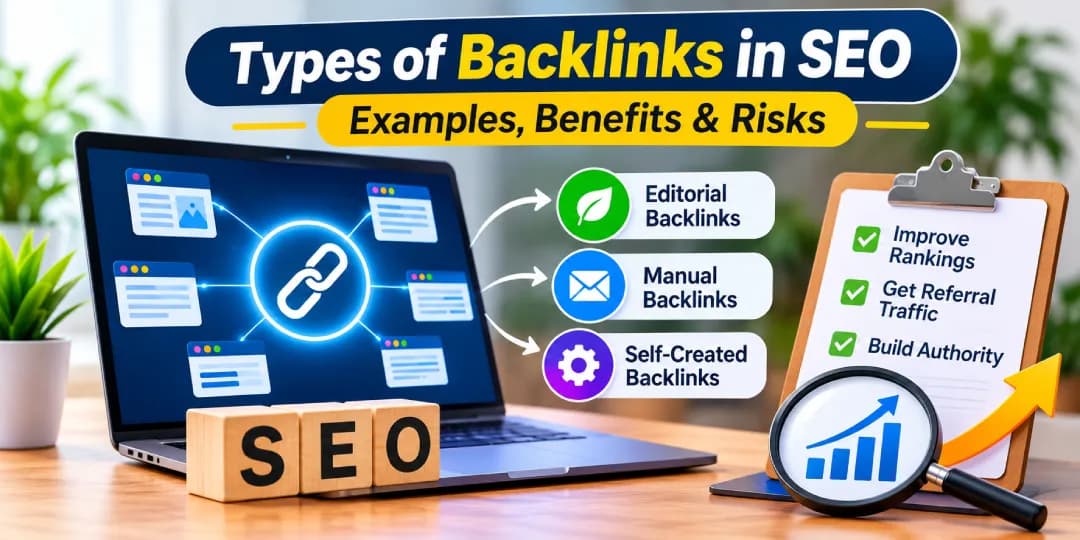
The types of backlinks in SEO fall into three main groups: editorial links that other sites give you naturally, outreach-based links you earn by asking, and self-created links you place yourself. Beyond that, backlinks are also sorted by link attribute (dofollow, nofollow, sponsored, UGC) and by source, such as guest posts, directories, digital PR, resource pages and forums. Some types are genuinely valuable, some carry little weight, and a few can put your rankings at risk. This guide explains each one with examples so you can decide which to pursue and which to avoid.
Table of contents13 sections
What Is a Backlink in SEO?
A backlink is a link from one website to another. If a blog mentions your tool and links to your page, that link is a backlink to you. Search engines treat these inbound links as third-party endorsements, which is why SEO backlinks remain one of the strongest authority signals in organic search.
How Backlinks Work (Link Juice, Anchor Text, and Referral Traffic)
Every backlink has a source page (where the link sits) and a destination URL (the target page it points to). The clickable words are the anchor text. The source page can pass value, often called link equity or link juice, to the target, while also sending visitors who click through.
How Search Engines Discover Links
Crawlers follow crawlable HTML links from page to page. When a bot finds a new link on an indexed page, it queues the destination for crawling. A link that is hidden in unrendered scripts or blocked from crawling may never be discovered. Links generated by JavaScript can be crawlable if the final HTML contains a proper anchor with an href, but links that depend on click events alone often are not.
Discovery is also only the first step. A page can be discovered (the URL is known), crawled (the bot has fetched it) and indexed (it is stored and eligible to appear in results). A backlink on a page that is never crawled or indexed is unlikely to help you, and a link seen by a third-party tool is not proof that Google counts it.
How Backlinks Can Pass Ranking Signals
Google's original PageRank idea still shapes how link value works: links from trusted, relevant pages tend to count for more. Authority signals pass through the link, though the exact weight depends on context, placement and the linking site's own credibility.
How Backlinks Generate Referral Traffic
A good link also works as a road. A well-placed mention in a respected article can send qualified website traffic for years, even if the ranking effect is modest.
Why Search Engines Use Backlinks to Rank Websites
Search engines can read your content, but they cannot easily judge whether people trust it. Links from other independent sites give them an outside signal. If many credible, relevant sites reference a page, it is more likely to deserve visibility.
Why Backlinks Are Important for SEO
Backlinks affect more than rankings. They shape how visible, discoverable and credible your site becomes.
Search Visibility and Organic Rankings
Pages with strong, relevant link profiles often outperform similar pages with weak ones, particularly for competitive search engine results pages (SERPs). Links are not the only factor, but they frequently separate close competitors.
Referral Traffic and Brand Awareness
Links put your brand in front of audiences that already trust the publisher. Over time that builds brand credibility and online reputation, which supports leads and conversions.
Content Discovery and Crawling
New pages get found faster when they are linked from sites that are crawled often. This helps with indexing, especially for new websites with few internal pathways.
Backlink Examples: What a Link Looks Like in HTML
In code, a basic backlink looks like this:
`<a href="https://example.com/seo-guide">SEO guide</a>`
Visitors see "SEO guide" as clickable text. Search engines see a link from the current page to example.com, with "SEO guide" as the anchor text.
It is worth separating backlinks from internal links. A backlink comes from a different website, while an internal link connects two pages on the same site. Internal links are your own tool for distributing link equity: a page that earns strong external links can pass some of that value to related pages through sensible internal linking. In practice, a backlink to one article can indirectly support your product page or category page if the article links to them naturally. Outbound or external links, meanwhile, are simply links from your site to others.
The 3 Main Categories of Backlinks
Editorial Backlinks (Naturally Earned Links)
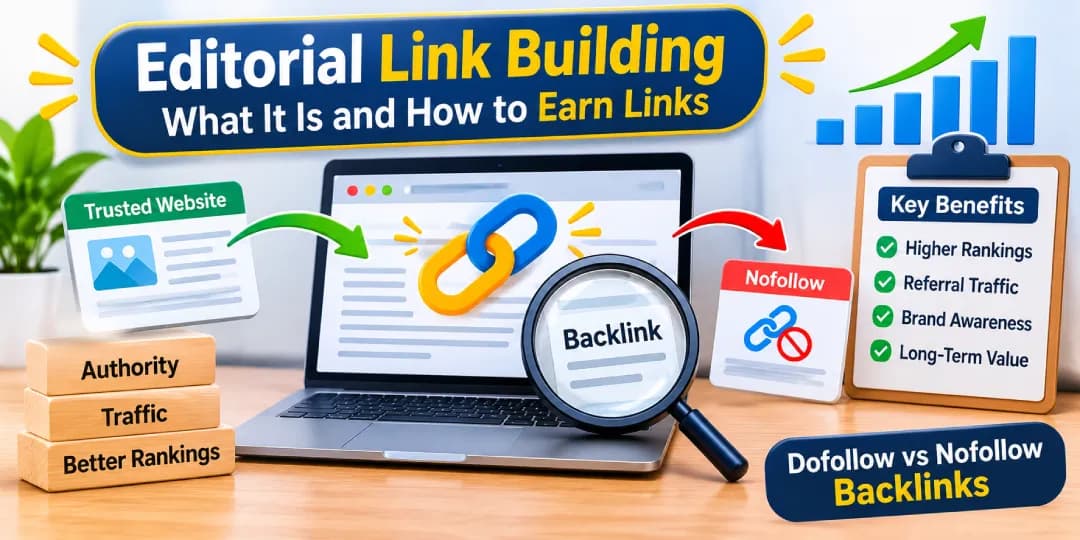
These are earned organic backlinks. Someone finds your research, tool or article useful and links to it without being asked. They are unsolicited, relevant and usually the most trusted type, which is why they sit at the top of most priority lists. Earning these links requires valuable content and a strong outreach strategy. Explore our detailed guide on editorial link building to learn how to earn high-quality editorial backlinks.
Manual (Outreach-Based) Backlinks
Here you ask for the link through email outreach, pitches or partnerships. The publisher still decides whether to link, so the result can be just as editorial. Guest posting, broken link building and digital PR campaigns belong here.
Manufactured (Self-Created) Backlinks
These are links you place yourself, such as forum signatures, profile links, blog comments and directory submissions. Most carry little value on their own, and when done in bulk they drift into link scheme territory. Use them sparingly.
Editorial vs. Outreach vs. Self-Created Backlinks
| Category | Who Places the Link | Typical Value | Typical Risk |
|---|---|---|---|
| Editorial | Third-party site, unprompted | High | Very low |
| Outreach-based | Third-party site, after your request | Medium to high | Low if done honestly |
| Self-created | You | Low | Moderate to high at scale |
Understanding different backlink types is an important part of a successful SEO strategy. However, knowing how to earn valuable links is equally important. Learn more about link building in SEO, its strategies, benefits, and best practices in our complete beginner's guide to link building.
Dofollow vs. Nofollow Backlinks Explained
What a Dofollow Link Passes to Your Site
A dofollow link is a standard link with no restricting attribute. It can pass link equity and authority signals, so it is the type most SEOs chase. Not every dofollow link helps, though. A dofollow link from an irrelevant, low-quality site may be ignored or, in bad cases, may look manipulative.
What a Nofollow Link (rel="nofollow") Does and When It's Used
The rel="nofollow" attribute tells search engines not to endorse the destination. Publishers use it for links they cannot vouch for, such as blog comments or untrusted references. Google now treats it as a hint rather than a strict command.
Other Link Attributes: Sponsored and UGC Tags
Google introduced two more attributes to describe link relationships more precisely.
Sponsored Backlinks (rel="sponsored")
Use this for paid placements, advertisements and affiliate links. It discloses that value was exchanged, which keeps paid backlinks within Google's guidelines.
User-Generated Content Backlinks (rel="ugc")
This marks links placed by users in comments, forum posts and community threads, where the site owner did not personally approve each link.
HTML Examples of Dofollow, Nofollow, Sponsored, and UGC Links
- Dofollow: `<a href="https://example.com">Example</a>`
- Nofollow: `<a href="https://example.com" rel="nofollow">Example</a>`
- Sponsored: `<a href="https://example.com" rel="sponsored">Example</a>`
- UGC: `<a href="https://example.com" rel="ugc">Example</a>`
- Combined: `<a href="https://example.com" rel="nofollow sponsored">Example</a>`
Attributes can be combined, as in the last example, which is common for paid links on sites that want to be extra cautious. Another attribute, target="\_blank", opens the link in a new tab. It affects user behavior, not ranking value. It also helps to remember that a clickable HTML link is different from a plain-text brand mention. A mention without a link can still support brand awareness, but it does not pass link equity in the usual way.
Dofollow vs. Nofollow vs. Sponsored vs. UGC: Comparison Table
| Attribute | Meaning | Common Use | SEO Effect |
|---|---|---|---|
| Dofollow (no attribute) | Normal editorial link | Articles, resources | Can pass ranking signals |
| rel="nofollow" | Do not endorse | Untrusted or general links | Treated as a hint, limited value |
| rel="sponsored" | Paid or affiliate | Ads, sponsorships | Disclosure, little ranking value |
| rel="ugc" | User-generated | Comments, forums | Limited, but can aid discovery |
How Google Treats Different Link Attributes
Since 2019, Google treats nofollow, sponsored and UGC as hints. It may still use them for crawling and discovery. In practice, a nofollow link from a major publication can still bring traffic, brand exposure and a more natural-looking profile. Understanding these link attributes is essential for evaluating backlink quality. Read our detailed guide on dofollow vs. nofollow backlinks to learn how they work and how they affect SEO.
Common Types of Backlinks by Source
Editorial/Contextual Backlinks Within Content
These sit inside the body of a relevant article, surrounded by related text. Because they appear within the flow of content, they usually carry more weight than links in footers or sidebars.
Contextual vs. Non-Contextual Backlinks
Contextual backlinks (in-content links) appear within relevant paragraphs. Non-contextual links sit in navigation, footers, sidebars or lists with no surrounding explanation. Search engines generally find contextual placement more meaningful.
Original Research and Data-Driven Backlinks
Surveys, statistics and original data give writers something to cite. A single well-done study can attract links from dozens of referring domains over time.
Expert Quote Backlinks
When journalists or bloggers quote you as a source, they often credit you with a link to your site. These tend to be relevant and credible.
Guest Post and Guest Blogging Backlinks
Guest post backlinks come from writing an article for another site, usually with a link in the body or in the author bio. Contributor and guest author links can work well when the host site is relevant and has real editorial standards.
Benefits and Risks of Guest Post Backlinks
The benefits include relevant exposure, authority and referral traffic. The risk appears when guest posting becomes a volume game, with thin articles on low-quality sites and repeated keyword-rich anchors. Google has warned about large-scale guest posting campaigns done mainly for links.
Resource Page Backlinks
Resource pages curate helpful links on one topic, for example "best SEO tools for beginners". Getting listed means your content is genuinely useful for that audience, so these links are both relevant and durable.
Link Roundup Backlinks
Link roundups are periodic curated lists of good content from around the web. Being included in a weekly or monthly roundup is a lighter but still valuable form of curated content linking.
Directory and Business Listing Backlinks
Quality business directory backlinks, particularly niche or industry-specific ones, can help with trust and discovery. Generic, low-quality directories usually do nothing.
Local Citation Backlinks
A local citation is a mention of your business name, address and phone number, often with a link. They matter most for local SEO.
NAP Consistency in Local Business Listings
Keep your name, address and phone number identical everywhere. Inconsistent details confuse search engines and weaken local signals.
Press Release and Digital PR Backlinks
Digital PR aims for real press coverage backlinks by giving journalists a story worth telling. Traditional press releases rarely earn strong links by themselves, but a newsworthy campaign can.
Media Mentions and Journalist Outreach Backlinks
Pitching journalists with data, expert commentary or a fresh angle can earn media backlinks from high-authority news sites. These are among the hardest links to get and among the most valuable.
Social Media Backlinks and Profile Backlinks
Links from social platforms are usually nofollow, so they rarely pass ranking value directly. They still support brand visibility and content discovery.
Social Profile Backlinks
Your profiles on major platforms link to your site and reinforce brand identity. Treat them as brand signals, not ranking drivers.
Social Sharing and Content Discovery Links
When people share your content, more users find it, and some of those users may link to it from their own sites. The effect on rankings is indirect.
Forum, Blog Comment, and User-Generated Content (UGC) Backlinks
These links are easy to create, which is why they are usually discounted. Quality still matters, but expect limited SEO value.
Forum Profile and Discussion Backlinks
Helpful participation in relevant communities can bring traffic and occasional mentions. Forum signature links added only for SEO purposes tend to be ignored.
Blog Comment Backlinks
Most comment links are nofollow or ugc, and mass commenting looks spammy. Comment to add to the conversation, not to drop links.
Q\&A Platform Backlinks
Answering real questions on Q\&A and community sites can earn visits and credibility when the answer genuinely helps. Link only when it adds something useful.
Broken Link Building Backlinks
You find a dead link on a relevant site, then offer your working page as a replacement. It helps the publisher fix a problem, so response rates tend to be better than with cold pitches.
Niche Edit and Relationship-Based Backlinks
These links are built through relationships with site owners and editors, often in a way that adds value to existing pages.
Existing Content Link Insertions
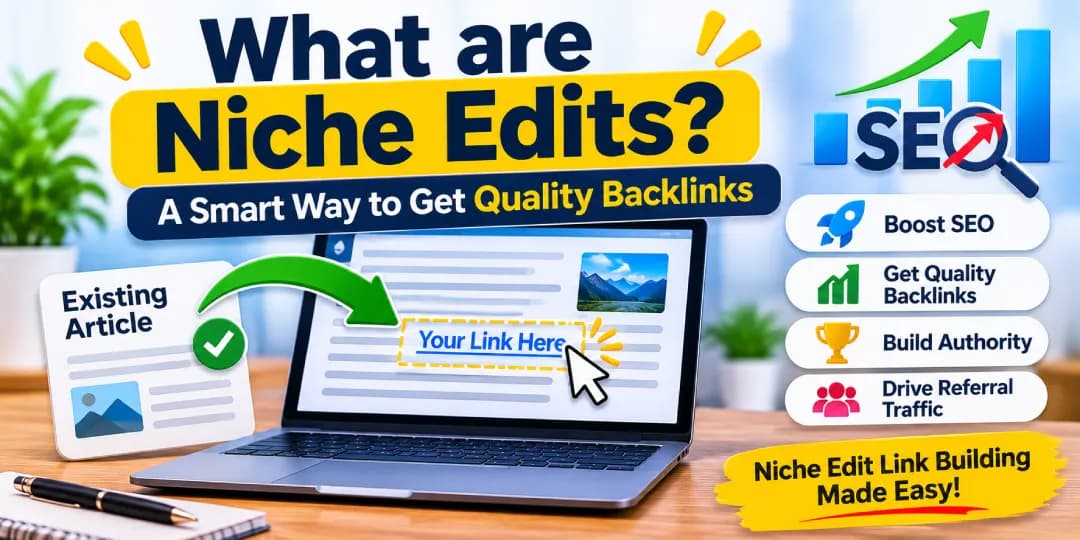
A niche edit (link insertion) adds your link to an already published, indexed article. It must make sense in context. If a placement is paid, it should be disclosed with the correct attribute, otherwise it can fall under paid link schemes. Niche edits are a popular link-building technique that involves adding links to existing content. Learn more about what niche edits are, including their benefits, risks, and best practices.
Partnership and Collaboration Backlinks
Partners, suppliers, co-marketing collaborators and associations can naturally link to each other. These links are valid when they reflect real relationships.
HARO (Help a Reporter Out) Backlinks
HARO-style platforms connect journalists who need sources with experts who can answer. The original HARO service has since changed and been retired, but similar journalist request platforms now serve the same purpose.
Journalist Request and Expert Source Backlinks
Respond quickly, answer the exact question, and keep it concise. When a journalist uses your quote, a link often follows.
Image and Infographic Backlinks
Visual assets get reused, and reuse can bring links.
Original Image Attribution Backlinks
If you publish original photos, charts or diagrams, others who use them often credit you with a link. Reverse image search helps you find uncredited usage.
Infographic Backlinks
A clear, data-rich infographic can attract links, especially when accompanied by embed code and outreach. Quality and accuracy matter more than design flair.
Image Submission Backlinks
Submitting images to galleries or sharing sites offers low value. It can bring minor discovery but little ranking impact.
Free Tool and Interactive Resource Backlinks
Useful tools are natural linkable assets.
Calculator and Free Tool Backlinks
A good calculator or free tool solves a real problem and earns links from people who recommend it. The cost to build is high, but so is the long-term payoff.
Templates and Downloadable Resource Backlinks
Templates, checklists and downloadable documents (including PDFs) get cited in how-to articles and resource pages.
Podcast and Webinar Backlinks
Being a guest creates relevant, human-curated links.
Podcast Guest and Show Notes Backlinks
Interviews often include a link to your site in the show notes. Podcast backlinks are reliable and relevant to the audience.
Webinar Speaker and Event Page Backlinks
Speaker pages, event listings and recorded session pages often link to the presenter's site.
Video Backlinks
Video platforms usually apply nofollow, but video descriptions still support discovery and brand reach.
Video Description and Attribution Links
Include your URL in descriptions and encourage proper attribution when others embed or reference your videos.
Testimonial and Review Backlinks
Genuine feedback can earn links.
Customer Testimonial Backlinks
When you give a testimonial to a tool or service you use, the vendor may feature it with a link. Only give testimonials you actually mean.
Blogger and Product Review Backlinks
Independent reviews can bring strong, relevant links. Free products in exchange for reviews should be disclosed, and links may need the sponsored attribute.
Acknowledgment and Sponsorship Backlinks
Event and community support can attract links.
Event and Organization Acknowledgment Links
Associations, charities and events often list supporters. If the relationship is genuine, the link is natural.
Sponsorship Backlinks and Disclosure Requirements
Sponsorship links should be marked as sponsored where payment is involved. Readers and search engines both deserve transparency.
Article and PDF Submission Backlinks
These tactics have lost most of their value.
Article Submission Backlinks
Article directories used to work, but they now attract thin content and are mostly seen as low quality.
PDF Submission Backlinks
Document-sharing platforms may give some exposure, but the SEO value is minimal.
Web 2.0 Backlinks
Web 2.0 sites let anyone publish a page or blog.
User-Published Content Platform Links
A genuine, useful post on a reputable publishing platform can bring readers. As a pure link tactic, it has little value.
Risks of Self-Created Web 2.0 Link Networks
Creating many thin Web 2.0 blogs to link to your site is a link scheme. It looks manipulative and can trigger spam detection.
Backlink Types Comparison: SEO Value, Benefits, and Risks
Backlink Types Comparison Table
| Backlink Type | Example | Potential SEO Value | Risk | Best Use Case |
|---|---|---|---|---|
| Editorial contextual | Blogger cites your study | High | Very low | Authority building |
| Guest post | Article on an industry blog | Medium to high | Low to moderate | Niche relevance and reach |
| Digital PR | News feature with link | High | Low | Brand authority |
| Resource page | Listed in a curated tools page | Medium to high | Low | Evergreen visibility |
| Broken link | Replace a dead resource | Medium to high | Low | Relevant, targeted links |
| Niche edit | Link added to existing article | Medium to high | Moderate if paid and undisclosed | Fast relevant placement |
| Local citation | Business directory listing | Medium (local) | Low | Local SEO |
| Social profile | Brand profile link | Low | Low | Brand presence |
| Forum or comment | Discussion reply | Low | Moderate at scale | Community engagement |
| PBN or link farm | Network blog link | Short-term at best | Very high | Not recommended |
These ratings depend on context. The same link type can be excellent on a relevant, respected site and worthless on a spammy one.
Which Backlink Types Can Provide the Most SEO Value?
Editorial links, digital PR coverage, relevant guest posts and resource page links tend to deliver the most value. They are relevant, earned and hard to fake.
Benefits, Limitations, and Risks of Different Backlink Types
High-value types usually take more effort and time. Easier types, such as profiles and directories, cost less but give less. Risk rises when links are paid for, mass-produced or unrelated to your topic.
Choosing Backlink Types Based on Website Goals
A local business benefits from citations and local press. A SaaS company gains more from tools, data and expert content. A new blog may start with relevant guest posts and community participation. Pick link types that match your audience.
What Makes a Backlink "Good" or High-Quality?
Domain Authority and Site Relevance
A good backlink comes from a credible site in a related field. Authority matters, but a relevant mid-sized site often beats a famous but unrelated one.
Domain Authority vs. Domain Rating vs. Google Ranking Signals
Domain authority (Moz), domain rating (Ahrefs) and authority score (Semrush) are third-party estimates. Google does not use them. Treat them as rough guides, not as ranking facts.
There is also a difference between domain-level authority and the authority of the specific page that links to you. A strong domain can host weak, orphaned or thin pages that have no backlinks of their own, and a link from such a page may do very little. On the other hand, a relevant page on a smaller site that has earned its own links and steady traffic can be worth more than a throwaway page on a high-DR domain. When you evaluate a prospect, check the linking page's own backlink profile, its traffic and whether it is indexed, not just the homepage score.
Topical Relevance Between Linking and Linked Pages
The closer the topic of the linking page is to yours, the more meaningful the link. A cooking site linking to a law firm looks odd.
Relevance has several layers. Topical relevance compares the subject of the source page with your destination page. Semantic relevance looks at the paragraph around the link: does the surrounding text naturally lead to what you offer? Audience relevance asks a practical question, which is whether readers on that page would actually find your page useful. Relevance also works at two levels. A general news site can have a perfectly relevant article for your topic, so page-level relevance can matter as much as site-level relevance.
Anchor Text Quality and Placement
Anchor text should read naturally and describe the destination. Varying it keeps the profile healthy.
Branded Anchor Text
Using your brand name as the anchor is the safest and most common form.
Exact-Match Anchor Text
An exact-match anchor uses your target keyword. A few are fine, but too many can look manipulative.
Partial-Match Anchor Text
Partial-match anchors include the keyword inside a longer phrase and usually look more natural.
Generic and Naked URL Anchor Text
"Click here" or a pasted URL is common in natural profiles and adds healthy variety.
Traffic and Trust Signals of the Referring Site
Check whether the linking site has real organic traffic, active readers and editorial independence. A site with no audience rarely has real authority.
The type of site and its domain extension can add context, but they are not shortcuts. Country-code domains (ccTLDs such as .pk or .de) can signal geographic relevance, which helps when you want to rank in a specific country, while generic top-level domains (gTLDs such as .com or .org) are not tied to one place. Links from .edu and .gov sites are often described as especially powerful, but Google has said it does not give those extensions special treatment. They tend to be valuable because the sites are usually trusted and hard to get links from, not because of the extension itself.
Follow Attributes and Link Placement
Dofollow links from visible, editorial positions are usually best, though a balanced profile includes some nofollow links too.
Body Content vs. Footer vs. Sidebar Links
Body content links get the most weight. Footer and sidebar links, especially sitewide ones, are often discounted.
Exact position inside the content matters too. A link in the opening paragraphs is usually more visible and more likely to be clicked than one buried near the end, and a link in the main body generally reads as a stronger editorial choice than one in an author bio. What counts most is whether the link is prominent, visible and surrounded by relevant context that explains why it is there. Also keep in mind that when a page contains many outbound links, each individual link tends to carry less weight and attract fewer clicks, so a link on a page with a handful of references is usually worth more than one on a page with fifty.
Referring Domain Diversity and Link Relevance
Fifty links from fifty relevant domains generally beat fifty links from one. Referring domain diversity signals that many independent sites value your content.
This is why link count and referring-domain count are different measurements. Ten links from the same site are one referring domain. Generally, the first link from a domain contributes the most, and later links add diminishing value, though a few separate editorial links from different articles on one respected site can still be natural. It also matters where those links point. Several links to the same URL can look repetitive, while links to different URLs on your site suggest broader interest. Repeated sitewide links, such as a footer link appearing on thousands of pages, inflate the link count without adding the value of separate editorial links.
High-Quality Backlink Evaluation Checklist
- Is the site relevant to your topic?
- Does it have real organic traffic and active content?
- Is the link placed within useful body content?
- Is the anchor text natural?
- Is the site free from obvious spam, such as unrelated outbound links?
- Would you want this link even if search engines did not exist?
Backlinks to Avoid: Low-Quality and Risky Link Types
Paid Links and Private Blog Networks (PBNs)
Buying links that pass ranking signals breaks Google's link spam policies. PBN backlinks come from networks of sites built to manipulate rankings. They may work briefly, but detection risk is high.
Spam Blogs and Automated/Low-Quality Directories
Sites with scraped content, unrelated links and no real audience offer nothing of value. Low-quality directories that accept anything fall into the same category.
Why Google Penalizes Manipulative Link Schemes
Links are meant to be votes. When they are bought, traded or faked, the signal becomes unreliable. Google's systems, including SpamBrain and the link handling that grew out of the Penguin update, are designed to neutralize or penalize such patterns.
Auto-Generated and Mass-Created Backlinks
Automated backlinks created by software are spam backlinks. Quantity without editorial judgment is a classic red flag.
Link Exchange Schemes and Excessive Reciprocal Links
Reciprocal links happen naturally, but excessive link exchange or three-way link exchanges arranged to boost rankings are link schemes.
Widget Backlinks
Embeddable widgets that hide keyword-rich links in their code can be treated as manipulative.
Blogroll Backlinks
Old-style blogroll links, especially bought ones or those in unrelated lists, rarely help.
Sitewide Footer and Sidebar Backlinks
A link repeated across thousands of pages looks unnatural and passes little value, particularly if it is paid or keyword-heavy.
301 Redirect Backlinks and Redirect Manipulation
Redirecting expired domains with old links to a new site, purely to inherit their authority, can be seen as manipulation. Legitimate redirects during a real site migration are fine.
Article Directory and Low-Quality Submission Links
Mass submissions to article directories are outdated and add excessive guest posting links of little worth.
How to Identify Spammy or Manipulative Backlinks
Look for unrelated sites, foreign-language pages with no connection to you, repeated exact-match anchors, unusual spikes in link velocity, high spam score and sites with no real content. Several of these together are a stronger warning than any single sign.
When Google May Ignore Links vs. Apply Manual Actions
In most cases, Google simply ignores low-quality links. Manual actions for unnatural links are less common and usually follow clear patterns of manipulation. They are reported in Search Console, where you can request a review after cleaning up.
The two work differently. Google's automated systems can neutralize manipulative links, meaning those links stop counting, without penalizing the whole site. That is an algorithmic effect, and there is no notification for it. A manual action is applied by a human reviewer, affects rankings for the site or specific pages, and appears in the Manual Actions report in Search Console. If you receive one, the usual process is to remove the offending links where you can, document your efforts and then submit a reconsideration request.
Which Backlinks Are Best for SEO Performance?
Prioritizing Relevant, Editorial Backlinks
Relevant editorial links should be your main goal. They are earned, contextual and trusted, so they usually hold their value over time.
Why Link Diversity (Many Domains) Matters More Than Link Volume
A profile built on many independent referring domains looks natural and carries more trust than lots of links from just a few sites.
Building a Natural, Balanced Backlink Profile
A healthy backlink profile mixes dofollow and nofollow, branded and generic anchors, and links from different source types. Gradual backlink growth looks more natural than sudden spikes.
It helps to look at the profile as a whole, not link by link. A natural backlink profile usually shows a wide spread of referring domains, many different source types (blogs, news sites, directories, communities), a mix of branded, partial-match and generic anchors, and link velocity that rises and falls with your real activity. A launch, a viral study or a press mention can cause a legitimate jump, and the links behind it tend to look varied. An unnatural profile looks different: hundreds of links appear in a few weeks, most use the same commercial anchor, the sources are similar low-quality sites, and nothing in your marketing explains the spike. Earned profiles are messy and uneven. Manufactured ones are suspiciously tidy.
Best Backlinks for New Websites
Start with relevant guest posts, local or niche directories, partnerships, podcast appearances and genuinely helpful content. A handful of strong links beats hundreds of weak ones.
Best Backlinks for Local Businesses
Prioritize local citations, chamber of commerce listings, sponsorships, local press and testimonial links from suppliers or partners. Geographic relevance counts here, so links from sites and country-code domains in your service area are often more useful than a random international link.
Best Backlinks for SaaS, Ecommerce, and Content Websites
SaaS companies do well with tools, integrations and data studies. Ecommerce sites benefit from product reviews, gift guides and digital PR. Content websites gain from resource pages, expert quotes and original research.
Quality vs. Quantity: What Matters Most?
Quality matters more. A few relevant links from credible sites can outperform a large pile of weak ones, and they carry less risk.
How to Get High-Quality Backlinks (Practical Strategies)
Creating Link-Worthy, Useful Content
Start with something worth linking to. Linkable assets give people a reason to reference you.
Original Research, Statistics, and Surveys
Run a small survey, analyze public data or share findings from your own work. Original data backlinks often keep arriving long after publication.
Infographics and Visual Assets
Turn complex data into clear visuals, and make them easy to embed and credit.
Free Tools and Interactive Content
Calculators, checkers and simple tools are among the most reliable ways to earn free resource backlinks.
Guest Posting and Digital PR Outreach
Outreach works when it is relevant, personal and useful.
Finding Relevant Websites for Outreach
Search for sites your audience already reads. Check that they publish regularly, have real traffic and link out to credible sources.
Writing Personalized Outreach Emails
Keep it short. Mention a specific article, explain what you can offer and make it easy to say yes. Generic mass emails get ignored.
Broken Link Building and Resource Page Outreach
Find broken links on relevant pages, then suggest your content as a fix. For resource pages, show why your page fits the list.
Earning Local SEO Backlinks via Business Profiles
Claim and complete your business profiles, keep your NAP consistent, and pursue local sponsorships and press.
Link Reclamation and Unlinked Brand Mentions
If a site mentions your brand without linking, ask politely for a link. Plain-text mentions are helpful for awareness, but a clickable HTML link is what sends visitors and passes link equity. The same applies to lost links caused by changed URLs or removed pages.
Competitor Backlink Gap Analysis
Compare your referring domains with those of competitors. Sites linking to several competitors but not you are logical prospects. This reverse-engineering of competitor backlinks reveals realistic opportunities.
Podcast, Webinar, and Expert Contribution Outreach
Offer specific topics you can speak about confidently. Hosts usually prefer guests with a clear angle.
Testimonial and Partnership Outreach
Offer honest testimonials to tools you use and explore partnerships with complementary businesses.
Link Roundup Outreach
Email curators with one strong, relevant piece of content, not a long list of pages.
How to Build Backlinks Without Violating Google's Spam Policies
Do not pay for links that pass ranking signals, use proper rel attributes when money is involved, avoid automated link building, and focus on content and relationships that earn links honestly.
How to Check and Analyze Your Backlinks
Using Backlink Analysis Tools to Review Your Profile
A backlink checker shows who links to you, with which anchor text and to which pages. Use more than one source because no tool sees every link. It is common for a backlink to show up in Ahrefs or Semrush but not in Google Search Console, because each tool crawls the web differently and Google only reports links it has processed. To verify a link, open the source page, confirm it is live, check that the anchor is a crawlable HTML link, review its rel attributes, and make sure it points to the intended destination URL. Even then, a link appearing in a tool does not guarantee that Google uses it as a ranking signal.
Google Search Console Links Report
It is free and comes straight from Google. It shows top linking sites, top linked pages and common anchor text.
Ahrefs Backlink Checker and Site Explorer
Ahrefs offers a large link index, with data on referring domains, new and lost links and domain rating. It is useful for competitor analysis too.
Semrush Backlink Analytics and Audit Tools
Semrush Backlink Analytics and its audit tools help with link quality assessment, toxic link flags and gap analysis. SEOptimer and similar tools can offer quick checks.
What to Look for in a Backlink Audit (Toxic vs. Healthy Links)
A backlink audit looks for unnatural patterns: repeated anchors, irrelevant sources and spikes of low-quality links. Remember that toxic scores from tools are estimates, not Google verdicts.
How to Find New and Lost Backlinks
Track new backlinks and lost backlinks regularly. If a valuable link disappears, find out why and try link reclamation.
Links age. Link rot happens when source pages are deleted, redirected or deindexed, when sites are redesigned, or when editors remove links during content updates. Sometimes the problem is on your side: a destination URL changes or breaks without a redirect. It also helps to separate a lost backlink from one that remains live but loses its SEO value. A link can stay on the page while the page loses traffic, drops out of the index, or gets a nofollow attribute added later. Both situations deserve attention, but only the first appears as a lost link in most tools.
How to Analyze Referring Domains and Anchor Text
Review the number of unique referring domains, their relevance and the distribution of branded, partial-match, exact-match and generic anchors.
How to Identify Broken and Unlinked Brand Mentions
Check for backlinks that point to 404 pages and redirect them to relevant pages. Search for your brand name to find mentions that lack links.
When Should You Use Google's Disavow Tool?
Rarely. Use the disavow file only if you have a manual action or a large number of clearly manipulative links you cannot remove. For ordinary spammy links, Google usually ignores them. Keep in mind that disavowing is not the same as removing a link. Removal means contacting the site owner to take the link down, while a disavow file only asks Google not to count it, so removal is usually tried first.
How to Monitor Backlink Quality Over Time
Set a regular review schedule, monthly or quarterly, and track growth, losses, anchor distribution and traffic from referring links.
Measuring real impact takes a bit more discipline. Record rankings and organic traffic for the target page before the campaign, then watch for changes after the links go live. Track referral sessions, leads and conversions from the linking pages, and compare what the campaign cost with the traffic and business results it produced. Be careful with attribution, though. If you also rewrote content, fixed technical issues or launched a promotion in the same period, backlinks may not deserve all the credit. Changing one thing at a time, where practical, makes the results easier to read.
Common Backlink Building Mistakes to Avoid
Prioritizing Domain Metrics Over Relevance
A high domain authority score means little if the site has nothing to do with your topic.
Overusing Exact-Match Anchor Text
Too many keyword-rich anchors look engineered. Mix them with branded and natural variations.
Building Links From Unrelated Websites
Relevance is a core part of link value. Unrelated links add noise.
Relying on Paid or Automated Link Schemes
Shortcuts can work briefly, but the risk to long-term SEO performance is real.
Ignoring Referral Traffic and Link Context
A link that sends no visitors and sits in an irrelevant place is rarely worth much. Check the page, not just the metric.
Treating Every Nofollow Link as Worthless
Nofollow links can drive traffic, build brand awareness and make a profile look natural. They are part of a healthy mix.
Conclusion
The best backlinks are relevant, editorial and earned through content people actually want to cite. Diversity matters more than volume, and link quality matters more than any single metric. Build a mix of source types, keep anchor text natural, avoid paid and manipulative schemes, and review your profile regularly. Sustainable link earning is slower, but it holds up when search algorithms change.
Frequently Asked Questions About Types of Backlinks
What is a backlink in SEO, with an example?
A backlink is a link from another website to yours. For example, if a travel blog links to your hotel booking page, that link is a backlink to your site.
How many types of backlinks are there?
There is no fixed number. They are commonly grouped as editorial, outreach-based and self-created, and also by attribute (dofollow, nofollow, sponsored, UGC) and by source (guest posts, directories, PR, forums and more).
What are the four main backlink link attributes?
Dofollow (no attribute), rel="nofollow", rel="sponsored" and rel="ugc".
What is the difference between dofollow and nofollow backlinks?
Dofollow links can pass ranking signals. Nofollow links tell search engines not to endorse the destination, though Google treats the attribute as a hint.
Which types of backlinks are best for SEO?
Relevant editorial links, digital PR coverage, strong guest posts, resource page links and expert mentions usually provide the most value.
What makes a backlink high-quality?
Relevance, credibility of the source, natural anchor text, visible placement in body content and real audience traffic.
What is the difference between contextual and non-contextual backlinks?
Contextual links sit inside relevant body content. Non-contextual links appear in footers, sidebars or lists without surrounding explanation.
Are guest post backlinks good for SEO?
They can be, when the site is relevant and has editorial standards. Mass guest posting for links alone is risky.
Are nofollow backlinks valuable for SEO?
They can be. They may bring traffic, brand exposure and discovery, and they help create a natural profile.
Can bad backlinks hurt your website rankings?
Occasionally. Google mostly ignores low-quality links, but patterns of manipulation, such as paid or mass-created links, can lead to ranking loss or manual actions.
What backlinks should a new website focus on first?
Relevant guest posts, niche directories, partnerships, podcast guest spots and useful content that attracts natural links.
How can I get free, high-quality backlinks?
Create original research, free tools and helpful resources, then promote them through outreach, broken link building, journalist requests and link reclamation.
How many backlinks does a website need to rank?
There is no set number. It depends on competition. Compare the referring domains of pages already ranking for your target keyword.
How can I check backlinks to my website?
Use Google Search Console for free, and tools such as Ahrefs or Semrush for deeper analysis.
Are paid backlinks against Google's guidelines?
Yes, when they are meant to pass ranking signals. Paid or sponsored links should use rel="sponsored" or rel="nofollow."