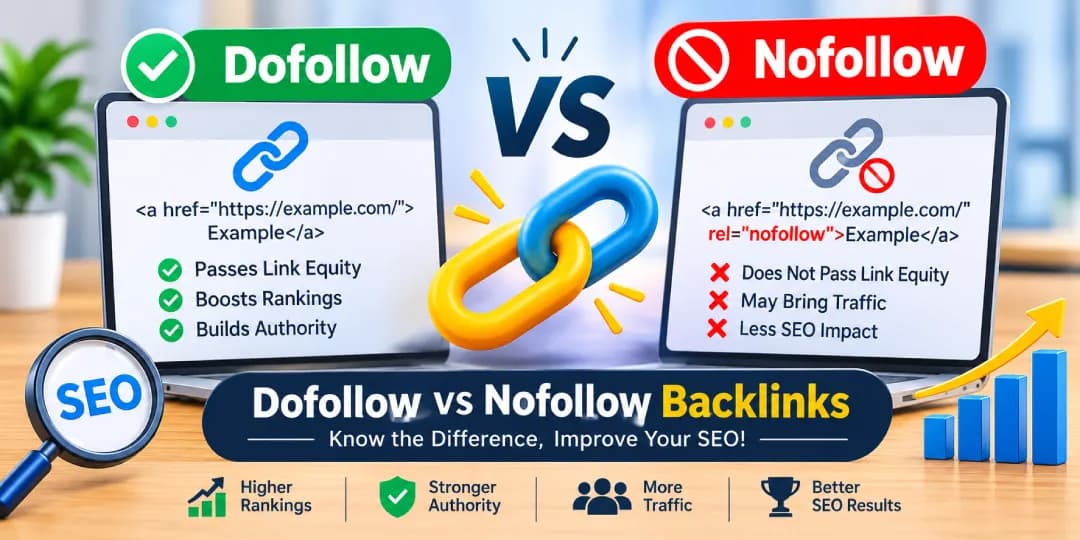
A dofollow backlink is a regular link that lets search engines follow it and pass ranking credit to the page it points to. A nofollow backlink carries a rel="nofollow" attribute that tells Google not to treat the link as an endorsement. In practice, dofollow links are the ones that build authority most directly, while nofollow links still bring traffic, visibility, and sometimes indirect SEO benefits. Google now treats nofollow as a hint rather than a strict rule, which is why the full picture is a bit more nuanced.
Table of contents19 sections
What Are Backlinks and Why Do They Matter for SEO?
What Is a Backlink?
A backlink is a link from one website to another. If an industry blog links to your guide, that is a backlink to your page, and it works like a vote of confidence from the linking site.
How Backlinks Influence SEO Rankings and Website Authority
Search engines use links to discover pages and to judge which ones deserve trust. When respected sites link to you, your website authority tends to grow, and your pages become more competitive in search rankings. Tools like Ahrefs and Moz summarize this with scores such as domain authority, although these are third-party estimates and not Google metrics.
Why Backlink Quality Matters More Than Quantity
One editorial link from a relevant, trusted publication usually does more than hundreds of low quality links from unrelated directories. Quality shows up in relevance, credibility, and how naturally the link was earned. The number of independent websites linking to you also matters, which we will cover in the audit section below. A bloated backlink profile full of weak links can even raise red flags.
What Are Dofollow and Nofollow Links?
What Is a Dofollow Link?
A dofollow link, also written do follow link or do-follow, is a standard hyperlink with no restricting attribute. Search engines can crawl it, and it can pass link equity (often called link juice) to the destination.
How Dofollow Links Work (With HTML Example)
There is nothing special to add. A normal text link looks like this:
\<a href="https\://example.com/"\>Example\</a\>
Because no rel value is present, crawlers treat it as a followable link by default.
The same logic applies to links that are not text. An image link, such as a linked logo, is simply an image wrapped in an anchor tag:
\<a href="https\://example.com/"\>\<img src="logo.png" alt="Example company logo"\>\</a\>
For this kind of link, Google uses the image's alt text in the way it would use anchor text. So a linked logo with a descriptive alt value gives search engines context about the destination, while an empty alt leaves that signal blank. Image links can still be followed and can pass equity, but only when the anchor itself has no restricting attribute.
What Is a Nofollow Link?
A nofollow link includes the rel="nofollow" attribute. Webmasters use it when they do not want to vouch for the destination, or when the link is paid, user-submitted, or untrusted.
How Nofollow Links Work (With HTML Example)
The nofollow link code looks like this:
\<a href="https\://example.com/" rel="nofollow"\>Example\</a\>
The link still works for visitors. The difference is how search engines interpret it.
On an image link, the attribute belongs on the anchor, not on the image:
\<a href="https\://example.com/" rel="nofollow"\>\<img src="logo.png" alt="Example company logo"\>\</a\>
Putting rel on the img tag does nothing. This is one of the easiest mistakes to make when tagging banners and logos.
How Search Engines Interpret Dofollow and Nofollow Links
Originally, Google ignored nofollow links entirely for ranking. Since March 2020, Google treats nofollow, sponsored, and ugc as hints. That means Google may use them for ranking, crawling, and indexing signals, but it is not obligated to follow the instruction literally. Dofollow links, by contrast, are simply processed normally, which still does not mean every one of them gets full credit.
Is Dofollow an Actual HTML Attribute?
No. There is no rel="dofollow" attribute in HTML or in Google's documentation. "Dofollow" is an SEO community term for any link without nofollow. Whether people search for dofollow link meaning, do follow tag, or enlaces dofollow, they are describing the absence of a restriction.
Dofollow vs Nofollow Backlinks: Key Differences
Link Equity and PageRank Flow
Dofollow links pass PageRank, the signal Google uses to estimate a page's importance. Nofollow links were designed to stop that flow. Because Google now treats the attribute as a hint, the exact amount passed can vary.
Still, the follow status is only one piece of the puzzle. The value a link passes depends on the page it sits on. A page that has many strong links pointing to it has more equity to share than a page nobody links to. The number of outbound links on that page matters too, because the equity is conceptually divided among everything the page links to. A dofollow link in a list of 200 outbound links carries far less weight than the only external link in a well-linked article. Finally, the page has to be crawled and indexed for any of this to work. So two dofollow backlinks can have very different real value, and the follow status alone never tells you which one is better.
SEO Ranking Impact of Dofollow vs Nofollow Links
Dofollow links are the stronger ranking signal. Nofollow links are generally weaker for rankings, but they are not irrelevant, and a natural profile contains both.
Crawling and Indexing Differences
Historically, nofollow links did not lead Google to new pages. Under the hint system, Google can choose to crawl or index through them. So you should never assume a nofollow link hides a page.
Advantages and Limitations of Each Link Type
Dofollow links give the clearest ranking benefit, but they are also what spammers chase, so they must be earned carefully. Nofollow links are safer for paid or user-generated content and still bring referral traffic, though they offer less direct ranking value.
Dofollow vs Nofollow Comparison Table
| Feature | Dofollow | Nofollow |
|---|---|---|
| HTML | No rel attribute | rel="nofollow" |
| Passes link equity | Yes | Limited, treated as a hint |
| Ranking value | Strong | Weak or indirect |
| Best for | Editorial links | Untrusted, paid, or user content |
Types of Link Attributes: Nofollow, Sponsored, and UGC
Understanding rel="nofollow", rel="sponsored", and rel="ugc"
In 2019 Google introduced two additional attributes so site owners could describe links more precisely.
rel="nofollow" for Non-Endorsed Links
Use it as the general option when you link to something but do not want to endorse it.
rel="sponsored" for Paid and Advertising Links
Use it for ads, sponsored posts, and paid placements. It is also appropriate for affiliate links.
rel="ugc" for User-Generated Content
Use it for blog comments, forum posts, and other user generated content where you cannot vouch for what people submit.
Nofollow vs Sponsored vs UGC: Comparison Table
| Attribute | Purpose | Typical use |
|---|---|---|
| nofollow | General non-endorsement | Untrusted external websites |
| sponsored | Paid relationships | Ads, sponsored content, affiliate links |
| ugc | User submissions | Comments, forum posts |
How to Combine Multiple rel Attributes in HTML
You can list several values in one rel attribute, separated by spaces:
\<a href="https\://example.com/" rel="sponsored nofollow"\>Example\</a\>
Google's documentation confirms that multiple values on a single link are valid, and the order does not matter. The same pattern works for user content:
\<a href="https\://example.com/" rel="ugc nofollow"\>Example\</a\>
Mixed situations come up more often than people expect. Say a brand pays a forum member to drop a recommendation into a thread. That link is both paid and user-generated. The most accurate label is sponsored, because money changed hands, and many site owners write rel="sponsored ugc" or rel="sponsored nofollow" to cover both facts. Google does not publish a strict precedence chart for these combinations, but the practical rule is simple: describe the link honestly, with the most specific value first in your mind and nofollow as a general fallback.
Keep the syntax clean. Values are separated by spaces, not commas, and each value should be spelled exactly as Google defines it.
Google's Link Attribute Updates and the Hint-Based System
Google's change means these attributes guide the algorithm rather than command it. As a result, using the correct label matters more than ever, particularly for paid links, because Google's guidance is that paid links should be tagged with sponsored or nofollow.
It also helps to separate four outcomes that people often blur together: ranking credit, crawling, indexing, and actual ranking improvement. A link without nofollow does not guarantee that Google will pass credit through it, crawl the destination, index it, or improve your rankings. A nofollow, sponsored, or ugc attribute does not guarantee the opposite either. The attribute is one signal that Google considers, along with the quality of the page, the context around the link, and its own spam detection. Think of the attribute as your honest description of the link, not a switch that controls what Google does with it.
How Do Dofollow and Nofollow Backlinks Affect SEO?
How Dofollow Backlinks Support SEO and Website Authority
Dofollow backlinks from relevant, trusted pages help Google understand that your content deserves visibility. They are usually the core of an effective SEO strategy and a main driver of a stronger backlink profile.
Do Nofollow Links Pass PageRank or Ranking Value?
Google says it may use nofollow links as a signal, but it does not promise they pass ranking credit. The safest assumption is that they carry little direct ranking power, while still being useful for other reasons.
Indirect SEO Benefits of Nofollow Backlinks
Referral Traffic and Brand Exposure
A nofollow link in a popular article can still send real visitors. More visitors mean more brand awareness, branded searches, and engagement.
Opportunities to Earn Natural Editorial Backlinks
Journalists, bloggers, and editors often discover sources through visible nofollow mentions. A single appearance on a large site can later turn into an editorial dofollow link.
Are Nofollow Backlinks Bad or Useless for SEO?
No. They are not harmful when they occur naturally, and they make a profile look realistic. Treating them as useless usually leads to unnatural link patterns.
What SEO Research and Case Studies Suggest About Nofollow Links
Many SEO studies and practitioner tests suggest that sites with strong rankings usually have a mix of link types. Results vary and cannot prove causation, so treat them as supporting observations rather than rules.
What Makes a High-Quality Dofollow Backlink?
Topical Relevance of the Referring Website
A link from a site in your own niche says more than one from an unrelated blog. Relevance helps Google connect your page to the right topic.
Quality, Credibility, and Authority of the Linking Page
Look at whether the linking page is real, maintained, and trusted. Check whether other sites link to that page, because a page with no incoming links has little equity to pass. Also look at how many outbound links it carries. Low quality pages stuffed with outbound links rarely help, even when every link is technically dofollow.
Anchor Text Relevance and Natural Placement
The anchor text should describe the destination naturally. Exact-match anchors repeated everywhere look manipulative. For image links, the alt text does the same job, so a linked logo should use the brand name or a short, accurate description rather than a keyword phrase.
Editorial Context and Link Position
Links inside the body of useful content are usually stronger than links in footers or sidebars. Context shows the link exists for the reader, not for rankings.
Referral Traffic and Audience Relevance
A good link should be capable of sending relevant visitors. If nobody would ever click it, it is probably a weak placement.
How to Get High-Quality Dofollow Backlinks
Building a strong backlink profile requires a consistent link building strategy that focuses on earning relevant, high-quality links from trusted websites.
Create Link-Worthy Content
Original research, practical guides, and useful tools earn links because others want to cite them.
Earn Editorial Backlinks Through Digital PR
Newsworthy data and expert commentary give journalists a reason to link. This is slow, but the links are strong.
Guest Posting on Relevant Websites
Guest posting on relevant, quality sites can build authority when the content genuinely helps their audience. Avoid mass-produced posts on sites that accept anything. Google's spam policies specifically call out large-scale guest posting campaigns that push keyword-rich anchor text, not guest posting itself.
Broken Link Building and Resource Page Outreach
Find broken links on relevant pages and suggest your content as a replacement. Resource pages work similarly when your content truly fits.
Build Relationships With Industry Publishers
Editors link to people they know and trust. Consistent, helpful contact tends to pay off over time.
Avoid Manipulative and Paid Links That Pass Ranking Credit
Paying for links that pass ranking credit goes against Google's spam policies. If money is involved, use sponsored or nofollow.
Google groups these practices under link spam, often called link schemes. The main patterns to avoid are:
- Buying or selling links that pass ranking credit, including payments in cash, goods, or free products in exchange for a followed link.
- Excessive link exchanges, such as "link to me and I'll link to you" arrangements, and heavy reciprocal linking between the same sites.
- Using automated programs or services to create links in bulk.
- Large-scale guest posting or article campaigns with keyword-rich, optimized anchor text.
- Low quality directory or bookmark links and optimized links in forum signatures and comments.
- Requiring a followed link as part of a widget, theme, or terms of service.
Google handles violations in two ways. Its systems can quietly ignore the links, or a manual reviewer can issue a manual action. Either way, the value you were chasing disappears. The safer test is whether the link exists because someone found your content worth citing, not because you arranged it for ranking purposes.
When Should You Use Dofollow vs Nofollow Links?
When to Use Dofollow Links
Natural Internal Links
Internal links should normally be followed so Google can discover pages and understand your site structure.
Editorial Links to Trusted External Resources
If you genuinely recommend a source, a normal link is fine and helpful for readers.
When to Use Nofollow, Sponsored, or UGC Attributes
Untrusted or Non-Endorsed External Links
When you link to something you cannot vouch for, nofollow is the appropriate choice.
Paid Links, Sponsored Posts, and Affiliate Links
Tag these as sponsored. This is the clearest case for when to use nofollow links.
Comments, Forums, and User-Generated Content
Use ugc, or nofollow, so spammers gain nothing from posting on your site.
When to Avoid Using Nofollow Links
Avoid it on normal editorial links and internal navigation. Overusing it does not protect you and may waste useful signals.
How to Handle Links to Spammy, Duplicate, or Auto-Generated Pages
If you cannot remove such links, mark them nofollow, or better, fix the pages. For sections you do not want in search, other methods are more reliable.
Nofollow Links, Internal Linking, and Crawling
Should You Use Nofollow on Internal Links?
Usually not. Adding nofollow to internal links can weaken how Google understands your site, and there are few situations where it helps.
How Nofollow Affects Crawling, Indexing, and Crawl Budget
Because nofollow is a hint, it is not a dependable crawl budget tool. Googlebot may still reach the page. For crawl control, use robots.txt or fix the underlying structure.
Nofollow vs Noindex: Link Attributes and Robots Directives
They do different jobs. Nofollow concerns how links are treated, while noindex tells search engines not to show a page in results.
Nofollow Link Attribute vs Nofollow Meta Robots Tag
The rel attribute affects a single link. The meta robots nofollow tag applies to all links on the page. Mixing these up is a common source of confusion.
PageRank Sculpting With Nofollow: Does It Work?
Not anymore. Google changed how it handles nofollow years ago, so using it to funnel PageRank to favorite pages does not work the way people once believed.
How to Check Dofollow and Nofollow Links
Inspect HTML Code Using Browser Developer Tools
Right click the link, choose Inspect, and look for rel="nofollow", sponsored, or ugc in the anchor tag. No rel attribute means it is followable. For an image link, inspect the anchor around the image and read the alt text as well.
Check Links Using Browser Extensions
A link checker or SEO extension can highlight nofollow links directly on the page. It is faster than inspecting each link.
Audit Backlinks Using Ahrefs and Semrush
Both tools list backlinks with their attributes, so a dofollow checker view is easy to build. Moz also shows follow and nofollow status in its link reports.
When you read these reports, separate total backlinks from unique referring domains. Total backlinks counts every individual link. Referring domains counts how many different websites link to you. Five hundred links from one site, often from a sitewide footer or sidebar, is a very different situation from five hundred links from five hundred independent sites. The first is usually one editorial decision repeated by a template. The second suggests broad recognition. Referring domains is generally the more meaningful number, though it still needs a quality check, since a hundred low quality domains are not worth much either.
Audit Link Attributes Using Screaming Frog
Screaming Frog crawls a website and exports link data, which is useful for auditing internal and outbound links at scale. It also reports image links and their alt text, so you can see where visual links are missing descriptive context.
Check Backlinks With Mangools LinkMiner and SiteProfiler
The Mangools SEO extension and SiteProfiler let you check dofollow and nofollow links quickly for a page or domain.
What Google Search Console Shows About Backlinks
Search Console lists top linking sites and pages, but it does not clearly label each link as dofollow or nofollow. Use other tools for that detail. The report is also a summary, not a complete export of every link Google knows about.
Keep in mind that no backlink dataset is complete. Ahrefs, Semrush, Moz, Mangools, and Search Console each use their own crawlers and their own refresh schedules, so their link counts rarely match. A link that shows up in a third-party tool does not prove Google has indexed that page, counted the link, or used it for ranking. Treat the numbers as a useful estimate and compare trends over time instead of trusting one exact figure.
How to Find Incorrectly Tagged Links
Export your outbound and internal links, then look for paid links without sponsored and normal internal links marked nofollow. Check image links and linked banners too, since they are easy to miss in a text-focused review. Confirm anything important by opening the live page, because a tool may be showing an older crawl.
How to Add, Remove, or Change Nofollow Attributes
How to Add or Remove rel="nofollow" in HTML
Add rel="nofollow" inside the anchor tag to apply it, and delete the attribute to remove it. For linked images, edit the surrounding a tag, not the img.
How to Add Nofollow Links in WordPress
Using the WordPress Block Editor
Select the link, open the link settings, and toggle the option to add nofollow. Save or update the page.
Using WordPress Plugins
SEO plugins can add nofollow, sponsored, or ugc with a checkbox or rule, which helps when you manage many links.
How to Add Nofollow Links in Webflow
In the link settings of an element, add a rel attribute through custom attributes with the value nofollow.
How to Add Sponsored and UGC Attributes
Use the same method but enter sponsored or ugc as the rel value. To use more than one, separate the values with a space. In WordPress, many plugins or themes include these options.
Common HTML Mistakes When Editing Link Attributes
Typical errors include misspelling rel, using rel="dofollow", placing the attribute outside the tag, putting rel on an img tag, separating values with commas, or replacing an existing value instead of adding to it.
How to Build a Healthy Backlink Profile
Why Dofollow and Nofollow Backlink Diversity Matters
Natural sites attract both types. A profile made only of one looks unusual.
What Is a Good Dofollow-to-Nofollow Ratio?
There is no official number. Most sites naturally have more dofollow links than nofollow ones, but the right mix depends on your niche and how your links were earned.
Can Too Many Nofollow or Only Dofollow Backlinks Hurt SEO?
Too many nofollow links will not hurt you in a meaningful way. A profile that is unnaturally dofollow-only, especially when links are obviously built, may look suspicious.
How to Combine Both Link Types in Your SEO Strategy
Pursue editorial links for authority, then use social profiles, forums, and community participation for visibility. Each plays a different role.
How to Monitor Backlink Quality and Adjust Your Strategy
Review your profile regularly, watch for spam, and look at which links bring traffic. Adjust your content and outreach based on what earns real mentions.
A few spammy links pointing to your site are normal and usually nothing to worry about. Google's systems are built to ignore most of them automatically, which is why the idea of negative SEO, where a competitor floods you with junk links, rarely succeeds. It helps to know the two ways Google responds to bad links. Algorithmic neutralization happens quietly, and you never get a notification. A manual action, on the other hand, is a human review decision that appears in the Manual Actions report in Search Console.
The Disavow Links tool has narrow use cases. Google says most sites never need it. Consider it only if you have received a manual action for unnatural links, or if you have a large number of artificial links that you cannot get removed and that could realistically trigger one, for example from past paid link campaigns. For ordinary low quality links, leaving them alone is usually the right call, since a mistaken disavow file can cut off links that were helping you.
Common Dofollow and Nofollow Link Mistakes
Unnecessarily Adding Nofollow to Internal Links
It makes your own site harder to understand without any real benefit.
Using Paid Dofollow Links to Manipulate Rankings
This risks manual actions or lost trust. Paid links should be labeled.
Prioritizing Link Quantity Over Quality
A large number of poor links rarely outperforms a few strong ones. Inflated link counts, especially from a single domain, can make a profile look healthier than it really is.
Assuming Nofollow Links Prevent Indexing
They do not. If a page must stay out of search, use noindex or access controls.
Ignoring Sponsored and UGC Attributes
Skipping them means missing the clearest way to describe paid and user-submitted links.
Using Manipulative Anchor Text or Irrelevant Links
Over-optimized anchors and unrelated placements look artificial and add little value.
Real-World Examples of Dofollow and Nofollow Backlinks
Are Social Media Backlinks Dofollow or Nofollow?
Most major social platforms use nofollow on outbound links, though behavior can change, so check the HTML. They still help distribution and discovery.
Nofollow Backlinks From Reddit, Forums, and Wikipedia
Reddit, many forums, and Wikipedia generally use nofollow or similar attributes. Even so, they can send meaningful traffic and strengthen brand visibility. Free profile backlinks are typically nofollow too.
How News Websites and Major Publications Use Nofollow
Some publications use nofollow for certain links, while others link normally in editorial content. Policies differ by site, so inspecting the link is better than guessing.
SEO Community Opinions and Real Case Studies
SEO professionals commonly report that a natural mix performs better than chasing one type. Case studies are useful for direction but rarely prove exact ranking effects.
How Long Does Google Take to Recognize Link Attribute Changes?
How Google Discovers Changes to Link Attributes
Google has to recrawl the linking page, so recognition can take days or weeks depending on how often that page is visited.
Does Changing Nofollow to Dofollow Improve Rankings?
Not automatically. Any gain depends on the quality of the linking page and whether other factors support the change.
Watch: Dofollow vs Nofollow Backlinks Explained
Video Walkthrough and Key Takeaways
A short video can help if you prefer visual learning. Look for one showing the HTML, a live link inspection, and the three rel values side by side.
Key Takeaways
- Dofollow links are normal links that can pass ranking credit; nofollow links ask Google not to treat them as endorsements.
- Dofollow is not an actual HTML attribute.
- Google treats nofollow, sponsored, and ugc as hints, and no attribute guarantees credit, crawling, indexing, or better rankings.
- Use sponsored for paid links and ugc for user content, and combine values with spaces when a link fits more than one.
- A link's real value depends on the linking page's own authority, its outbound links, and relevance, not just its follow status.
- Buying links, link exchanges, automated links, and over-optimized guest post campaigns fall under Google's link spam policies.
- Referring domains tell you more than total backlink counts, and every backlink tool shows only a partial picture.
- Image links work through the anchor's rel attribute and the image's alt text.
Conclusion
Both link types have a place. Dofollow backlinks build authority, while nofollow links add traffic, visibility, and a natural profile. Focus on relevant, editorially earned links, and label paid and user-generated links correctly. That approach keeps your link building honest and sustainable.
Frequently Asked Questions
What is the difference between a dofollow and a nofollow backlink?
A dofollow backlink has no restricting attribute and can pass ranking credit. A nofollow backlink uses rel="nofollow" and is treated as a hint not to endorse the destination.
Do nofollow backlinks help SEO?
Indirectly, yes. They may bring traffic, exposure, and future editorial links, though their direct ranking value is limited.
How can I check if a backlink is dofollow or nofollow?
Inspect the link's HTML, use a browser extension, or review backlinks in tools like Ahrefs, Semrush, or Screaming Frog. Remember that tools can differ from one another and from what Google has indexed.
What is the HTML code for a nofollow link?
<a href="https://example.com/" rel="nofollow">Example</a>
Should internal links ever be nofollow?
Rarely. Internal links should normally be followed so Google can crawl and understand your site.
What is the difference between nofollow, sponsored, and UGC attributes?
Nofollow is general, sponsored is for paid links, and ugc is for user-submitted content. They can be combined when a link fits more than one description.
How many dofollow backlinks do I need to rank higher?
There is no fixed number. It depends on competition, relevance, and link quality, and unique referring domains usually matter more than raw link counts.
What is the ideal dofollow-to-nofollow backlink ratio?
No official ratio exists. A natural profile usually has more dofollow links, with a healthy share of nofollow.
Are social media backlinks dofollow or nofollow?
Mostly nofollow, but check each platform's link HTML.
Can too many nofollow backlinks hurt SEO?
Not in a meaningful way. They are a normal part of a natural profile.
How long does Google take to recognize a nofollow or dofollow link?
It depends on when Google recrawls the page, often from days to a few weeks.
What is the difference between nofollow and noindex?
Nofollow relates to how links are treated. Noindex tells search engines not to show the page in results.
How do I add a nofollow link in WordPress?
Select the link in the block editor, open the link settings, and enable the nofollow option, or use an SEO plugin.
Can Google crawl or discover pages through nofollow links?
It can. Since nofollow is a hint, Google may still crawl them.
Can a link have both sponsored and nofollow attributes?
Yes. Combine them with a space, like rel="sponsored nofollow". The same works for other pairs, such as rel="ugc nofollow" or rel="sponsored ugc", and a paid user-generated link should always include sponsored.
Do nofollow backlinks from Reddit or Wikipedia have SEO value?
Their direct ranking value is limited, but they can bring traffic, awareness, and new link opportunities.
Can I change a nofollow backlink into a dofollow backlink?
Only the site owner can change it. You can ask politely, but editors often keep their policy.