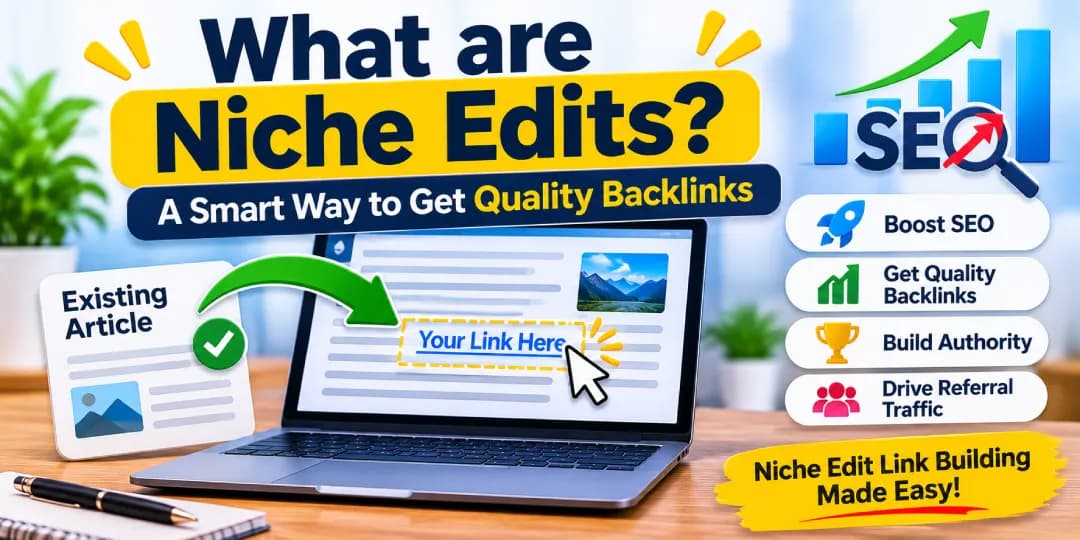
A niche edit is a backlink placed inside an existing, already indexed article on another website, rather than inside a brand-new post. Instead of writing a guest post from scratch, you ask the site owner to add a relevant link to your page within content that already ranks and has history. Done well, niche edit link building gives you a contextual backlink from an aged page in your industry, usually faster than traditional outreach.
Table of contents16 sections
What Is a Niche Edit in SEO?
Niche Edit Definition Explained Simply
Think of a niche edit as a small, targeted insertion. A blogger published a post two years ago on email marketing tools. You contact them and suggest adding a link to your guide where it fits. If they agree, your URL is placed inside the existing sentence or paragraph with an anchor text that suits the context. People also call this link insertion or a curated link.
How Niche Edits Fit Into a Backlink Profile
A healthy backlink profile is a mix of link types: editorial mentions, guest posts, directory listings, digital PR, and some niche edit backlinks. Niche edits are one tool among several. They work best when they sit alongside other links, so your profile doesn't look built from a single tactic. To understand how niche edits fit into a broader SEO campaign, explore our guide to link building and learn how different strategies help build a strong backlink profile.
Why Site Owners Use Niche Edits for Link Building
The appeal is simple. The page is already indexed, sometimes already ranking, and may have picked up its own links over time. Because a link lands on an established page, it can pass authority sooner than a new post that still has to earn its footing. That is why many SEO teams treat niche edits as a shortcut worth testing.
How Do Niche Edits Work?
The Process: From Finding Relevant Content to Link Insertion
The workflow is fairly consistent. First, you find pages that are relevant to your topic and have real traffic. Next, you identify the site owner and send a personalized request. If they accept, they add your link to the existing page, and you confirm it went live. Everything depends on relevance and a believable reason for the link to be there.
Role of Anchor Text and Link Placement in Existing Content
Where the link sits and what it says matter as much as the site it comes from. A well-placed link reads as part of the original sentence. A forced one stands out.
Choosing Natural and Relevant Anchor Text
Match the anchor text to the surrounding sentence. A descriptive phrase, a partial match, or a branded anchor usually reads better than a repeated exact-match keyword. Varying your anchor text helps keep a link profile natural.
Contextual Links vs. Sidebar and Footer Links
Contextual links sit inside the body copy, where readers actually engage with them. Sidebar and footer links appear sitewide and carry far less editorial value. When you buy niche edits, contextual placement is what you should be paying for.
Link Juice, Link Equity, and Domain Authority (DA) Considerations
Link equity, often called link juice, is the value a link passes from one page to another. It depends on the authority of the linking page, its relevance, and how many other links share the page. Domain Authority and Domain Rating are useful shorthand, but neither is a Google metric. Use them as rough guides, not guarantees.
What Are the Different Types of Niche Edits?
Manual or Editorial Niche Edits (White Hat)
These happen when you reach out, make a genuine case, and the editor adds your link because it improves the article. Nothing is exchanged for the link, or any compensation is clearly disclosed. It is slower, but it is the safest approach.
Paid Niche Edits (Grey Hat)
Here, a site owner or intermediary charges a fee to place your link. This is the model behind most niche edit services and marketplaces. It is common in the industry, though it sits in a grey area because a payment for a link that passes ranking credit can conflict with Google's rules. How that payment is handled and labeled is covered in the safety section below.
Black Hat Niche Edits and Hacked Link Insertions
Some sellers insert links into pages without the owner's permission, or through hacked sites. This is a clear violation and can result in penalties. Avoid it completely.
Pros and Cons of Manual Niche Edits
On the plus side, manual edits are relevant, low risk, and build real relationships. On the downside, they take time, response rates are modest, and results are hard to scale. Many marketers accept that trade for the quality.
Niche Edit vs. Guest Post: Key Differences
Content Creation vs. Link Insertion Into Existing Pages
A guest post means writing new content and publishing it on someone else's site. A niche edit means adding a link to something already published. In the niche edit vs guest post debate, the main difference is whether you create content or borrow existing page strength.
Cost, Speed, and Effort Comparison
Niche edits are generally faster because there is no draft to write or approve. Guest posts take more effort but give you control over the content. Pricing varies widely, so compare quotes for similar site quality rather than looking at the headline price.
Which Method Fits Different SEO Goals
If you want authority from a ranking page quickly, niche edits make sense. If you want brand exposure, a fuller message, or a chance to showcase expertise, guest posting is the better fit. Many strategies use both.
Niche Edits vs. Other Link Building Strategies
Niche Edits vs. Traditional Blogger Outreach
Traditional blogger outreach usually pitches new content or a collaboration. Niche edit outreach pitches a specific insertion into something that exists. The second is narrower and tends to get quicker answers.
Niche Edits vs. Broken Link Building
Broken link building replaces a dead link with a working resource of yours. It is essentially a type of niche edit with a built-in reason for the site owner to say yes. It is usually the easiest pitch to get accepted.
Niche Edits vs. Digital PR and Press Mentions
Digital PR earns links through newsworthy stories, data, or expert commentary. It builds brand trust at scale but is less predictable and rarely lets you choose the exact page or anchor.
Niche Edits vs. Resource Page Link Building
Resource pages curate helpful links on a topic. You can request inclusion if your content genuinely fits. These pages are designed for linking, so the ask feels natural.
Choosing the Right Link Building Strategy for Your Site
Consider your budget, your timeline, and the quality of your content. A newer site might lean on digital PR and guest posts first, while an established one with strong pages might add niche edits to boost specific URLs.
How to Find and Get Niche Edit Backlinks
Identify Relevant Websites and Existing Articles
Start with a simple search for topics close to your page. Look for articles that already cover the subject, show recent updates, and receive steady visits. These are the best candidates.
Find Niche Edit Opportunities Using SEO Tools
Tools take much of the guesswork out of prospecting.
Finding Relevant Pages With Ahrefs and Semrush
Both platforms let you filter pages by topic, traffic, and referring domains. Look at pages that rank for your target keywords and see who is already linking there.
Finding Broken Links and Unlinked Brand Mentions
Broken link checkers highlight dead outbound links. Brand monitoring reveals pages that mention you without linking. Both are warm leads.
Find and Verify Website Owner Contact Information
Look for an editor, author, or contact page, and confirm the person actually manages that site. Reaching the wrong person wastes time and can annoy the right one.
Write a Personalized Niche Edit Outreach Email
Keep it short and specific. Mention the exact article, explain why your page helps readers, and suggest where it could fit. Avoid generic templates that read as mass mail.
Negotiate Link Placement and Follow Up
If the editor is open to it, agree on the anchor text and location. Follow up politely after a week or so. A single reminder is fine, but repeated nudges are not.
Manage Ongoing Niche Edit Outreach Campaigns
Track every contact, status, and result in a spreadsheet or outreach tool. Consistent records make it easier to see what is working and where to improve. They also show you, at a glance, how many links come from one publisher and how they are spread across your pages.
In-House Outreach vs. Outsourcing Niche Edits
Doing it yourself gives you control and costs less money but more time. Hiring an SEO partner or a niche edit service provider saves effort, though it requires careful vetting.
How to Evaluate a High-Quality Niche Edit Placement
Check Website and Content Relevance
The site and the page should relate closely to your topic. A relevant mention from a smaller site often beats an off-topic one from a larger one.
Evaluate Organic Traffic and Traffic Trends
Look at the site's monthly traffic and whether it is growing, steady, or falling. A sudden collapse can signal a penalty or a neglected site.
Review Domain Authority, Domain Rating, and Referring Domains
Check DR or DA along with the number and quality of referring domains. A high score with a spammy link source is not a good sign.
Assess the Existing Page's Backlink Profile and Ranking Performance
Page-level strength matters. A page that already ranks and attracts links tends to pass more value than a page nobody visits.
An aged page also has a history, and that history deserves a look. Check the ranking trend in your SEO tool. A page that held steady positions for years is a better bet than one that dropped sharply or swung wildly. Review its backlink profile as well. If it suddenly gained a burst of links, especially from unrelated or low-quality sites, that is a warning sign. Unusual spikes in either rankings or links can mean the page was manipulated before you arrived, and you don't want to be the next link in that pattern.
Check Content Quality and Outbound Link Patterns
Read the article. Is it well written and useful? Also check how many outbound links it carries, since a page full of sponsored links dilutes the value of each one.
Then ask a question many people skip: has the page drifted from its original purpose? Articles get rewritten over the years. A post that once ranked for one topic may now target a different search intent, or it may have been updated so heavily that its current focus no longer matches the content that earned its rankings. The old relevance and the current relevance are not always the same thing. Compare the live page against an older version using the Wayback Machine, and make sure your link fits what the page is about now, not what it used to be about.
Verify URL Indexability, Status Codes, and Redirects
Confirm the linking page is indexed, returns a 200 status, and isn't redirecting elsewhere. A noindex tag on that page makes the link close to worthless.
Your own page needs the same scrutiny, and this is a separate check. The linking page being indexed and your destination URL being indexable are two different conditions, and both must hold. Make sure your target page does not carry a noindex tag and that its canonical tag points to itself, not to another URL. If your link points to a page that canonicalizes elsewhere, the value may be consolidated to that other page instead. Also check for redirect chains. If your URL redirects once, twice, or more before landing, link the final destination URL directly so nothing is lost or delayed along the way.
Technical eligibility is only half the picture. The destination also has to deserve the click. Ask whether your page satisfies the search intent of the reader who lands on it from that article. If the linking paragraph is about comparing email tools and your link drops visitors on a generic homepage, the match is weak. The content of the target page should continue the same thought the linking article started, and it should be genuinely useful for the topic in question. A technically perfect URL that doesn't serve the reader's intent gives both users and search engines little reason to value the link.
Do Niche Edits Work in SEO? Benefits and Risks
Benefits: Domain Rating, Organic Traffic, and Search Engine Rankings
Relevant contextual links can support stronger rankings, higher Domain Rating, and more organic traffic over time. They are not a magic switch, but they can move the needle when combined with quality content.
Faster Link Acquisition and Existing Page Visibility
Because the page is already live, the link can be discovered quickly. Your URL also gains visibility from an article that readers already visit.
It helps to separate three stages that people often lump together. Discovery happens when Google finds the new link, which usually requires the linking page to be crawled again. Crawling and processing follow, as Google fetches your destination and evaluates the link along with everything else it knows. Only after that can the link influence ranking systems, if it influences them at all. A link being live, or the linking page being indexed, does not guarantee any immediate ranking effect. Pages that are recrawled often, such as active, well-linked articles, tend to pass through the first stage faster, which is one real advantage of choosing established pages.
Risks of Low-Quality or Spammy Niche Edit Links
Links on thin sites, link farms, or unrelated pages can do more harm than good. Cheap bulk packages often fall into this category.
It also helps to understand how Google deals with such links, because the consequences are not all the same. Not every unnatural link triggers a penalty. Google's automated systems are designed to detect spam and often simply ignore or neutralize those links, so they give you no ranking value rather than hurting you. A manual action is a different matter. It is applied by a human reviewer when a pattern of manipulation is found, and it appears as a specific message in the Manual Actions report in Search Console. So wasted money on links that count for nothing is the common outcome, while a visible manual action is the more serious, if rarer, one. Both are good reasons to avoid low-quality placements.
White Hat vs. Grey Hat vs. Black Hat Niche Edit Practices
The main difference is risk. White hat approaches rely on genuine editorial decisions. Grey hat involves payment and demands careful disclosure. Black hat breaks rules outright and can lead to penalties.
Can Niche Edits Improve AI Search Visibility?
This is an emerging area. Strong, relevant mentions across trusted pages may help establish a brand's topical presence, which could play a part in how AI systems encounter it. However, no one can guarantee citations or rankings in AI-generated answers.
Are Niche Edits Safe? Google's Link Spam Guidelines
Google's Policy on Paid Links and Link Manipulation
Google's spam policies treat buying or selling links that pass ranking credit as a violation when the goal is to manipulate search results. That includes money, goods, or services exchanged for a link. It also covers excessive link exchanges and large-scale link campaigns built to influence rankings.
This is where the line between a paid placement and an editorial insertion becomes important. A commercial arrangement does not automatically make a link bad, and a link being editorially relevant does not automatically make it safe. What matters to Google is why the link exists. If a site owner added your link because it genuinely helps readers, and no payment was involved, it is an editorial decision. If the link is there because you paid for it, it is a paid link, however relevant the page looks. A niche edit can be relevant and still be a paid placement, and it should be treated as one.
Three ideas are easy to mix up, so it is worth keeping them apart. Editorial endorsement means the publisher chose the link freely. Qualification means a paid link carries a label, such as rel="sponsored", that tells Google not to treat it as an endorsement. Compliance is the broader question of whether your overall approach fits Google's policies. Qualifying a paid link addresses the first concern, but it doesn't turn a paid link into an editorial one, and it doesn't excuse a campaign built around mass-produced placements. A labeled link is one piece of compliance, not the whole of it.
Sponsored, Nofollow, and Editorial Link Attributes
Google asks that paid links be marked with rel="sponsored" or rel="nofollow", and that user-generated links use rel="ugc". These attributes tell search engines the link is not an unpaid editorial endorsement, which keeps you on the right side of the guidelines. Genuinely editorial links need no such label.
One technical detail matters here. Google treats sponsored, nofollow, and ugc as hints rather than strict commands. In practice, such links are generally not used to pass ranking credit, but the attribute alone is not a guarantee in either direction. A dofollow link, meaning one with no restricting attribute, is not guaranteed to pass value either, because Google still decides how much weight any link deserves. So don't judge a placement purely by its attribute, and don't promise yourself ranking credit because a tag is missing.
The trade-off is plain. A sponsored or nofollow link may pass less ranking value, but it still brings referral traffic, brand exposure, and a more natural profile. A paid link left unmarked saves nothing and adds risk. If a provider tells you to ask for dofollow on a purchased link without disclosure, treat that as a reason to look closer.
How to Avoid Link Schemes and Spammy Placements
Avoid large volumes of similar links, networks of sites that exist only to sell links, and exact-match anchors repeated everywhere. Focus on pages that would make sense without your payment.
Think at the campaign level too, not just link by link. A few patterns create trouble even when each link looks fine alone:
- Taking many links from the same publisher or the same network of related sites
- Pointing every link at a single target page
- Letting paid links make up most of your backlink profile, with little editorial or earned coverage
A balanced approach spreads links across different publishers and several relevant pages, and keeps paid placements as one part of a mix that also includes editorial links, digital PR, and other methods.
Risk vs. Reward of Niche Edit Link Building
The reward can be real authority and faster visibility. The risk grows with volume, low quality, concentration in a few sources, and undisclosed paid links. Moderate, varied, and carefully labeled use keeps the balance favorable.
How Much Do Niche Edits Cost?
Average Price Per Link and Per Placement
Prices vary a lot. Entry-level placements can start at a few tens of dollars, while links on high-authority, high-traffic sites often run into several hundred. Always check current quotes, since niche edit pricing changes by provider.
Factors That Affect Niche Edit Pricing (DA, Traffic, Relevance)
Higher DR, stronger monthly traffic, tight topical relevance, and category (finance and SaaS cost more) all push the price up. Exclusive or low-outbound pages are premium.
A higher price, though, is not the same as higher SEO value. A pricey link on an impressive-looking site can still sit on a page with little traffic, loose relevance, or a crowded outbound list. Price reflects what the seller can charge, not what the link will do for you.
Cheap Niche Edit Links vs. Quality Niche Edits: What to Expect
Cheap niche edit links often come from weaker sites with little real traffic. Quality placements cost more because they come from legitimate sites with genuine audiences. Typically, you get what you pay for, though not always. Judge each placement on its own merits instead of assuming cost tells the whole story.
Niche Edit Delivery Time and Turnaround
Many providers quote one to three weeks, though complex or high-authority placements can take longer. Ask for a clear timeline in writing.
How to Choose a Niche Edit Service or Provider
What to Look for in a Trusted Niche Edit Service
Look for transparent site lists, real traffic data, clear pricing, and examples of past work. A reputable provider explains how placements are secured and offers replacement if a link disappears.
Red Flags to Avoid When You Buy Niche Edit Links
Be wary of guaranteed rankings, hidden site lists, unrealistically low prices, and sellers who can't describe their process. Pressure to buy quickly is another warning sign.
Questions to Ask Before You Buy Niche Edits
Ask how sites are selected, whether links are tagged sponsored, how long they stay live, what happens if one is removed, and whether you can approve each placement first.
How to Verify and Track Niche Edit Results
How to Confirm Your Niche Edit Link Is Live
Open the page and find the link directly. Then confirm it appears in a backlink tool such as Ahrefs or Semrush after it has been crawled.
Keep in mind that these tools are not identical. Each runs its own crawler, so they differ in coverage, how often they refresh, how quickly they report new or lost links, and even how many referring domains they count for the same site. A link missing from one report may show up in another, or in none yet. No single tool gives you a complete backlink inventory. If a link is visible on the page but not in your tool, don't assume it failed. Check the page source first, then compare a second tool or wait for the next crawl.
Check Link Attributes, Anchor Text, and Placement
Inspect the HTML to see whether the link is dofollow, nofollow, or sponsored. Make sure the anchor text and position match what was agreed.
Monitor Link Removal, Redirects, and Page Changes
Pages get updated, and links sometimes vanish. Recheck periodically, and watch for redirects or noindex changes to the page.
The context around your link can change even when the link stays. The paragraph next to it might be edited or deleted. The link might be moved to an unrelated section, where it loses much of its value. Over time, someone could also alter the anchor text, swap the destination URL, or add a rel attribute such as nofollow or sponsored. Any of these changes can reduce the value of a placement without removing it. A monthly or quarterly check, ideally with a backlink monitoring tool, catches these quietly.
Track Referral Traffic and SEO Performance
Use analytics to see visits from the linking page, and Search Console to watch impressions, clicks, and ranking changes for the target URL.
A word of caution on interpretation. If rankings rise after a link goes live, that does not prove the link caused it. Content updates, technical fixes, algorithm updates, seasonal demand, and competitor activity can all move rankings in the same window. To get a meaningful read, record the baseline before you acquire the link: rankings, clicks, impressions, and conversions for the target page. Then compare against the same measures afterward, and note anything else you changed in the meantime. Correlation is a starting point, not proof.
How Long Does It Take to See SEO Results?
It varies, but many sites notice early movement within a few weeks, with clearer effects after several months. Competition and content quality play a big role. Remember that the link first has to be discovered, crawled, and processed, so a quiet first week doesn't mean the placement failed.
Measuring Niche Edit ROI
Compare what you spent with the outcomes: ranking gains, traffic, leads, or revenue tied to the target page. Keep expectations realistic and measure over a reasonable window.
Look beyond rankings, too. Referral visitors from a niche edit can be few in number but high in quality if the linking article matches your audience. Track what those visitors do: sign-ups, enquiries, purchases. A placement that costs more but brings qualified leads can be a better investment than a cheap one that brings nothing.
The best way to judge a niche edit strategy is a documented case study of your own. Write down:
- Baseline: the target page's rankings, organic traffic, and conversions before the campaign
- Links acquired: how many, from which sites, and the quality of each (relevance, traffic, DR, attributes)
- Timeframe and results: the measured changes in rankings, organic traffic, and conversions at set intervals, such as 30, 60, and 90 days
Keep the data verifiable with screenshots or exported reports. When you read case studies from providers, check whether they share the same details. Results without a baseline, a timeframe, or named metrics are marketing, not evidence.
Niche Edits for Different Industries and CMS Platforms
Niche Edits for SaaS and Technology Websites
SaaS niche edit backlinks work best on software review sites, how-to guides, and tool comparisons, where a product link fits naturally.
Niche Edits for E-commerce and Local Businesses
Online stores and local companies benefit from links within buying guides, local resource lists, and community blogs that match their audience.
Niche Edits for Blogs and Content Publishers
Publishers can use niche edits to strengthen cornerstone articles, though quality and topical match remain more important than volume.
Niche Edits Across WordPress, Shopify, Wix, and Webflow
The platform rarely changes the principle. Whether the page lives on WordPress, Shopify, Wix, or Webflow, relevance and editorial fit decide whether a link helps.
Best Practices for Niche Edit Link Building
Prioritize Topical Relevance Over Link Volume
A handful of closely related links beats dozens of loosely related ones. Quality placements consistently outperform quantity.
Maintain Natural Anchor Text and Link Diversity
Mix branded, partial, and descriptive anchors, and spread links across several pages and several publishers instead of pointing everything at one URL or taking many links from one source.
Align Niche Edits With Search Engine Guidelines
Follow Google's guidance, label paid links properly, and avoid anything that looks like a scheme. Staying compliant protects your long-term results.
Avoiding Common Mistakes When Building Niche Backlinks
Common errors include buying in bulk, ignoring page quality and history, overusing exact-match anchors, skipping the technical and intent check on your own destination URL, trusting a single backlink tool, and never checking whether the link and its surrounding content stay in place.
Build Long-Term Relationships With Relevant Publishers
Editors remember polite, useful contacts. Ongoing relationships lead to better placements and easier approvals in the future.
Conclusion
A niche edit is a link inserted into an existing, indexed page, and it can be a fast, effective part of a wider link building plan. The results depend on relevance, page history, technical eligibility, and natural placement, not on how many links you collect or how much you pay. Evaluate every opportunity carefully, label paid links as Google asks, spread your risk across publishers and pages, and measure against a clear baseline. Used with care, niche edits can support steady, sustainable SEO growth.
Frequently Asked Questions
What is a niche edit in simple terms?
It is a backlink added to an existing article on another site, usually in a sentence that fits your topic.
What is the difference between a niche edit and a guest post?
A guest post is brand-new content published on another site. A niche edit adds a link to content that already exists.
Do niche edits actually work for SEO?
They can, especially when the page is relevant, indexed, and well established. Results are not guaranteed, and an improvement in rankings is not always caused by the link alone.
How much do niche edit links typically cost?
Prices range from modest fees for lower-authority sites to several hundred dollars for strong, high-traffic ones. A higher price does not guarantee higher value, so compare current quotes and judge each placement on its merits.
Are niche edits considered white hat, grey hat, or black hat?
It depends on how they are obtained. Genuine editorial edits are white hat, paid ones are grey hat, and unauthorized or hacked insertions are black hat.
How do I find relevant sites for niche edit backlinks?
Search for topically related articles, use tools like Ahrefs and Semrush, and look for broken links or unlinked mentions.
Is it safe to buy niche edits from a service provider?
It can be, if the provider is transparent, uses genuine sites, and follows Google's guidelines on paid links, including rel="sponsored" or rel="nofollow" where needed. Poor quality and bulk packages carry more risk, whether that means links Google simply ignores or, in rarer cases, a manual action.
How long does it take to see results from niche edit links?
Some movement may appear within weeks, but clearer results often take a few months. A live or indexed link does not guarantee an immediate ranking effect.
What makes a good niche edit backlink?
Relevance, a high-quality page with real traffic and a stable history, natural anchor text, contextual placement, and an indexable destination that matches the reader's intent.
How do I know if my niche edit link is live?
Visit the page, find the link, and verify it with a backlink tool once it has been crawled. Since tools differ in coverage and speed, compare more than one if needed, and recheck later in case the link or its surrounding text changes.
How long does a niche edit take to deliver?
Typically one to three weeks, depending on the provider and the site.
Are niche edits the same as digital PR or press mentions?
No. Digital PR earns coverage through newsworthy stories, while niche edits insert links into existing content.
Can niche edits improve AI search visibility?
They may contribute to a stronger topical presence, but no one can guarantee AI citations or rankings.