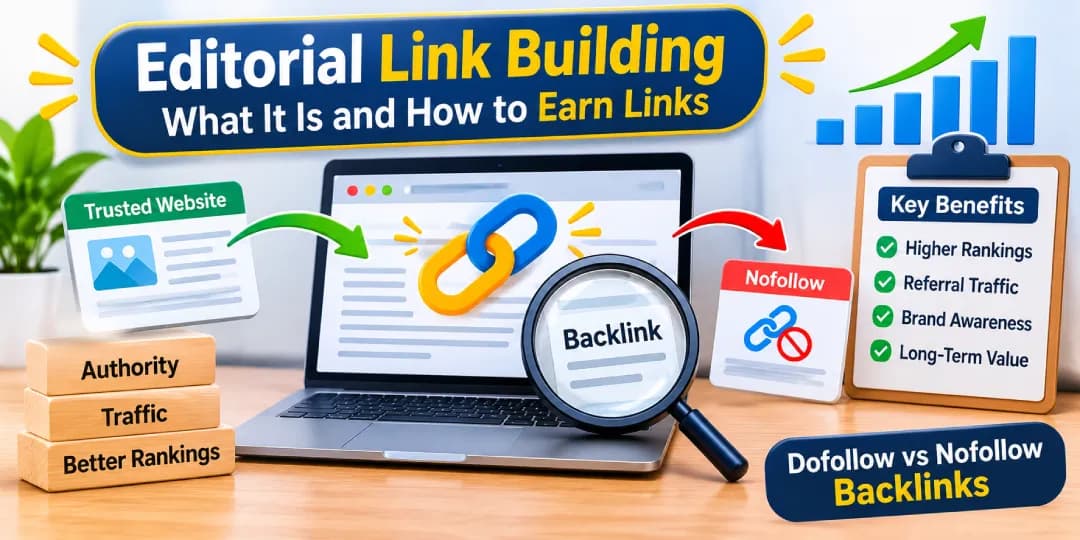
Editorial link building is the process of earning backlinks from websites that choose to link to your content on their own, because they find it useful, credible, or newsworthy. Unlike paid placements or directory submissions, an editorial link comes from a writer or editor deciding your page is worth citing. That is why this form of SEO link building carries so much weight with Google, and why it remains the benchmark for any link building agency or in-house team.
Table of contents15 sections
What Is Editorial Link Building?
At its core, link building is the work of getting other websites to point to yours. Editorial link building narrows that to links placed by editorial judgment. Someone reads your research, your guide, or your quote, and links to it inside their own article.
Editorial Link Definition
An editorial link is a backlink given without payment or exchange, placed within the body of content because the linking site considers the resource valuable. Think of a journalist citing your survey, or a blogger linking to your template. Nobody negotiated the link. The content earned it.
Editorial Links vs. Other Backlink Types
Not every backlink is editorial, and the differences matter when you plan a link building strategy.
Editorial Links vs. Acquired Links
Acquired links come from direct action such as submitting to a directory, creating a profile, or paying for a placement. They can be legitimate, but the site owner did not choose them on merit. Editorial links are earned through the quality of what you publish and the pitch you make.
Editorial Links vs. Guest Posts and Niche Edits
Guest posts are articles you write for another site. Niche edits insert a link into an existing page. Both can be editorial when the host site applies real standards, but both are often arranged commercially. The test is simple: would the site have linked to you without the arrangement?
Natural vs. Manual vs. Automated Link Building
Natural link building happens with no outreach, usually because content spreads widely. Manual link building involves outreach and relationship work. Automated link building relies on software, spam comments, or link farms, and it is the one that tends to attract penalties.
Why Search Engines Value Editorial Backlinks
Search engines treat links as votes of confidence, and editorial links are the hardest votes to fake. Google's own documentation says it uses links both to discover pages and as a signal of what other sites think of a page. A link from a respected publication, placed in context, suggests that a real person vouched for your page. That trust signal is difficult to manufacture at scale, which is exactly why it counts.
There is an important limit here, though. Google does not publish how much any single link is worth, and it has said it ignores many links it considers unhelpful or spammy. So an editorial link is a strong candidate for passing value, not a guarantee of it. The link existing, the link looking good in a tool, and the link actually moving rankings are three separate things, and the sections below keep coming back to that distinction.
Benefits of Editorial Link Building for SEO
Impact on Organic Traffic and Search Rankings
Relevant editorial backlinks help pages rank for competitive terms, and higher rankings bring more organic traffic. The effect is rarely instant, but it tends to compound as more quality links accumulate. Be realistic, however. A link to a weak page, or one that sits on a page Google barely trusts, may do very little. Rankings depend on content quality, search intent match, and many other signals alongside links.
Building a Stronger Backlink Profile and Authority
A healthy backlink profile includes a variety of referring domains, natural anchor text, and links from relevant sites. Authority link building of this kind steadily lifts third-party metrics such as domain rating. Keep in mind that those scores are estimates built by tools like Ahrefs and Semrush. Google does not use them, so a rising score shows you are heading in a good direction but does not prove a ranking gain.
Referral Traffic, Brand Awareness, and Credibility
A link in a well-read article sends real visitors. Beyond clicks, appearing in respected publications builds credibility that paid ads cannot replicate. Readers remember who gets cited.
Editorial Links and Visibility in AI Search / Answer Engines
AI search tools tend to draw on sources that are widely cited and trusted. While nobody outside the platforms knows the exact mechanics, brands mentioned and linked across reputable sites appear more often in AI-generated answers. Editorial coverage supports that visibility, although it should be treated as a likely benefit rather than a proven formula.
Long-Term Value, Cost-Effectiveness, and Scalability
A good editorial link keeps working for years, unlike ad spend that stops when the budget does. Scaling takes effort, because quality links need people and time, but the cost per month of benefit is usually low.
What Makes a High-Quality Editorial Backlink?
Before looking at individual signals, it helps to separate three ideas people often blend together. A link can exist and be live. It can look strong on paper, with good authority metrics and relevant content around it. And it can actually influence rankings in Google's systems. The first does not ensure the second, and the second does not ensure the third. Each signal below should be read as a reason to expect value, not a promise of it.
Topical Relevance and Website Authority
A link from a site in your niche usually beats a stronger-looking link from an unrelated one. Authority matters, but relevance tells Google why the link exists. A high-authority site that covers everything may offer less than a smaller specialist publication your audience actually trusts.
Editorial Standards and Organic Traffic Quality
Check whether the site has real editors, a visible publishing standard, and genuine organic traffic. A site with inflated metrics and no readers is a warning sign. Traffic that comes from relevant search queries is a better sign than a large number with no clear source.
Link Placement and Surrounding Content
Links inside the main body of an article, surrounded by relevant text, carry more value than those in footers or sidebars. Link placement should feel like a natural reference, not an afterthought.
Placement also has a technical side. Google can reliably follow standard HTML links, meaning an anchor tag with an href attribute that points to a real URL. Links that only appear after a click, rely on JavaScript events instead of an href, or are injected in ways crawlers do not process may never be discovered. Before counting a link as an asset, view the page source or use a URL inspection tool and confirm the link is present in the rendered HTML.
Natural Anchor Text and Link Context
Anchor text should read the way a writer would phrase it, such as a brand name, a page title, or a descriptive phrase. Exact-match keywords repeated across many links look engineered. Google also uses the words around a link to understand its target, so context counts as much as the anchor itself.
Dofollow, Nofollow, Sponsored, and UGC Attributes
Dofollow links pass ranking signals in the traditional way. Google recognizes three link attributes for qualifying outbound links: rel="nofollow", rel="sponsored" for paid or affiliate links, and rel="ugc" for user-generated content such as comments and forum posts. Google says it treats these as hints rather than strict commands. Editorial links are often dofollow, but a nofollow link from a major publication still brings traffic and credibility, and it can help discovery and brand visibility.
Co-Citations and Co-Occurrences
When your brand appears alongside established names in the same article, even without a direct link, it helps associate you with that topic. This is a smaller factor, but it adds up.
How to Identify Low-Quality or Manipulative Links
Watch for sites that publish on every topic, sell link placement openly, show sudden traffic drops, or surround links with unrelated text. If a page exists mainly to host links, it is likely a link farm. Google's spam policies describe link spam as links created mainly to manipulate rankings, including buying or selling links that pass ranking credit, excessive link exchanges, large-scale guest posting campaigns with keyword-rich anchors, and automated link creation. If a link would not exist without a deal built around SEO, treat it with suspicion.
Types of Content That Naturally Earn Editorial Links
Original Research, Surveys, and Statistics
New data gives writers something they cannot get elsewhere. Even a modest survey of your customers or industry peers can become a cited source.
Case Studies and Data-Driven Reports
Detailed case studies with real numbers earn links because they show what happened, not just what might. Data-driven reports work the same way.
Evergreen Content and Definitive Guides
A thorough guide that stays accurate and gets updated becomes the page people link to when they need to explain a concept.
Infographics and Visual Assets
Clear visuals are easy for other sites to embed and credit. They work best when they simplify something that is hard to explain in text.
Free Online Tools and Calculators
Useful tools attract links for years. A simple calculator that solves a real problem often outperforms a dozen articles.
Expert Insights, Interviews, and Industry Commentary
Original opinions from recognized practitioners give journalists quotable material and bloggers a reason to reference you.
Templates, Checklists, and Unique Resources
Resource link building thrives on practical downloads. Templates and checklists get saved, shared, and linked from resource pages.
How to Create and Update Link-Worthy Content
Start by asking what is missing from the current search results. Build something better or different, then review it regularly so statistics, screenshots, and examples stay current. Fresh content keeps earning links that stale content loses. Also make sure the page itself is crawlable and indexable, since a great asset that Google cannot index cannot benefit from the links it earns.
How Editorial Link Building Works: Step-by-Step
Step 1: Find Relevant Editorial Link Opportunities
Research Niche-Relevant Websites and Publications
Begin with the sites your audience already reads. Industry blogs, trade publications, and local outlets all count. Search for roundups, resource pages, and articles that cite sources similar to yours.
Analyze Competitor Backlinks and Referring Domains
Look at who links to competitors and why. If several sites cited a rival's study, they may cite yours too.
Step 2: Evaluate Link Prospects and Editorial Quality
Review traffic, relevance, publishing standards, and how the site treats outbound links. Skip anything that looks built for selling links. Also check whether the pages on that site are actually indexed. A link from a page Google has not indexed, or one blocked from crawling, may never be counted.
Step 3: Find Editors, Journalists, and Contact Information
Look for the person who actually covers your topic. Author pages, social profiles, and masthead listings usually reveal the right contact. A targeted email to the right person beats a generic message to a general inbox.
Step 4: Develop a Valuable Content or Story Pitch
Decide what is in it for the editor. A fresh statistic, an expert angle, or a useful update to an existing article gives them a reason to respond.
Step 5: Send Personalized Outreach Emails
Write an Effective Editorial Outreach Email
Keep it short. Mention a specific article of theirs, explain what you can add, and make the next step easy. Skip flattery and long introductions.
Follow Up Without Spamming
One or two polite follow-ups, spaced several days apart, are enough. If there is no reply, move on.
Step 6: Secure and Verify Editorial Placements
Once a link goes live, confirm the URL, anchor text, and attributes. Then check that the link is technically usable, because a live link is not always a countable one. Look for these points:
- The link is a standard HTML anchor with an href, not a script-triggered click or an image without a proper link.
- It appears in the rendered page, not only after user interaction.
- The linking page is not blocked by robots.txt. If crawlers cannot fetch the page, they cannot see the link.
- The linking page is indexable. A page set to noindex may be dropped from the index, and Google has indicated that long-term noindex pages may eventually stop passing signals.
- The destination page is also indexable and returns a normal status code, so the value points to a page that can rank.
It helps to remember the difference between the two ends. A linking page can be indexed while your destination is blocked, or the other way around, and either gap weakens the result. Thank the editor, and keep the relationship warm.
Step 7: Monitor and Maintain Earned Links
Pages change and links disappear. Check periodically, and reach out politely if a link is removed by mistake.
Editorial Link Building Strategies That Work
Skyscraper and Content Upgrade Outreach
Find a popular article, publish a meaningfully better version, and contact the sites that linked to the original. It only works if your version is genuinely improved.
Broken Link Building and Outdated Resource Replacement
When a linked page no longer exists, you can suggest your own content as a replacement. Similarly, outdated resources can be updated with your newer material.
Digital PR and Media Coverage
Digital PR pitches stories to journalists and publications. Newsworthy data, expert commentary, and timely angles tend to earn coverage and links together.
HARO/Journalist Outreach for Editorial Backlinks
Responding to journalist requests with real expertise can produce high-authority mentions. Answer quickly, stay specific, and only respond where you truly qualify.
Unlinked Brand Mentions and Lost Link Reclamation
If someone mentions your brand without linking, ask for a link. The same applies to links that were removed or broken after a site redesign.
Resource Page and Listicle Outreach
Many sites maintain curated links pages or best-of lists. If your content genuinely belongs, a short, courteous request often works.
Building Relationships with Authoritative Websites and Journalists
The most reliable links often come from people who already know your work. Share their content, offer help, and be useful before you ask for anything.
Expert Collaborations and Industry Partnerships
Joint studies, co-authored guides, and interviews with practitioners naturally lead to cross-promotion and links from both sides.
Guest Posting and Niche Edits: Editorial Considerations
Both tactics can work when the host site has real standards and the link serves readers. Avoid sites that accept anything for a fee. Google's spam policies specifically call out large-scale guest posting campaigns with keyword-rich anchor text, so keep volume low and relevance high.
Content Repurposing for Editorial Link Opportunities
Turn a report into a visual, a webinar, or a short data summary. Each format reaches different publishers and expands your chances of being cited.
How to Promote Content and Attract Editorial Links
Pitch Linkable Assets to Relevant Publications
Even great content rarely spreads on its own. Send it to the writers who cover the subject and explain why their readers would care.
Promote Original Research Through Digital PR
Package key findings into a clear press angle with a headline number and a short summary. Journalists work fast, so make the story easy to pick up.
Social Media and Online Community Promotion
Sharing in relevant communities can put your work in front of writers and bloggers. Participate honestly rather than dropping links.
Email Newsletters and Content Distribution
A newsletter keeps your content in front of an interested audience, some of whom publish their own content.
Paid Content Promotion and Its Limitations
Paid promotion can increase exposure, but it does not create editorial links by itself. Use it to reach people who might then choose to link.
Best Tools for Editorial Link Building
Ahrefs and Semrush for Prospecting and Backlink Analysis
Both tools show who links to competitors, which pages attract links, and where gaps exist. Ahrefs link building workflows are especially common among agencies. Remember that their authority scores are third-party estimates, so use them to compare prospects, not to predict rankings.
Google Search Operators for Finding Editorial Prospects
Simple searches such as "your topic" plus "resources" or "write for us" can surface relevant sites without any paid software.
Journalist Request and Expert Sourcing Platforms
Platforms that connect journalists with sources help you find timely opportunities for quotes and commentary.
Outreach and Email Management Tools
These tools help with personalization, scheduling, and follow-ups, but they should never replace thoughtful writing.
Google Search Console for Link Monitoring
The Links report shows who links to you and how often, and it comes straight from Google. It is also where you find the Manual Actions report, which tells you whether Google has applied a penalty related to unnatural links. The URL Inspection tool helps confirm whether a specific page is indexed and crawlable. Note that Search Console shows a sample of links, not a complete list, so combine it with a backlink tool.
Spreadsheets and CRM Tools for Outreach Tracking
A simple sheet or CRM tracks prospects, replies, and live links, which keeps campaigns organized as they grow.
Editorial Link Building Mistakes, Risks, and Challenges
Buying Manipulative or Irrelevant Backlinks
Paying for links on unrelated or spammy sites can do more harm than good. Cheap bulk packages are the most common source of trouble. The damage can range from links that are simply ignored to a manual action that suppresses your site in search results.
Over-Optimized Anchor Text
Using the same keyword-rich anchor repeatedly looks unnatural. Vary it and let context guide the wording.
Generic Outreach and Excessive Follow-Ups
Mass emails get ignored or flagged. Personal, relevant messages perform better and protect your reputation.
Ignoring Website Relevance and Editorial Quality
A link from a site with no connection to your topic adds little value and may raise questions.
Google Link Spam Policies and Paid Link Disclosure
Google's spam policies, which sit within Google Search Essentials, describe link spam as links placed mainly to manipulate ranking. Buying or selling links that pass ranking credit falls under this, whether the payment is money, goods, or services. Google's guidance on qualifying outbound links says paid and affiliate links should carry rel="sponsored" or rel="nofollow", and user-generated links should use rel="ugc" or nofollow. Anything arranged commercially should be disclosed and marked this way.
Google also says its automated systems, including SpamBrain, are designed to neutralize unnatural links, so many manipulative links simply stop counting without any penalty notice. A manual action is a different matter. It is applied by a human reviewer and appears in Search Console.
If you suspect a problem, work through it in order:
- Open the Manual Actions report in Search Console and check for a message about unnatural links, either to or from your site.
- If there is no manual action but rankings dropped, do not assume links are the cause. Check for algorithm updates, technical errors, and content changes first.
- If there is an action, list the problem links using Search Console and a backlink tool.
- Ask site owners to remove the links. For paid or exchanged links that you control, add the correct sponsored or nofollow attribute.
- For links you cannot get removed, the disavow tool is an option, but Google describes it as an advanced feature to use with care, and it is rarely needed for sites with no manual action.
- Submit a reconsideration request that explains what happened, what you fixed, and what you will do differently. Keep records of your outreach as evidence.
Recovery can take weeks, and a rejected request usually means more cleanup is needed. Prevention is far easier than repair.
Disadvantages and Limitations of Editorial Link Building
It is slow, results vary, and success is never guaranteed. Small brands may also find it harder to attract attention at first. Even a successful placement may not move rankings, because Google decides how much weight any link carries and does not share that figure.
Why Editorial Outreach Campaigns Fail
Most failures come down to weak content, poor targeting, or impatient follow-up. The pitch was not relevant, or the asset was not worth linking to. Sometimes the links are earned but cannot be crawled or sit on pages that are not indexed, so the campaign looks successful in a report and does nothing in search.
Editorial Link Building Services: Choosing the Right Agency
What a Link Building Agency Typically Offers
Most agencies provide prospecting, content creation, outreach, placement, and reporting. Some focus on digital PR, others on guest content, and some offer complete link building services.
In-House vs. Outsourced Editorial Link Building
In-house teams know the brand best but need time and skills. Outsourcing adds experience and capacity, though it requires careful vetting. If you are researching a specific provider such as Editorial.Link, judge it by the same criteria you would apply to any agency.
Performance-Based vs. Per-Link Pricing Models
Per-link pricing is simple but can encourage volume over quality. Performance-based models tie cost to results, though definitions of "result" need to be clear.
Questions to Ask Before Hiring a Link Building Consultant
Ask how they find sites, what quality standards they apply, whether they share examples, and how they handle links that disappear. It is also fair to ask how they confirm that placements are crawlable and indexed, and how they label paid or sponsored content under Google's guidelines.
Signs of a Quality Link Building Company
Look for transparent reporting, realistic promises, relevant placements, and a clear explanation of the process. A good provider will also be honest that links influence rankings but cannot be promised to produce a specific position.
Link Building for SaaS, Agencies, and Enterprise Brands
SaaS companies often need niche, relevant placements. Agencies need consistent capacity. Enterprise brands usually need strict compliance and quality control.
White Label Link Building for Digital Marketing Agencies
White label services let agencies offer link building under their own name. Quality control becomes especially important because your reputation is attached.
Red Flags: Cheap Link Building and Low-Quality Vendors
Be cautious of guaranteed rankings, unrealistic volume, vague site lists, and prices far below market. Quality editorial work costs real time.
How to Measure Editorial Link Building Success
Measuring links honestly is harder than most reports suggest. Rankings rarely change because of one thing, so the goal is to separate the effect of links from everything else that happened at the same time.
New Editorial Backlinks and Referring Domains
Track the number of new links and unique referring domains over time, not just totals. Record the date each link was first seen, since that is what lets you compare before and after.
Backlink Relevance and Quality
A few relevant links usually outweigh many weak ones. Review where each link comes from, and confirm each one is live, crawlable, and sitting on an indexed page.
Referral Traffic and Organic Search Performance
Watch referral visits, impressions, and rankings for the pages you promoted. To judge whether links caused a change, set a baseline first: record rankings, clicks, and impressions for the target pages for several weeks before the campaign. Then compare against the period after links appear.
Next, list everything else that changed in that window. Content updates, title tag edits, internal linking changes, site migrations, speed fixes, seasonal demand, and Google algorithm updates can all move rankings. If you edited the page and earned links in the same month, you cannot say which one helped. Where possible, change one thing at a time, or compare against similar pages that received no new links. Even then, treat the result as evidence, not proof.
Brand Mentions and Earned Media Coverage
Mentions without links still show growing awareness and can lead to future links.
Outreach Response and Placement Rates
Reply and success rates reveal whether your targeting and pitches are working.
Tracking Lost, Removed, and Changed Links
Monitor links that vanish or change attributes so you can respond early.
Measuring AI Search Visibility
Check whether your brand or pages appear in AI-generated answers for key topics. The data is still imperfect, but it is worth watching.
Editorial Link Building Case Studies and Results
Real-World Editorial Link Building Examples
A useful case study is documented, not described in general terms. When you read one, whether from an agency or your own records, look for these details:
- The starting point: the site's baseline traffic, rankings, and number of referring domains before the campaign.
- The work done: what content was created, what was pitched, and to whom.
- The results in links: how many links and referring domains were earned, and from which kinds of sites.
- The timeframe: when the campaign started, when links appeared, and when results were measured.
- The outcome: measurable changes in rankings, organic traffic, or referral traffic, with a note on what else changed.
- Verification: live URLs or screenshots you can check yourself.
Patterns that tend to appear in credible examples include industry surveys covered by trade publications and free tools cited by educational sites. This article does not present invented numbers. If you are comparing providers such as Editorial.Link, ask each one for case studies that meet the checklist above, and treat any result without a baseline or timeframe as a marketing claim rather than evidence. If you have your own campaign data, adding it here with the same structure will make this section far stronger.
Example Outcomes for Early-Stage and Growth-Stage Companies
Early-stage companies often see their first relevant links from niche blogs and communities. Growth-stage companies can pursue broader media coverage and larger publications. In both cases, outcomes vary widely, and a case study from one site rarely transfers directly to another.
What Realistic Timelines Look Like
Most campaigns need several months before the effect on rankings becomes clear. Links may appear within weeks, but search performance usually follows more slowly, and some links never produce a visible change.
Additional Link Building Concepts
How Hyperlinks Work in HTML
A hyperlink uses an anchor tag with an href attribute pointing to a destination. The visible text is the anchor text, and attributes such as rel can describe the link's nature. Google follows these standard links most reliably, which is why links built only with scripts or click events can fail to pass anything.
Internal vs. External Links
Internal links connect pages within your own site and help distribute authority. External links point to other sites, and backlinks are external links pointing to you.
Link Producers vs. Association Producers
Link producers create content that earns links directly. Association producers earn visibility by being connected to trusted names or topics.
Structured Data and Link Building in AI Search
Structured data helps search engines understand your content, which can support visibility. It does not replace links, but it complements them.
Conclusion
Editorial link building rewards patience and quality. Create something worth citing, reach the right people with a clear reason to link, and measure what matters. Check that each link is crawlable and indexed, follow Google's guidance on paid and sponsored links, and be honest about what you can and cannot attribute to links. Whether you handle it yourself or hire a link building agency, the standard stays the same: relevant sites, natural context, and links that exist because someone chose them.
Frequently Asked Questions
What is an editorial link?
It is a backlink placed by a site owner or writer who chose to reference your content without payment or exchange.
How is an editorial link different from a guest post or niche edit?
Guest posts and niche edits are often arranged. An editorial link is given on merit, though guest content on strict sites can still qualify.
How much do editorial link building services cost?
Prices vary by quality, niche, and pricing model. Very low prices usually signal weak sites or automation.
How long does it take to see results from editorial link building?
Expect several months for noticeable ranking changes, though individual links can appear sooner.
Can you buy editorial links, and is it safe for SEO?
Paying for placements carries risk. Google's spam policies treat links that pass ranking credit in exchange for payment as link spam unless they are marked with sponsored or nofollow. Unmarked paid links can be ignored or, in serious cases, lead to a manual action.
What makes a link building agency trustworthy?
Clear processes, honest expectations, relevant placements, verifiable case studies, and transparent reporting.
Is editorial link building better than other backlink strategies?
It is generally safer and more durable, but it works best alongside other sound tactics.
How do editorial links affect visibility in AI-powered search results?
Brands cited across trusted sites tend to appear more often in AI answers, though platforms do not publish exact rules.
Are backlinks the same as editorial links?
No. Editorial links are one type of backlink, defined by how they were earned.
How can you get editorial backlinks naturally?
Publish original, useful content, then share it with people who cover the topic.
What types of content attract editorial links?
Original research, case studies, guides, tools, visuals, expert commentary, and practical templates.
How do you identify a high-quality editorial backlink?
Check relevance, genuine traffic, editorial standards, natural placement, sensible anchor text, and whether the link is crawlable on an indexed page.
Can editorial links be earned without outreach?
Yes, if content is strong and discoverable, though outreach usually speeds things up.
Are editorial links always dofollow?
No. Many are, but some carry nofollow, sponsored, or ugc attributes and still offer value. Google treats these attributes as hints.
What are the disadvantages of editorial link building?
It is slow, results are uncertain, a link may not improve rankings even when it is high quality, and it needs strong content and consistent effort.
Which tools are best for editorial link building?
Ahrefs, Semrush, Google Search Console, outreach platforms, and a simple tracking sheet cover most needs.
How can you track editorial backlinks?
Use Search Console and a backlink tool, and record placements in a spreadsheet for ongoing checks.
Can small websites earn editorial backlinks?
Yes. A focused niche, original insights, and personal outreach can compete with larger brands.
How can you speed up editorial link building?
Improve targeting, use timely data, build relationships, and publish assets that are easy to cite.
Can paid promotion help earn natural editorial links?
It can raise visibility, which may lead to links, but it cannot guarantee them.