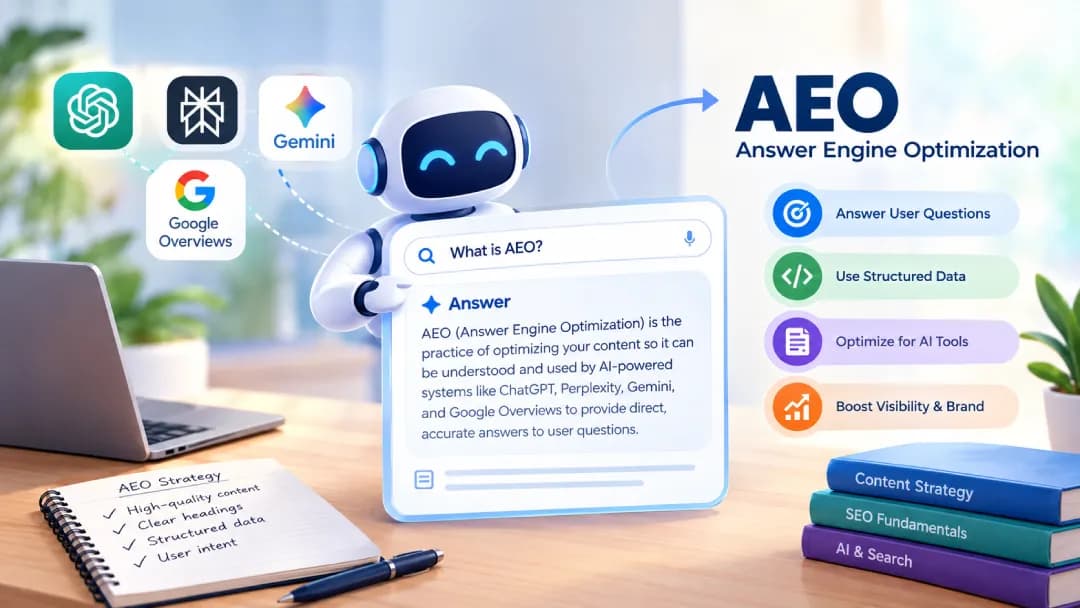
Answer Engine Optimization (AEO) is the optimization of content for extraction by AI-based systems, such as ChatGPT, Perplexity, Gemini, and Google Overviews, which can integrate content into answers in a chat GPT or similar systems. Instead of optimizing content to rank higher in search engine results pages (SERPs), AEO optimizes content to ensure that the content becomes selected as the answer that a user will view. AEO is a corresponding response to how users search for information today. As opposed to clicking through several search results to get information, searchers expect to have their questions answered with direct, concise results.
Table of contents10 sections
AEO Meaning: Understanding Answer Engine Optimization
AEO Definition Explained in Simple Terms
At its foundation, answer engine optimization deals with a machine’s ability to repeat answers to user questions. It is about writing the answer two different people would want. One of those people is the AI system and the other person is the final user who is the human. When you satisfy both, your answer will come up in the search, whether someone is searching or using a voice assistant.
What Does AEO Stand For?
AEO refers to Answer Engine Optimization. There is another definition for AEO that is unrelated to international trade and customs, where AEO stands for Authorized Economic Operator. In international trade, this definition of AEO is relevant. Within the context of digital marketing and strategy, content, and SEO, AEO always refers to answer engine optimization.
How Answer Engines Differ from Traditional Search Engines
Traditional search engines show results in a list of “blue links.” It is up to the user to click through each of the links to obtain an answer. Answer engines, being new, read and synthesize all of the content, and provide users with a quick answer. This shift in search engine technology alters how content producers view "ranking well."
How Answer Engines Work
The Role of Large Language Models and Natural Language Processing
Answer engines use large language models and natural language processing to understand what users are actually asking beyond formulating questions in exact words. This is contrary to prompt engineering in that instead of crafting the perfect prompt to obtain the desired answer, you are crafting content that is a response to a broad range of prompts. The ability of these systems to understand and repurpose your content is improved by how eloquently it is structured and written in natural language.
From Blue Links to Direct Answers: The Shift in Search Results
Search engine results used to be pages of links, but that has changed in the last decade. Many searches now never end up on a results page. Instead, the answer to many user questions is generated in the results view, AI chat tools, Google Overviews, or even featured snippets. Why do these features pull answers directly? Because the underlying content is structured clearly.
Examples of Answer Engines (ChatGPT, Perplexity, Gemini, Google Overviews)
ChatGPT, Perplexity, Gemini, and other similar tools, have quickly become short answer research go tos for people who are interested in quick results and not lengthy research sessions. In the search world, Google Overviews have a similar function in that they combine data from several sources into a single answer that is concisely generated at the top of the search results page. If your content isn't designed to be understood by these tools, it will be effectively invisible to a greater number of search users.
Why SEO Matters for Digital Marketing and Content Creators
Zero-Click Searches and Changing User Behavior
Tools like ChatGPT, Perplexity, and Gemini are general research aids for people looking for an answer rather than engaging in traditional research. Google Overviews is a companion tool in this space. It summarizes the information from many sources in a single answer at the top of a search result page. These tools are becoming more popular, meaning search results without content structured in a way that these systems are likely to understand, will essentially become undiscoverable to a greater percentage of searchers.
Impact on Brand Awareness and Visibility in AI Search
When a pattern of AI-generated search answers mentions your brand, it can create an assumption of credibility for a user that may not have found your brand via search. Beyond SEO, this credibility also impacts your digital marketing strategy. If a brand remains mentioned within search engine generated AI answers, that brand will gain a sort of passive authority, which encompasses a brand’s digital marketing, social media, paid advertisement, and traditional media strategies.
AEO's Role in Data-Driven Decision Making
Studying your content's performance in answer engines along with standard web analytics will help you make more informed spending decisions on your content. This analytics framework is currently growing, but will likely be a common element of content strategies in the future.
AEO vs SEO vs GEO: Key Differences Explained
AEO vs SEO: How the Approaches Differ
Search Engine Optimization (SEO) entails the optimization of web pages to improve search engine rankings and the number of clicks. AEO vs SEO are not necessarily competing concepts. Traditional key elements of SEO like keyword analysis, structured data, and website optimization also apply to SEO. However, intent differs in SEO versus AEO. SEO is primarily concerned with getting the click, whereas SEO is concerned with the citation. In practice, Technical SEO fundamentals help simplify the achievement of SEO.
What is GEO (Generative Engine Optimization)?
Generative Engine Optimization (GEO) and Answer Engine Optimization (AEO) have a lot of overlap and can be used interchangeably. GEO describes optimizing for generative AI interfaces in a broad sense, whereas AEO focuses on answering a specific user query/question. There is enough overlap in the concepts and strategies that most practical approaches will work for GEO and AEO.
AEO, SEO, and GEO: How They Work Together
Treating traditional search engine optimization, AEO, and GEO in this way allows us to understand that as different methods of achieving the same goal, they align rather than compete with one another. This goal is to provide the most suitable search results and content to the intended individual irrespective of whether they search through traditional search engines or prompt a question to an AI-powered model.
Core SEO Strategies and Best Practices
Structuring Content to Answer User Questions Directly
The most effective SEO strategies start with identifying real user questions and answering them plainly, ideally within the first sentence or two of a section. Avoid burying the answer under unnecessary context.
Using Schema Markup and Structured Data
Schema markup and structured data help search engines and answer engines understand the content on your page. FAQ schema, in particular, can help content to give direct answers to user questions in the search results.
Optimizing for Featured Snippets and People Also Ask
Featured snippets and People Also Ask sections are early-stage answer engines. Write concise answers using headings with clarity and formatting everything in a content layout that requires little effort to read in order to improve your odds of appearing in both.
Keyword Research for Answer Engines (User Intent Focus)
Keyword(s) for AEO must address full-sentence questions rather than fragmented keywords. ChatGPT and Perplexity tend to become query interfaces for people. Because of this, content should be tailored to this mindset. Users will ask more conversational questions, earning more natural searches.
Writing Clear Headings and Concise Answers
Clear headings help both readers and machines navigate content quickly. Pairing that with concise answers, ideally two to three sentences before elaborating, gives answer engines an easy, quotable chunk to work with.
How to Apply SEO to Your Content (Step-by-Step Process)
Auditing Existing Content for Answer-Readiness
First look at the existing pages and ask if each one responds to a particular question in the first few lines. Content that goes all over the place before getting to the point is difficult for any engine to pick up. Human or AI.
Optimizing Content Structure for Search Engines and AI Tools
The text below shows how to leverage structured data to provide direct answers that will benefit both traditional and AI-based search engines.
Measuring Performance with Web Analytics
Web analytics continue to evolve with the online space, allowing for tracking referrals and citations mentions in line with zero-click behavior where some data measurement precision is lost as compared to before. Consider this part of your marketing data tools in a state of transit as compared to measurement settled.
Common Mistakes to Avoid in Answer Engine Optimization
Ignoring User Intent in Content Creation
The classic The most common mistake is writing content around a keyword, rather than a real user query. Search engines specialize in detecting and responding to intent match.
Ignoring Structured Data Opportunities
Not using structured data at all leaves content at a disadvantage. The interpretation of your web pages by answer engines and search engines can be improved by the use of schema markup at a minimal level.
AEO Beyond Marketing: Other Meanings of AEO
AEO in Supply Chain: Authorized Economic Operator Explained
AEO can also refer to Authorized Economic Operator as written on the application or sometimes as 'Authorised Economic Operator' as an endorsement issued by customs authorities. This endorsement is not related to digital marketing, rather this relates to customs legislation and trade compliance.
How Customs-Related AEO Differs from Answer Engine Optimization
They only have one acronym in common. One concerns trust with customs authorities in international trade. The other concerns trust with search and answer engines. From context you can determine which definition is being used.
Conclusion
AEO, or answer engine optimization, is the next big thing in searching for information. It's about staying away from link lists and obtaining direct, AI-generated answers. While it does not eliminate SEO, it does add a layer of optimization that is more about answering a question clearly and concisely rather than trying to game the system. Brands that adopt this change early, by drafting clear, structured, intention-focused content, have better positioning for what search will be like in the near future.
FAQs
What does AEO stand for in digital marketing?
AEO stands for Answer Engine Optimization, the practice of optimizing content to appear in AI-generated answers.
Is AEO replacing traditional SEO?
No. AEO builds on SEO fundamentals rather than replacing them; both work together.
What is the difference between AEO and GEO?
AEO focuses on answering specific user questions, while GEO covers broader optimization for generative AI platforms. The terms overlap significantly.
How do I optimize my content for AI answer engines?
Answer questions directly and early, use clear headings, add structured data, and write in natural, conversational language.
Does schema markup help with AEO?
Yes, schema markup helps answer engines understand and extract your content accurately.
What is AEO in supply chain and customs (Authorized Economic Operator)?
It's a customs status granted to businesses meeting supply chain security standards, unrelated to digital marketing.
Can small businesses benefit from AEO strategies?
Yes. Clear, well-structured content benefits any business, regardless of size, by improving visibility across both search and AI tools.