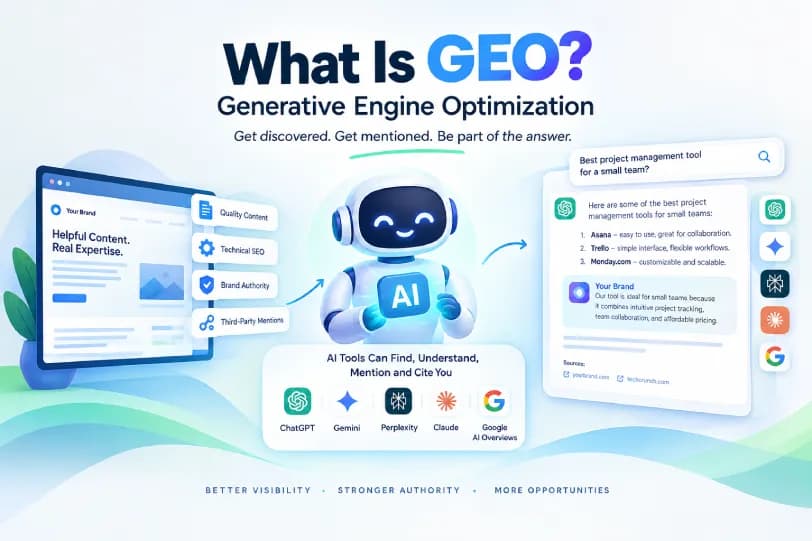
GEO stands for Generative Engine Optimization. It is the practice of shaping your content, brand presence, and website so AI tools such as ChatGPT, Gemini, Perplexity, Claude, and Google AI Overviews can find, understand, mention, and cite you in the answers they generate. Where SEO aims to rank a page in a list of links, GEO aims to make your brand part of the answer itself.
Table of contents13 sections
What Is Generative Engine Optimization (GEO)?
GEO Definition in Digital Marketing
In digital marketing, GEO is the work of improving how often and how accurately your brand appears in AI-generated answers. It covers on-page content, off-site mentions, technical accessibility, and brand clarity. The target is visibility inside the response, not only a position on a results page.
What Does GEO Stand For?
GEO stands for Generative Engine Optimization. A "generative engine" is any search tool that writes a response from multiple sources instead of simply listing links.
GEO Explained in Simple Terms
Imagine someone asks an AI assistant for the best project management tool for a small team. The assistant names a few products and explains why. GEO is everything you do so your product is one of those names, described correctly.
GEO vs. Geography: Clarifying the Term
Search results for this term are messy because "geo" means many things. People also look up geo fencing, geo targeting, geo blocking, geo location, geo tagging, geo politics, geo engineering, and even Nat Geo channel listings. Those relate to location or earth science. GEO in this guide has nothing to do with maps or physical places.
Where the Term GEO Comes From
The term gained traction after researchers published a 2023 paper on optimizing content for generative engines. Marketers adopted it as AI search tools grew, and the label stuck.
What Is the Main Goal of GEO?
The main goal is to be included, cited, and represented accurately when AI systems answer questions in your field. Traffic matters, but so does being described correctly to people who never click.
How Does GEO Work?
How AI Search Engines and Generative Engines Generate Answers
Large language models generate text based on patterns learned in training. Many AI search tools also retrieve fresh web content at the moment of the question, then summarize it. This combination of retrieval and generation is why current, well-structured content has a real chance of being used.
How AI Systems Discover and Retrieve Content
These systems rely on crawlers, search indexes, and partner data sources. If a page is blocked, hidden behind scripts, or poorly linked, it may never enter the pool of sources an AI can draw from.
There is a second layer that many marketers miss. Retrieval systems often work at the passage level, not the page level. A long article is typically split into smaller chunks, and the system pulls the chunks that best match the question. So a single well-written section can be used even when the rest of the page is never touched. The reverse is also true. A strong page with vague, rambling sections may lose out to a shorter page whose sections each answer one question cleanly.
Context still matters, though. A passage that says "it costs more than the alternative" means nothing once it is pulled out of the page. A passage that names the product, the alternative, and the reason can stand on its own.
How AI Engines Select and Cite Sources
Engines tend to favor pages that answer the question clearly, come from credible sites, and agree with other trusted sources. Nobody outside these companies knows the exact formula, so treat any claim of a guaranteed method with suspicion.
It also helps to separate two things that look similar. A source can influence an answer without being shown, and a source can be linked without shaping much of the wording. Some tools display a handful of links under the answer, while the model may have read many more pages. Others show no links at all and simply describe brands from what they have learned or retrieved. Therefore, a missing link does not prove you had no influence, and a visible link does not prove you drove the answer. Treat influence, brand mentions, and visible citations as three related but different signals.
Key Factors That Influence AI Visibility
Several signals appear consistently in practice:
- Clear, direct answers to specific questions
- Strong topical expertise across a site
- Mentions of your brand on trusted third-party sites
- Fresh, accurate information where the topic demands it
- A clearly defined brand identity
- Technical accessibility for crawlers
How AI Uses Information From Multiple Sources
An AI answer is usually a blend. It may pull a definition from one site, a statistic from another, and a recommendation from a review roundup. That is why what others say about you often matters as much as what you say about yourself.
How AI Citation and Visibility Are Measured
Measurement is still maturing. Teams usually run a fixed set of prompts, record whether their brand appears, note which sources are cited, and track changes over time. Later sections explain how to keep those tests fair.
GEO vs. SEO vs. AEO: Key Differences
What Is Search Engine Optimization (SEO)?
SEO is the practice of improving a website so it ranks well in traditional search results. It covers keywords, content quality, technical health, and backlinks.
What Is Answer Engine Optimization (AEO)?
AEO, or Answer Engine Optimization, focuses on being the direct answer to a question, such as in featured snippets, voice assistants, and answer boxes. AEO stands for the same idea whether you see it written as AEO or answer engine optimization.
GEO vs. Traditional SEO
SEO competes for ranked positions and clicks. GEO competes for inclusion in a generated answer. SEO leans heavily on your own site, while GEO also depends on how the wider web talks about you.
GEO vs. AEO
The two overlap heavily. AEO traditionally targets a single, concise answer. GEO is broader, because generative tools blend many sources and often mention several brands at once.
What GEO, SEO, and AEO Have in Common
All three reward helpful, accurate, well-organized content written for real people. They also share a dependence on technical accessibility and on trust signals.
How SEO and GEO Work Together
Strong SEO gets your pages crawled, indexed, and trusted. GEO builds on that by making the content easy to extract and by strengthening your reputation beyond your own domain. For a deeper understanding of **search engine optimization** (SEO), explore our beginner’s guide to SEO.
Why GEO Is Not Replacing SEO
Many AI tools still rely on search indexes to find sources, and people still use traditional search heavily. GEO extends SEO. It does not replace it.
Example of Combining SEO and GEO
Say you publish a guide on choosing a CRM. SEO work ensures it targets the right keywords and loads quickly. GEO work adds a short, direct answer near the top, a comparison table, and original data, then earns mentions in industry roundups.
Why GEO Matters for Businesses and Marketers
The Shift From Search Visibility to AI Visibility
Visibility used to mean ranking on page one. Now it also means being named inside a summary that the user may read without ever scrolling to the links.
Benefits of Generative Engine Optimization
Done well, GEO can increase brand exposure, bring more qualified visitors, and improve how you are described. It also pushes you to write clearer, more useful content, which helps every channel.
Building Brand Authority, Trust, and Credibility
When an AI repeatedly names a brand as a reliable source, people tend to trust it. Authority comes from consistent expertise, original insight, and credible mentions elsewhere.
GEO's Role in Reputation Management
AI tools summarize what exists about you online, including reviews, news, forums, and old articles. If outdated or negative content dominates, the summary reflects it. GEO-minded reputation work means publishing accurate information, correcting errors, and earning positive coverage so the sources AI reads present a fair picture.
It also means checking for confusion. If another company shares your name, or an old product name still circulates, an AI tool may mix up the two and attribute the wrong reviews or claims to you. Catching that early is part of protecting your reputation.
How AI Search Influences Customer Research and Purchase Decisions
Buyers increasingly ask AI tools to compare options and shortlist vendors. If you are absent from those answers, you may be eliminated before you ever get a visit.
Zero-Click Searches and the Changing Customer Journey
Many questions are now answered on the results page itself. Fewer clicks do not mean less influence, but they do mean your brand must make an impression within the answer.
Competitive Advantage Through GEO
Plenty of companies have not started yet. Early, steady effort can give you an edge in how AI describes your category.
Can Small Businesses Benefit From GEO?
Yes. A local or niche business with clear, specific expertise can be a strong source on narrow topics. Detailed answers, consistent business information, and genuine reviews go a long way.
How to Build a Successful GEO Strategy
Research Customer Queries, Prompts, and Search Intent
Start with how customers actually ask questions. Sales calls, support tickets, and community threads reveal the real wording better than keyword tools alone.
Analyze Competitors Appearing in AI-Generated Answers
Run your key prompts in several AI tools and note which brands appear. Look at why they were chosen and what sources were cited.
Identify Relevant Topics and User Questions
List the questions your audience asks at each stage, from basic definitions to comparison and purchase questions. Group them by topic so you can cover each one thoroughly.
Create High-Quality, Original, and Helpful Content
AI tools have little reason to cite content that repeats what everyone else says. Add real experience, original examples, and clear opinions.
Use Conversational Language and Question-Based Keywords
People type and speak to AI the way they talk. Headings phrased as questions, written in plain language, match that behavior.
Answer User Questions Clearly and Directly
Put the answer first, then explain. A two or three sentence direct response under a question heading is easy for both readers and machines to use.
Structure Content With Clear Headings, Lists, and Tables
Logical headings, short lists, and comparison tables make a page easier to scan and to summarize. Do not overdo it, though. Structure should serve the reader.
Make Content Easy for AI to Extract and Summarize
Because retrieval often works on passages, write each section so it can survive on its own. Keep paragraphs focused on one idea, define terms where they first appear, and name the subject instead of leaning on words like "it" or "this." Put the key fact in the first sentence or two under each heading.
A quick test helps. Copy any section into a blank document. If a stranger could still understand what it describes and why it matters, the passage is extractable. If not, add the missing context.
Support Claims With Original Research, Statistics, and Examples
Specific data and cited sources make a claim more useful and more quotable. Original research is especially valuable because it cannot be found elsewhere.
Demonstrate Experience, Expertise, Authority, and Trust
Show who wrote the content, why they are qualified, and where the information comes from. Author bios, credentials, and transparent sourcing support EEAT.
Earn Brand Mentions and Citations Across the Web
Digital PR, expert commentary, partnerships, and industry publications all create the third-party mentions AI systems tend to rely on. This is where PR and GEO overlap most.
Maintain Consistent Brand Information Across Platforms
Your name, description, pricing, and contact details should match everywhere. Conflicting information makes it harder for AI to describe you correctly.
Consistency is only half of the job. The other half is disambiguation, which means making it obvious which entity you are. If your brand name is common, shared with another company, or easily confused with a product or a person, AI systems may blend them together. Use the same full name, a one-line description of what you do, and your location or industry wherever you appear. Link your website to your official profiles, and describe how your products, leaders, and services relate to the company. These relationships help AI tools connect the right expertise to the right brand.
Keep Content Accurate and Up to Date
Review key pages regularly and update statistics, product details, and screenshots. Stale content is a quiet reason pages get passed over.
That said, freshness does not matter equally everywhere. For pricing, software features, regulations, and "best of" lists, recent information is often essential. For settled topics, such as a historical event or a basic concept, an established and well-cited page may carry more weight than a freshly edited one. Updating a page just to change its date adds little. Update when something real has changed, and leave stable, reliable pages alone.
Use Relevant Images, Videos, and Interactive Content
Visuals help people understand and trust your content. Add descriptive alt text and transcripts so the meaning is accessible to machines too.
Technical SEO and Website Optimization for GEO
Ensure Search Engines and AI Crawlers Can Access Your Website
If a crawler cannot reach a page, it cannot use it. Confirm that important pages return proper status codes and are linked internally.
It also helps to know that "AI crawler" covers several different jobs. Training crawlers collect content to help build or improve models. Search or retrieval crawlers build the indexes that power live answers with links. User-triggered fetchers visit a specific page when a person asks the tool to read it. Many AI companies publish separate names for each, so a choice about one does not automatically apply to the others.
Check Robots.txt, Crawling, and Indexing
Review your robots.txt file to make sure you are not blocking crawlers you actually want. Then check indexing in Google Search Console.
This is where the distinction above becomes practical. Allowing AI training and allowing live search visibility are separate decisions. You might block a training crawler while still allowing a search crawler, so your pages can appear in cited answers without being used for model training. Be careful with the reverse, since blocking a search crawler can reduce your chances of being linked in that tool's answers. For Google, regular Googlebot access governs Search and AI Overviews, while the separate Google-Extended control relates to certain Gemini uses. Crawler names and policies change, so confirm them in each company's official documentation before editing your file.
Make Important Content Accessible Without JavaScript Rendering Issues
Some crawlers do not execute JavaScript well. Key content should be present in the HTML that loads first.
Use Structured Data and Schema Markup Appropriately
Schema markup describes your content in a standard format, covering organization details, articles, products, and FAQs. Use it accurately and only for content visible on the page.
Use Semantic HTML and a Clear Content Hierarchy
Proper heading order, lists, and tables give machines a clear map of your page. This also helps passage-level retrieval, because clear sections are easier to separate into meaningful chunks. It helps accessibility as well.
Improve Page Speed, Mobile Usability, and Accessibility
These basics support both user experience and crawling. A slow, hard-to-use page rarely earns trust from anyone.
Keep Brand Information Consistent Across Your Website and Structured Data
Your schema should match what your visible pages say. Organization markup can state your official name, logo, website, and profile links, which helps separate you from similarly named entities. Mismatches create confusion and weaken trust.
Is Structured Data Necessary for GEO?
Not strictly. Google has said no special markup is required to appear in AI Overviews, and structured data does not guarantee citations. It still helps clarify meaning and is good practice.
Does llms.txt Help With GEO?
The llms.txt idea proposes a file that guides AI systems to your key content. Adoption is limited, and major engines have not confirmed they rely on it. It is a low effort to try, but do not expect results from it alone.
What Does GEO Look Like in Practice? Examples and Implementation
A Practical Example of GEO in Action
Consider an accounting firm that serves freelancers. The walkthrough below is hypothetical, and the figures are illustrative, not real results. Its purpose is to show what a measurable GEO project records at each stage.
Baseline. The firm tests 25 freelancer tax prompts across ChatGPT, Gemini, Perplexity, and Google. Suppose its brand appears in 2 of the 25 answers and is never linked. Sentiment is neutral, and one tool confuses it with a similarly named firm in another city.
Changes. Over eight weeks, it publishes a plain-language tax guide with a direct answer under each question heading. It adds a comparison table, shares anonymized client findings as original data, and clarifies its name, location, and services across its site, schema, and business profiles. It also gets quoted in a business publication.
Testing period. It reruns the same 25 prompts every two weeks, using the same tools and settings, three runs each.
Measured outcome. Say the brand now appears in 9 of the 25 answers, the confusion with the other firm disappears, and new client inquiries mention "I saw you recommended by an AI tool." The exact numbers will differ for every business. What matters is that baseline, changes, test window, and results were all written down.
How to Improve a Blog Post for AI Citations
Open with a direct answer, break the topic into clear sections that each stand on their own, add a unique data point or example, and cite your sources. Then update the post when something genuinely changes.
Before and After: Making Content More Direct and Extractable
Before: "There are many considerations when thinking about email tools, and the right choice depends on lots of factors."
After: "The best email tool for a small business is one that offers automation, easy list management, and fair pricing. For most teams under 20 people, a simple platform beats an enterprise suite."
The second version states a clear answer that is easy to quote.
How to Test Your Content in ChatGPT, Gemini, Perplexity, and Google AI Overviews
Ask the questions your customers ask, using natural phrasing. Note whether you appear, how you are described, and which sources are cited. Repeat monthly, because answers vary.
To make the comparison fair, control the variables. Record the tool, model or version, and whether search mode was on. Note your location, language, and whether you were logged in, since personalization can change results. Run each prompt several times, because the same question can produce different answers minutes apart. Use a private session when you can, and keep the wording identical from one round to the next. Without these notes, you may mistake normal randomness for progress.
Analyze Competitor Citations and Content Gaps
If a competitor is cited for a topic you have not covered well, that is a gap. Study what makes their page useful, then create something better and more original.
A Step-by-Step GEO Implementation Workflow
- Build a list of priority prompts.
- Record your current AI visibility, with test settings noted.
- Fix technical access issues and crawler rules.
- Clarify your brand identity across your site and profiles.
- Rewrite or create content that answers each prompt directly in self-contained sections.
- Earn third-party mentions.
- Retest under the same conditions and refine.
Common GEO Mistakes to Avoid
The usual mistakes include chasing tricks, ignoring basic SEO, publishing thin AI-written content, blocking crawlers by accident, confusing training access with search access, and expecting overnight results.
Experiment, Measure, and Refine Your Strategy
Treat GEO as ongoing testing. Change one thing at a time, observe the result over several weeks, and keep what works. If you change five things at once, you will never know which one helped.
How to Measure GEO Performance
What Is AI Visibility?
AI visibility describes how often and how favorably your brand appears in AI-generated answers across relevant prompts.
Track AI Citations and Brand Mentions
Count how often AI tools link to your site and how often they name your brand without linking. Both matter. Keep in mind that a visible citation is only part of the picture, since a source can shape an answer without being displayed.
Measure Share of Voice in AI-Generated Answers
Share of voice compares your mentions with competitors across a fixed set of prompts. It shows whether you are gaining or losing ground.
Monitor Brand Sentiment and Context
Being mentioned is not enough. Check whether the tone is positive, neutral, or negative, and whether the facts are right. Also check that the answer is describing your brand and not a similarly named one.
Track Prompts and Queries That Mention Your Brand
Keep a log of which prompts lead to your brand and which do not. Patterns will show where your content is strong or missing.
Identify Which Pages and Sources AI Engines Cite
Note which of your pages get cited, and which outside sources shape answers about you. Those outside sources are often your best outreach targets.
Measure Referral Traffic and User Engagement
Look in your analytics for visits from AI platforms and compare engagement. Visitors arriving this way are often further along in their research.
Direct referrals only tell part of the story. Someone may see your brand in an AI answer, then search your name later, type your URL, or ask a colleague. Those visits show up as branded search or direct traffic, so GEO's influence can hide inside other channels. Useful signals include growth in branded searches, a rise in direct visits, and sales or intake forms that ask "How did you hear about us?" with an AI option. Review assisted conversions in your analytics too, not just last-click results.
Compare GEO Performance With Traditional SEO Metrics
Rankings, clicks, and impressions still matter. Compare them with AI visibility to see how the two channels support each other.
Benchmark Your AI Visibility Against Competitors
Run the same prompts for your main competitors and compare results regularly. A single snapshot says little, but a trend says a lot.
Challenges and Limitations of GEO Measurement
AI answers change from one session to the next, referral data can be incomplete, and personalization, location, and model updates all affect results. Attribution is also imperfect, since much of the influence is indirect. Therefore, treat numbers as directional, not exact.
GEO Tools and Resources for Tracking AI Visibility
AI Visibility and Citation Tracking Tools
A growing set of platforms, including Profound and Writesonic's GEO features, track brand mentions and citations across AI engines. Features and pricing change quickly, so test a few before committing. Check how each tool handles repeated runs, locations, and model versions, since that affects how reliable its numbers are.
Brand Mention and Reputation Monitoring Tools
Traditional monitoring tools remain useful for tracking news, reviews, and social conversation, which feed the sources AI reads.
Prompt Research and Competitor Analysis Tools
Some tools suggest prompts customers use and show which competitors appear. You can also do this manually with a spreadsheet and consistent prompts.
Resources for Understanding AI Search and Crawling
Google Search Central documentation and the official documentation from AI companies explain how their crawlers behave. These are more reliable than most opinion pieces.
How to Stay Updated on GEO Best Practices
Follow official documentation, reputable industry publications, and published research. Be wary of any source promising a secret formula.
Risks, Challenges, and Limitations of GEO
Why AI Citations and Brand Mentions Are Not Guaranteed
AI companies control their systems, and no tactic forces them to mention you. You can improve the odds, but not secure the outcome.
Why AI Search Visibility Can Fluctuate
Answers can change with model updates, new sources, personalization, or even phrasing. Short-term swings are normal.
Balancing AI Optimization With Human Readability
If content is written only for machines, readers notice. Always write for people first.
Risks of Keyword Stuffing and Over-Optimization
Repeating terms unnaturally hurt SEO years ago and does not help GEO either. Natural language works better.
Why GEO Best Practices Cannot Guarantee Rankings
Best practices raise the likelihood of visibility. They are not guarantees, and anyone who says otherwise is overselling.
Balancing GEO, SEO, and Other Marketing Channels
Do not abandon email, social, paid, or traditional SEO. A balanced mix is more resilient than any single channel.
The Future of GEO and AI Search
How AI Is Changing the Search Experience
Search is becoming more conversational, with follow-up questions and summarized answers. People are asking longer, more specific questions.
The Role of Google AI Overviews in GEO
Google AI Overviews and AI Mode show generated summaries with links to sources. Google has said that foundational SEO practices continue to apply for appearing in them.
How GEO Differs Across AI Search Platforms
Each platform pulls from different sources and behaves differently. Perplexity shows citations prominently, while ChatGPT and Gemini vary by mode. Test each one separately.
Emerging GEO Trends and Industry Developments
Expect better measurement tools, more focus on original research, and growing attention to brand sentiment inside AI answers. Entity clarity and passage-level quality are likely to matter more as retrieval improves.
How GEO and Traditional SEO May Evolve Together
The two will likely merge into one broader discipline of search visibility, with the same foundations of quality and trust.
How Marketers Can Prepare for the Future of AI Search
Invest in original expertise, keep your technical foundation strong, build a reputation across the web, and keep testing. Those habits hold up whatever platforms emerge.
Conclusion
GEO exists because people now get answers from AI tools, and brands want to be part of those answers. It does not replace SEO. It sits on top of it, adding a stronger focus on clarity, original expertise, and reputation across the web. To get started, check that the right crawlers can reach your site, write direct answers in sections that stand on their own, make your brand identity unmistakable, and earn credible mentions elsewhere. Then test your visibility under consistent conditions and look beyond direct clicks when judging results. Progress is rarely instant, but steady, honest effort tends to pay off.
Frequently Asked Questions About GEO
What Is GEO in Simple Terms?
GEO is the practice of making your content and brand easy for AI tools to find, trust, and mention in their answers.
What Does GEO Stand for in Marketing?
In marketing, GEO stands for Generative Engine Optimization.
Is GEO Replacing SEO?
No. GEO builds on SEO, and many AI tools still depend on search indexes.
How Is GEO Different From SEO and AEO?
SEO targets rankings, AEO targets direct answers, and GEO targets inclusion in AI-generated responses that blend multiple sources.
How Does Generative Engine Optimization Work?
AI tools retrieve and summarize content, often at the passage level. GEO improves your chances by making content clear, credible, accessible, and widely referenced.
What Are the Benefits of GEO?
Benefits include greater brand visibility, stronger authority, more qualified visitors, and better control over how AI describes you.
How Can I Optimize My Website for GEO?
Ensure crawlers can access your pages, answer questions directly, use clear structure, keep information current, and build mentions elsewhere.
How Can I Make My Content More Likely to Be Cited by AI?
Publish original, specific, well-sourced content with a direct answer near the top and self-contained sections, and keep it updated when facts change.
Do I Need Structured Data for GEO?
It is not required, but it helps clarify your content and brand details.
How Can I Check Whether AI Chatbots Mention My Brand?
Ask relevant questions in ChatGPT, Gemini, Perplexity, and Google, then record whether your brand appears and how it is described. Keep your settings and wording consistent and repeat each prompt a few times.
How Do I Measure GEO Performance?
Track citations, mentions, share of voice, sentiment, and referral traffic over time. Add branded search growth and assisted conversions to capture indirect impact.
What Are the Best GEO Tools?
It depends on your needs and budget. Evaluate a few tracking platforms against your priority prompts before choosing.
Can Small Businesses Use GEO?
Yes. Focused expertise and consistent information can help smaller brands compete in specific topics.
What Are the Risks and Limitations of GEO?
Results are not guaranteed, visibility fluctuates, and measurement is imperfect.
Can GEO Guarantee That AI Will Mention My Brand?
No. It improves your chances but cannot guarantee any specific outcome.
What Are Google AI Overviews, and How Do They Relate to GEO?
AI Overviews are AI-generated summaries at the top of some Google results. GEO helps your content become a source they draw from.
How Can I Optimize Content for ChatGPT, Gemini, and Perplexity?
Use clear answers, credible sourcing, and strong third-party presence, then test each platform since their behavior differs.
Is GEO the Same as Geographic Targeting?
No. Geographic targeting, such as geo targeting or geo fencing, relates to location-based marketing. GEO here refers to Generative Engine Optimization.