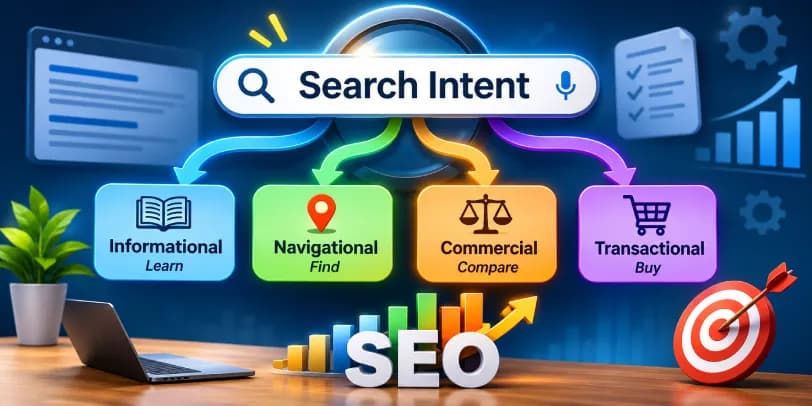
Search intent is the reason behind a search query: what the person actually wants when they type or speak something into a search engine. In SEO, it tells you whether someone wants to learn something, find a specific website, compare options, or buy. Understanding search intent is an important part of effective search engine optimization, as it helps you create content that matches what people are looking for. The four main types of search intent are informational, navigational, commercial, and transactional. Matching your content to the right one is one of the most reliable ways to earn and keep rankings.
Table of contents14 sections
What Is Search Intent? (Definition & Meaning)
Search Intent Definition Explained Simply
Every search starts with a goal. Someone who types "fiddle leaf fig brown leaves" wants a fix, not a history of the plant. Someone who types "buy chia seeds" wants a product page with a price. Search intent, also called keyword intent, is simply that goal, read from the words a person uses and the context around them.
It helps to separate three things that often get blurred together. The first is the literal meaning of the query, which is just what the words say. The second is the task behind it, which is what the person is trying to get done. The third is context, which changes what the searcher expects to see. Take "jaguar speed." Literally, it is two words. The task might be finding how fast the animal runs or how fast the car goes. Context, such as recent searches or the device in use, nudges which one Google assumes. Reading intent well means looking past the words to the task.
Search engines exist to satisfy that task. When your page delivers what the searcher was after, Google has a reason to show it. When it doesn't, no amount of keyword placement will save it.
Search Intent vs. User Intent: Are They the Same?
Mostly, yes. People use "user intent" and "search intent" interchangeably, and in everyday SEO work the difference is small. If you want to be precise, user intent is the broader idea of what a person wants to achieve, on any platform. Search intent is that same motivation expressed through a search query. A person might have user intent to redecorate a living room, and the search intent is "best sofa for small spaces."
How Google Understands Search Intent Through Semantic Search
Google no longer matches only exact words. Through semantic search, it interprets meaning, related entities, and context. If you search "apple," Google looks at your history, location, and the phrasing of your query to decide whether you mean the fruit or the company. Natural language processing lets it connect "cheap flights" with "budget airfares" and understand they carry the same goal.
For writers, this means covering a topic thoroughly with related terms and subtopics matters more than repeating one phrase.
Google's Search Intent Classifications: Know, Do, Website and Visit-in-Person
Google's Search Quality Rater Guidelines describe four needs that overlap with the familiar four types. A Know query seeks information. A Do query wants to accomplish something, like buying or downloading. A Website query aims to reach a particular site. A Visit-in-Person query looks for a nearby place. Search quality evaluators use these categories when judging whether a result is helpful, so they are worth understanding even if you work mostly with the SEO labels.
Why Search Intent Matters in SEO
How Search Intent Affects Rankings and SERP Positioning
Top-ranking pages on any results page tend to share a pattern. If the first page is full of how-to guides, a product page will rarely break in, however well optimized. Google has learned from user behavior what people prefer for that query, and it ranks accordingly. Intent alignment often decides who appears at all, before authority or links even enter the picture.
Search Intent and Google's Helpful Content Guidelines
Google's helpful content guidance asks a simple question: does this page leave the reader satisfied? Content written for people who arrive with a specific need, and that meets it, fits that principle naturally. Pages built mainly to catch traffic without answering the query tend to struggle.
How Search Intent Impacts Content Strategy and Conversions
Intent shapes what you publish and where it fits in your site. A blog post can attract learners, but it won't convert someone ready to buy. A product page won't attract someone still asking basic questions. When each page serves one clear purpose, visitors move forward more easily, and conversions follow.
What Happens When Content Doesn't Match Search Intent?
Visitors leave quickly, rankings slip, and the page often stalls on page two or three. I've seen well-written articles go nowhere simply because they targeted a transactional phrase with an essay. The content wasn't bad. It was answering a question nobody was asking at that moment.
The 4 Main Types of Search Intent (With Examples)
Before going through each type, one caution. These four labels are a useful way to think, but real queries don't always sit neatly inside them. A single keyword can fit more than one category, and two tools may label the same phrase differently. Treat the types as a starting point, then confirm them against what actually ranks.
Informational Intent: Users Looking to Learn
These searchers want knowledge. They are looking for information, explanations, or step-by-step instructions, and they are not ready to buy.
Informational Search Intent Examples
"What is search intent," "how to prune a fiddle leaf fig," and "why is the sky blue" are all informational queries. Many begin with what, how, why, or guide.
How to Optimize for Informational Intent
Answer the question early and clearly, then expand. Use descriptive headings, short paragraphs, and lists where steps matter. Adding a concise definition near the top improves your chances of earning featured snippets. Finally, link to deeper resources for readers who want more.
Navigational Intent: Users Searching for a Specific Site or Brand
Here, the person already knows where they want to go. They use search as a shortcut.
Navigational Search Intent Examples
"Facebook login," "Google Search Console," and "Semrush pricing page" are typical. The searcher wants a specific website or page, and a specific brand name usually gives it away.
How to Optimize for Navigational Intent
If the query is your brand, make sure your homepage and key pages rank well for it. Keep titles clear, set up a proper Google Business Profile where relevant, and make branded landing pages easy to find. You generally cannot, and should not try to, win navigational queries for other companies' brands.
Commercial Intent: Users Researching Before Buying
Commercial investigation sits between curiosity and purchase. The user is comparing options and weighing risks.
Commercial Search Intent Examples
"Best running shoes for flat feet," "Semrush vs Ahrefs," and "iPhone 16 review" all fit. Words like best, top, review, and versus are common signals.
How to Optimize for Commercial Intent
Offer honest comparisons, clear criteria, and real pros and cons. Show how you tested or evaluated products, because trust is the deciding factor here. Include comparison tables, and guide readers toward the next step without pushing too hard. Freshness matters too. A review of last year's model or a comparison with outdated pricing quickly loses credibility, so keep these pages current.
Transactional Intent: Users Ready to Take Action
These users want to complete an action: purchase, sign up, download, or book.
Transactional Search Intent Examples
"Buy Apple iPhone," "buy ghost pepper seeds," and "order chia seeds online" are classic transactional keywords. Terms like buy, order, coupon, and near me often appear.
How to Optimize for Transactional Intent
Make the path short. Use product pages or landing pages with a clear price, strong images, trust signals, and an obvious call to action. Remove anything that slows the visitor down, and make checkout simple. Accuracy counts as much as design here. Wrong prices or out-of-stock items shown as available frustrate buyers and can cost you the sale and the ranking.
Understanding Mixed and Advanced Search Intent
What Is Mixed Search Intent?
Some queries don't point in one direction. Mixed search intent means the searcher could want more than one thing, and Google's results reflect that by showing a blend of page types.
Mixed Search Intent Examples
"Ghost pepper" might bring up a Wikipedia entry, growing guides, hot sauce products, and recipes. Similarly, "fiddle leaf fig" can return care guides alongside shops selling the plant.
Primary vs. Secondary Search Intent
The primary intent is the main goal behind most searches for a query. Secondary intent covers a smaller group with a different goal. For example, "iPhone 16" is mostly commercial or transactional, but some people just want specifications. A strong page serves the primary intent first and acknowledges the secondary one without losing focus.
This is where many pages go wrong. Trying to satisfy several intents at once can make a page feel confused. Combining informational and commercial content works when the support is light, such as a short buying guide section on a product category page, or a "which one should you pick" block at the end of a how-to article. It stops working when two purposes compete for the same space, for instance a 3,000-word tutorial wrapped around a checkout form. Visitors can't tell what the page is for, and neither can Google. If the secondary need deserves real depth, give it its own page and link the two. Decide on one clear primary purpose, then let everything else support it.
How to Identify Dominant Search Intent
Look at what Google rewards. If seven of the top ten results are listicles, that format reflects the dominant intent. Count the page types, check the SERP features, and let the pattern tell you what most searchers appear to want.
How Location, Device and Context Influence Search Intent
The same words can mean different things in different situations. "Pizza" on a phone at 7 p.m. almost certainly means delivery or a nearby restaurant. On a desktop at noon, it might mean recipes. Location, device, time, and past behavior all shape what Google shows.
This has a practical side for anyone analyzing results. Personalization means your SERP is not everyone's SERP. A search from Lahore can look different from the same search in London. Results can also differ between a logged-in browser with a long search history and a clean, logged-out session. So when you check a keyword, remember that you are seeing one version of the page. Use a private window, set the location where you can, and compare a few variations before drawing conclusions. Tools that pull results from a fixed location and device give a more consistent baseline than your own browser.
Local Search Intent and Location-Based Queries
Local search intent covers queries where proximity matters, such as "dentist near me" or "coffee shop open now." Results typically include a map pack, reviews, and business details. Accurate listings and consistent business information matter far more here than long articles.
How Search Intent Changes Over Time
Intent isn't fixed. A query like "election results" changes character as events unfold, and "best smartphone" shifts when new models launch. Products, seasons, and trends all move the target, which is why content that ranked well last year may need a fresh look.
Freshness also matters differently depending on the intent. For commercial queries, people expect current reviews and comparisons. For transactional queries, up-to-date prices and availability are part of the answer. For news-related informational queries, the newest information often wins outright. On the other hand, a page explaining how photosynthesis works rarely needs constant updates, and a stable, well-built guide can hold its place for years. The skill is knowing which kind of query you are dealing with. When the top results are all recently published or updated, treat that as a sign that freshness is part of the intent.
How to Identify and Analyze Search Intent
How to Analyze Top-Ranking Pages and SERP Features
The most dependable method is also the simplest: search your target keyword and study the first page. You are looking for repeated patterns across the top ranking pages. The three elements below come from the Three Cs framework explained later in this guide. Keep personalization in mind while you do this, and check the results more than once if the query is local or ambiguous.
Identify the Dominant Content Type and Format
Notice whether results are blog posts, product pages, category pages, tools, or videos. Then check the format: listicle, tutorial, comparison, or opinion piece. When most results look alike, that is your signal.
Analyze Featured Snippets, People Also Ask and Local Packs
Common SERP features reveal intent. A featured snippet suggests a direct informational answer. People Also Ask boxes show related questions you can cover. A local pack signals location-based intent, while shopping results point toward transactional intent.
Other features tell you just as much. A knowledge panel usually appears for well-known entities, often with navigational or quick-fact intent. Video results suggest people want to watch a process, such as a repair or a recipe. Image packs point to visual searches like design ideas or product appearance. Top Stories means the query is tied to current news. Discussions and forums show that searchers want real experiences and opinions, which is common for product problems and honest recommendations. AI-generated summaries suggest the query can be answered in a short synthesis. Each feature is a clue about the format Google believes will satisfy the search.
Identify the Dominant Content Angle
Look at how the winning pages position themselves. Are they aimed at beginners, written for experts, focused on price, or built around "fast" or "easy"? That angle is part of what searchers have shown they prefer.
Reading Keyword Modifiers That Signal Intent
Small words carry weight. "How to" and "what is" suggest learning. "Best" and "vs" suggest comparison. "Buy," "price," and "discount" suggest purchase. Brand names suggest navigation. Modifiers are a quick first filter, though always confirm them against the actual results.
Using Ahrefs, Semrush and Google Search Console to Identify Intent
Semrush labels keywords by intent type, and the Keyword Overview and Keyword Magic Tool make this easy to scan at scale. Ahrefs shows SERP overviews and parent topics that hint at what a query is really about. Google Search Console adds real data, showing which queries already bring people to your pages and how they perform. Enterprise platforms such as BrightEdge also analyze intent patterns across large keyword sets.
A word of caution on automated labels. They are estimates, not verdicts. Different tools may tag the same keyword differently, and many keywords legitimately carry more than one intent. Use the labels to sort a large list quickly, then check the live results for any keyword that matters. Human judgment is what confirms the real intent.
The Three Cs of Search Intent
The Three Cs give you a repeatable way to describe what searchers expect.
Content Type
This is the kind of page: blog post, product page, landing page, category page, or tool.
Content Format
This is how the information is organized, such as a how-to guide, list, review, comparison, or tutorial.
Content Angle
This is the hook or selling point, for instance "for beginners," "in 2026," "cheapest," or "step by step."
How to Identify Your Target Audience's Search Intent
Start with who your readers are and what problems they bring. Review customer questions, support tickets, sales calls, and on-site search data. Then compare those insights with search results. Real audience language often reveals intent better than any tool.
Search Intent and Keyword Research
Types of Keywords in SEO by Intent
Keywords divide into informational keywords, navigational keywords, commercial keywords, and transactional keywords. Sorting your list this way turns a pile of terms into a plan, because each group calls for a different type of page.
High-Intent Keywords vs. Low-Intent Keywords
High-intent keywords show a readiness to act, like "buy chia seeds online." Low-intent keywords show early curiosity, like "what are chia seeds." Neither is better. Low-intent terms build awareness and trust, while high-intent terms drive revenue.
How to Map Keywords to the Buyer's Journey
Search intent mapping connects each keyword to a stage: awareness, consideration, or decision. Informational queries usually fit awareness, commercial ones fit consideration, and transactional ones fit decision. Mapping them shows where your content has gaps.
The real value comes when those stages work together as a funnel rather than as separate piles of pages. Each stage needs its own landing page and its own call to action. An awareness article might offer a checklist or newsletter signup. A consideration page might invite readers to compare plans or read a case study. A decision page should offer a clear purchase or booking step. Internal links connect them, so a reader can move from a how-to guide to a comparison and then to a product page without hunting. Finally, remember that people rarely convert on the first visit. Measuring assisted conversions, not only last-click ones, shows how much your early informational content contributes to the sale.
How to Group Keywords by Search Intent
Group keywords that deserve the same page. If two queries return nearly identical results, one page can usually target both. If the results differ, they probably need separate pages. Checking the SERP, not just the wording, keeps you from mixing intents on a single URL.
For a handful of keywords, you can do this by hand. For thousands, you need a scalable method. SERP-based clustering compares the top-ranking URLs for each keyword and groups terms that share a meaningful number of the same results. Many tools use a similarity threshold, for example grouping keywords when three or four of the top ten URLs overlap. A lower threshold creates broader clusters, and a higher one creates tighter, more specific ones. Keywords that clear the threshold can share a page. Keywords that fall below it usually need their own. Treat the threshold as a setting to test rather than a fixed rule, and spot-check a few clusters by hand to make sure they make sense.
Grouping also protects you from cannibalization, which happens when several pages on your site target the same intent and compete for the same queries. Overlapping keywords alone are not a problem. Two pages can mention similar terms and still serve different purposes, such as a beginner's guide and a buying guide. The real warning sign is two pages answering the same question for the same audience, with rankings swapping between them in Google Search Console. When that happens, consolidate by merging the weaker page into the stronger one with a redirect. When the intents truly differ, keep separate URLs and make the distinction obvious in titles, headings, and internal links.
How Search Intent Relates to Keyword Volume and Difficulty
High volume doesn't guarantee valuable traffic. A smaller transactional query can outperform a larger informational one when conversions matter. Difficulty also varies by intent, since competitive commercial terms often attract strong brands. Balance all three before choosing targets.
How to Optimize Content for Search Intent
Matching Content Format and Angle to Search Intent
Once you know what the SERP rewards, build the same type of page with a stronger angle. If top results are step-by-step guides, write a better one rather than an essay. Matching the pattern doesn't mean copying; it means meeting expectations and then adding something useful.
Aligning On-Page Elements With Search Intent
Every visible element should reflect the goal of the page.
Optimizing Title Tags and Meta Descriptions
Make titles clear and specific, and let the meta description promise exactly what the page delivers. If the intent is commercial, signal that comparison is inside. Misleading titles can win clicks but lose trust.
Optimizing Headings, Introductions and CTAs
Use headings that mirror the questions people ask. Open with the answer rather than a long preamble. Choose a call to action that suits the stage: "learn more" for informational pages, "compare plans" for commercial ones, "buy now" for transactional ones.
How to Satisfy the Full Intent Behind a Search Query
A person asking one question often has three more behind it. Someone searching "how to start a blog" will probably need hosting, a platform choice, and a content plan. Covering these related questions, ideally informed by People Also Ask, helps your page feel complete.
Improving Content Readability and User Experience
Short paragraphs, clean layout, fast loading, and mobile-friendly design all help visitors find answers quickly. Good content that is hard to read still loses to a simpler page.
Using Internal Links to Support Different Search Intents
Internal links guide readers to the next logical step. A guide can point to a comparison page, and a comparison page can lead to a product page. Descriptive anchor text keeps the journey clear for people and search engines.
Structured Data and Search Intent Optimization
Structured data helps search engines understand what a page contains. Product, FAQ, review, and local business markup can support rich results that align with the query's goal. It supports good content but never replaces it.
Common Search Intent Optimization Mistakes to Avoid
Targeting a transactional keyword with a blog post is the most common one. Others include ignoring the SERP, mixing several intents on one page, letting similar pages compete with each other, stuffing keywords, and never revisiting old content. Another is writing for tools rather than readers.
How to Perform a Search Intent Content Audit
How to Identify Search Intent Mismatches in Existing Content
List your key pages with their target keywords, then compare each against the current SERP. If your page is a guide and the results are product pages, you have found a mismatch. Pages with high impressions but low clicks or engagement are good places to start. Also look for pairs of pages that rank for the same queries, since they may be competing rather than helping each other.
How to Perform a Competitor Content Gap Analysis
Compare your coverage with competitors ranking for the same topics. Tools like Ahrefs and Semrush show keywords they rank for that you don't. Those gaps point to content you could create or improve.
How to Find Missing Subtopics in Top-Ranking Pages
Read the top results and note the subtopics they share. If most of them cover a point your page skips, that omission may be holding you back. Adding it often helps more than rewriting everything.
How to Update Existing Content to Better Match Search Intent
Adjust the format, rewrite the introduction to answer faster, add missing sections, and refresh outdated details. In some cases the better move is a new page for a different intent rather than stretching one page too far.
How to Measure Search Intent Optimization Success
Tracking Search Performance With Google Search Console
Watch impressions, clicks, average position, and the queries driving each page. A page that begins ranking for the right queries, with improving click-through rate, is usually moving in the right direction.
Keep zero-click searches in mind when reading these numbers. Many queries are answered directly on the results page through featured snippets, knowledge panels, or AI summaries, so a person gets what they need without visiting any site. As a result, impressions can rise while clicks stay flat, and that doesn't always mean your content is failing. Ranking visibility and receiving clicks are two different outcomes. Looking at impressions, position, and click-through rate together gives a fairer picture of how your pages are really performing.
Analyzing Engagement and Conversions With Google Analytics
Look at engagement rate, time on page, and conversions. If visitors arrive and take the intended action, intent alignment is working. If they leave right away, revisit the page. Check assisted conversions as well. An informational article may never be the last click before a sale, yet it may start many of the journeys that end in one.
Understanding Post-Click User Behavior
What people do after landing matters. Scroll depth, return visits to the results page, and exits all hint at whether the page satisfied them. Heatmaps and session recordings can add useful detail.
Monitoring SERP Changes and Intent Shifts
Check your main keywords periodically. New SERP features, different page types, or fresh competitors can signal that the dominant intent has shifted.
Search Intent Examples Across Different Industries
E-commerce Search Intent Examples
"Best running shoes" is commercial and fits a buying guide. "Nike Pegasus size 10" is transactional and fits a product page. "How to clean running shoes" is informational and fits a blog post.
Local Business Search Intent Examples
"Plumber near me" and "emergency dentist open now" signal immediate need. Strong local listings, reviews, and clear contact details matter most.
Search Intent Examples for SaaS and Service Businesses
"What is project management software" is informational. "Asana vs Trello" is commercial. "Asana free trial" is transactional. A good SaaS site has a page ready for each.
Search Intent Examples for Blogs and Informational Websites
"How to grow ghost peppers" suits a tutorial. "Ghost pepper seeds" may suit a resource page or a shop link. A blog benefits from understanding which of its articles can gently lead to products or newsletters.
Search Intent in AI Search and Emerging Search Trends
How AI Search Changes User Intent
People now ask longer, more conversational questions and expect direct answers. Generative search intent is often more complex, combining several needs in a single prompt. Content that answers clearly and covers related questions fits this behavior well.
Search Intent in Google AI Overviews and AI Search Tools
AI Overviews summarize information at the top of the results, which can reduce clicks for simple informational queries. This is part of the wider zero-click trend, where the search is satisfied on the results page itself. For quick facts and definitions, expect fewer visits. For complex, comparison-heavy, or decision-driven queries, people still click through to get depth and make up their minds. Pages that offer original insight, clear structure, and trustworthy detail are more likely to be cited. Advertising is changing too, with intent-based advertising beyond search now using signals from browsing and context rather than only queries.
Voice Search and Conversational Search Intent
Voice queries sound like questions people would ask a friend. Concise answers, natural phrasing, and FAQ-style sections make content easier to surface for these searches.
Search Intent Tools and Practical Applications
Using Ahrefs to Analyze Search Intent and Content Gaps
Enter a keyword into Ahrefs and review the SERP overview, top pages, and parent topic. Use Content Gap to see what competitors cover that you don't.
Using Semrush to Identify Keyword Intent
Semrush's Keyword Overview displays intent labels, and the Keyword Magic Tool lets you filter lists by intent type. It is a quick way to separate informational keywords from transactional ones in a large list. As noted earlier, treat the labels as a first pass and confirm them in the live results.
Using Mangools KWFinder and Seobility for Intent Research
KWFinder offers a straightforward view of SERP competition, while Seobility helps with on-page checks. Both suit smaller sites that want simple workflows.
Using AI Tools to Support Search Intent Analysis
AI tools can summarize top results and suggest related questions. Treat their output as a starting point and always verify against the live SERP.
Conclusion
Search intent is the reason behind every query, and it decides which pages deserve to rank. Identify the intent, check the SERP, match the content type, format, and angle, and then measure the results. Revisit your pages regularly, since what people want from a query can change. Do that consistently, and your content will serve readers better and perform better in search.
Frequently Asked Questions About Search Intent
What are the 4 types of search intent?
Informational, navigational, commercial, and transactional.
How do you determine the search intent of a keyword?
Search the keyword, study the top results and SERP features, and read the modifiers in the query.
Can a keyword have more than one search intent?
Yes. Many queries have mixed intent, and Google often shows different page types for them.
Does search intent change over time?
It can. Trends, new products, and seasons all affect what people want.
What is the difference between commercial and transactional intent?
Commercial intent means researching before buying. Transactional intent means being ready to act now.
How does search intent affect SEO rankings?
Pages that match what searchers want tend to rank and retain positions more reliably.
What are high-intent keywords?
Keywords that suggest a readiness to buy or act, such as "buy," "order," or "pricing."
What are the three Cs of search intent?
Content type, content format, and content angle.
What is mixed search intent?
A query that could reflect more than one goal, so results blend different page types.
What is the difference between primary and secondary search intent?
Primary intent is the main goal behind most searches. Secondary intent is a smaller, different goal.
What are Google's Know, Do, Website and Visit-in-Person intents?
Categories in Google's quality rater guidelines describing wanting information, completing a task, reaching a site, or visiting a place.
What is the difference between search intent and keyword intent?
They are largely the same idea. Keyword intent applies the concept to individual terms in research.
How do you identify dominant search intent?
Look at which page types and formats appear most often among the top results.
What is local search intent?
A goal tied to a physical place, such as finding a nearby business or service.
How can you tell if your content matches search intent?
Compare it to the top results, then check engagement, rankings, and conversions.
How does search intent affect AI search results?
AI tools interpret the full intent behind a conversational query and favor clear, trustworthy, well-structured answers.
Can location and device change search intent?
Yes. The same query can mean different things depending on where and how someone searches, and personalized results mean one person's SERP may differ from another's.
What happens when content doesn't match search intent?
Visitors leave quickly, engagement drops, and rankings usually suffer.
How often should you review search intent?
Check important pages every few months, and sooner after major SERP changes.