Off-page SEO is everything you do outside your own website to improve its visibility, authority, and rankings in search engines. It includes link building, brand mentions, digital PR, social media marketing, reviews, and other signals that show Google other people trust your site. In short, on-page SEO tells search engines what your pages are about, and off-page SEO shows them whether anyone else thinks those pages deserve to rank.
Table of contents13 sections
What Is Off-Page SEO? Definition and Overview
Off-Page SEO Meaning Explained in Simple Terms
Think of off-page SEO, also called offsite SEO or off-page optimization, as your website's reputation. You can write the best page on a topic, but search engines still look for proof that real people and real websites value it. Backlinks, mentions, reviews, and shares are that proof.
Off-Page SEO vs. On-Page SEO vs. Technical SEO
These are the three pillars of SEO. On-page SEO covers what you control on the page: content, titles, headings, and internal links. Technical SEO covers how well search engines can crawl and index your site, including speed, structure, and mobile usability. Off-page SEO covers authority built elsewhere. Strong results usually need all three working together, because a well-linked page with poor content or a broken site structure will still struggle.
Why Off-Page SEO Matters for Search Engine Rankings
Search engines use external signals to separate trustworthy pages from the thousands of similar ones competing for the same query. Without them, rankings tend to stall even when the content is good.
How Off-Page SEO Can Increase Brand Awareness
Every mention, guest post, or interview puts your brand in front of people who have never visited your site. Over time, this leads to more branded searches, which is a healthy sign of trust.
How Off-Page SEO Can Support Organic Traffic
Better rankings bring more organic traffic, and quality links also send referral traffic directly from the pages that mention you.
How Off-Page SEO Can Contribute to Lead Generation and Sales
Visitors who arrive through a trusted recommendation tend to convert better than cold visitors. Authority also shortens the decision process, since people are more willing to contact a brand they have seen mentioned in several places.
What Is the Difference Between Off-Page SEO and Off-Site SEO?
In practice, nothing meaningful. Off-page SEO and off-site SEO are used interchangeably. Some people use "off-site" for activities that happen on other websites and "off-page" more broadly, but search engines treat both phrases as the same idea.
How Off-Page SEO Works
How Google Uses External Signals to Evaluate a Website
Google cannot judge quality from your content alone, so it looks at how the rest of the web treats you. Links from relevant sites, consistent brand mentions, reviews, and user behavior all help it estimate whether your site is credible.
The Role of Trust, Authority, and Credibility in Rankings
Trust builds slowly. A site that earns links from respected publications in its industry sends a much stronger signal than one with hundreds of links from unrelated directories. Credibility is about who vouches for you, not how many.
How Off-Page SEO Supports E-E-A-T
E-E-A-T stands for experience, expertise, authoritativeness, and trustworthiness. Your own content can claim all four, but off-page signals confirm them. When industry sites cite your research, journalists quote your team, and customers leave honest reviews, you are showing authority rather than just asserting it.
How Off-Page Signals Influence Domain Authority
Domain authority is a third-party metric from Moz, and tools like Ahrefs and Semrush offer similar scores. Google does not use them directly, but they estimate how strong a site's link profile is. Better off-page signals usually raise these scores, which is why they are a handy yardstick even though they are not ranking factors.
How Backlinks Influence PageRank and Search Visibility
PageRank was Google's original method of ranking pages by the links pointing to them. It has evolved a great deal, but links remain one of the clearest ways Google measures importance.
How Backlinks Can Pass PageRank
When a trusted page links to yours, it passes some of its authority along. The stronger and more relevant the linking page, the more value it tends to pass.
The History of Off-Page SEO and PageRank
Google's founders built PageRank on the idea that a link works like a vote. Early SEO took advantage by manufacturing links in bulk, which led to spam updates and a steady push toward quality, relevance, and natural link earning.
What Does Off-Page SEO Include?
Link Building and Backlinks
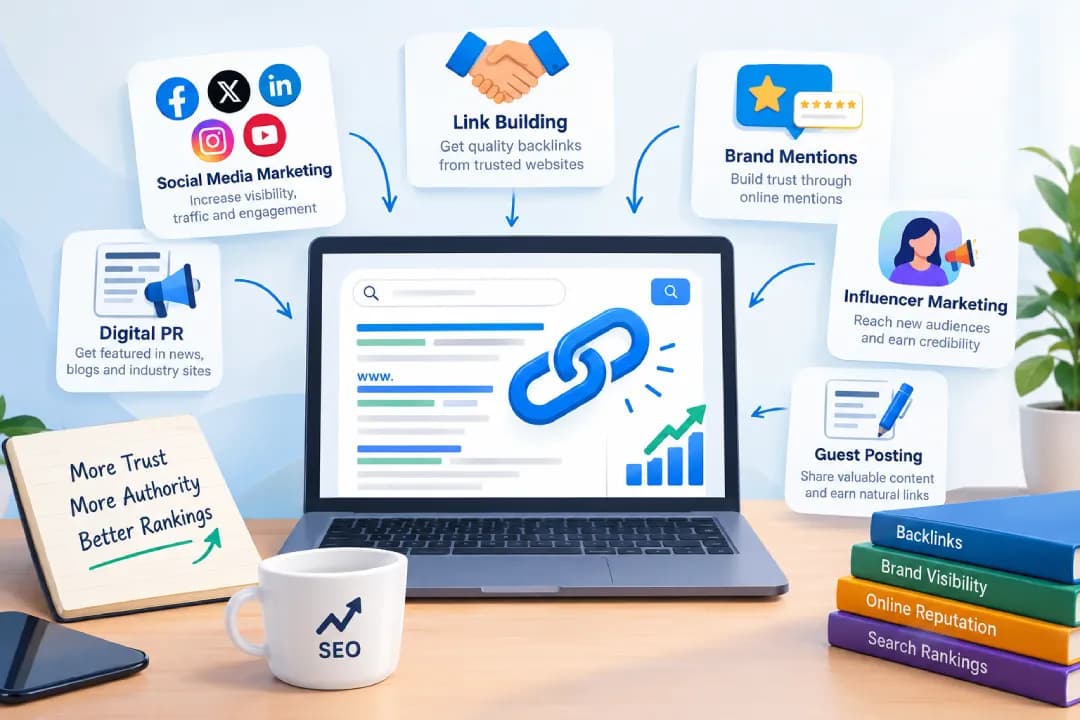
Link Building is the core of off-page SEO: earning links from other websites to yours. Everything else on this list tends to support it.
Social Media Marketing and Social Signals
Social shares are not a confirmed ranking factor. Still, social platforms help content get seen, and content that gets seen is more likely to earn links.
Brand Mentions and Digital PR
Digital PR means creating newsworthy stories, data, or commentary that publications want to cover. Even when a mention carries no link, it builds recognition and helps search engines connect your brand with your topic.
Influencer Marketing and Collaborations
Working with creators and industry voices extends your reach into audiences you could not easily reach alone.
YouTube Influencer Marketing
Video reviews and walkthroughs from trusted creators can drive referral traffic and branded searches, especially for products that benefit from demonstration.
Influencer Collaborations and Exclusive Promotions
Giving influencers an exclusive offer or early access gives them a reason to share your brand naturally, rather than posting a generic endorsement. If the collaboration is paid or you provide a free product, links should carry the appropriate attribute and the relationship should be disclosed.
Guest Posting and Article Marketing
Writing useful articles for relevant sites in your industry earns exposure and, often, a contextual link. Quality matters far more than volume here. Google has specifically called out large-scale guest posting campaigns that push keyword-rich anchor text as a link scheme. The line is usually clear in practice. A genuine contribution gives the publication's readers something they would want, covers a topic you actually know, and links to you only where it helps the reader. A placement written mainly to carry a ranking link, repeated across dozens of sites with near-identical content, is the pattern that gets sites into trouble.
Local SEO: Google Business Profile, Citations, and Local Listings
For local businesses, your Google Business Profile, consistent name, address, and phone number (NAP) across directory listings, and local citations all feed into local pack results.
Online Reviews and Reputation Management
Reviews act as trust signals for both people and algorithms. Responding to them professionally matters as much as collecting them.
Reputation work is broader than your Google profile. Customers also talk about you on industry review sites, marketplaces, social platforms, and forums, so it helps to monitor the places that matter in your niche, set up brand alerts, and check them regularly. When a negative review appears, reply calmly, acknowledge the problem, and offer a way to resolve it offline. Future customers read those replies as closely as the review itself. If a review looks fake, abusive, or off-topic, flag it through the platform's reporting process and keep a record of why you believe it violates their policies. Do not retaliate or post your own fake reviews.
It also helps to keep expectations realistic. Strong reputation management builds customer trust and can improve conversion rates and local visibility. Google has not confirmed that review sentiment elsewhere on the web is a direct ranking signal for standard organic results, so treat it as a business and trust benefit first.
Content Marketing and Blogging as an Off-Page Strategy
Publishing helpful content gives others something worth linking to. Content marketing becomes off-page SEO when you actively get it in front of people who will reference it.
Forum Participation, Q\&A Sites, and Community Engagement
Answering questions on forums and Q\&A sites builds visibility and goodwill. The rule is simple: contribute first, mention your brand only where it truly helps.
Content Promotion and Earned Media
Earned media is coverage you did not pay for, such as press features, podcast invitations, and citations. Promotion is how good content finds those opportunities instead of waiting for them.
Events, Sponsorships, and Strategic Partnerships
Sponsoring a local event or partnering with a complementary brand often produces relevant links, mentions, and relationships that are hard to get any other way.
Off-Page SEO Techniques and Strategies: A Practical Guide
How to Build High-Quality Backlinks
Quality backlinks come from relevant, trusted sites that link to you for a reason. Several methods work, and the best campaigns usually combine them inside one repeatable process.
A typical campaign starts with a goal and a short list of pages that deserve links, usually pages that already convert or could rank with more authority. Next comes finding and qualifying prospects, then writing personalized outreach and following up at sensible intervals. Throughout, keep a simple record of who you contacted, who replied, which placements went live, the link attributes, and what each placement cost in time or money. After a few months, that record shows which methods earn links and which only consume hours. Without it, you are guessing.
Natural, Editorial, and Outreach-Based Backlinks
Natural links happen when people discover and cite your content on their own. Editorial links come from writers who choose to reference you. Outreach-based links come from you contacting a site and making a case. Good content makes all three easier.
Guest Posting Outreach
Pick sites your audience actually reads, pitch specific topics rather than generic ones, and write something you would be proud to publish on your own site.
Expect rejections. Most publishers decline because the pitch was generic, the topic overlapped with existing content, or the sender clearly had not read the site. Study the site's editorial guidelines, tailor each pitch, and send one polite follow-up after about a week rather than a chain of reminders. Once a piece is accepted, check publication requirements, confirm the link attribute is what you agreed, and verify after publication that the link is live and points to the right page.
Broken Link Building
Find broken links on relevant pages, then politely suggest your own content as a replacement. It helps the site owner fix a problem, which is why it tends to get better responses.
Digital PR and Media Outreach
Pitch journalists stories backed by original data, expert views, or timely angles. Generic press releases rarely get attention.
Journalist Requests and Expert Commentary (HARO-Style Outreach)
Responding quickly to journalist queries with clear, specific expertise can earn authoritative mentions and links from publications that are otherwise hard to reach.
Link Reclamation: How to Recover Lost Backlinks
Links disappear when pages are deleted, redesigned, or redirected incorrectly. Track them, find out why they were lost, and either restore the page, add a redirect, or contact the site owner.
How to Find and Convert Unlinked Brand Mentions
Search for your brand name and find mentions without links. A short, friendly message asking the author to link the mention is often all it takes.
How to Analyze Competitors' Backlink Profiles
Use a backlink tool to see who links to the sites outranking you. Look for patterns, such as which publications, resource pages, or content types attract links in your niche.
How to Identify Link-Building Opportunities
Compare your competitors' link sources with your own, look for resource pages and industry roundups, and note sites that regularly link to content like yours. Then qualify each prospect before you write a single email.
A high DR or DA score alone does not make a site worth pursuing. Check whether the site gets organic traffic that matches your audience, and whether both the site and the specific page are indexed. Look at its outbound links: a site that links out to unrelated casinos, loans, and supplements, or publishes sponsored posts on every topic, looks like a link farm. Finally, read a few articles. Real editorial standards, active readers, and topical relevance matter more than any third-party number.
How to Optimize Anchor Text Naturally
Let anchor text read like normal language. Mix branded, partial-match, and generic anchors, and avoid forcing exact-match keywords into every link.
How to Use Social Media Platforms to Support SEO
Building a Strong Social Media Presence
Complete your profiles, post consistently, and stay active on the platforms where your audience spends time.
Sharing High-Quality Content and Engaging With Users
Share content worth reading and respond to comments. Engagement keeps your brand visible and approachable.
Leveraging Social Media for Brand Awareness
Use social channels to reach new audiences, which often leads to branded searches and eventually links.
How to Set Up and Optimize a Google Business Profile
Claim your listing, verify it, choose accurate categories, and keep your address, phone number, hours, and photos current. Consistency with your website is essential.
How to Get Authentic Online Reviews
Ask satisfied customers after a positive experience, make the process simple with a direct link, and never offer incentives that break platform rules or fabricate feedback. Each platform has its own policies, so read them before running any review campaign. Asking every customer, not only the happy ones, keeps your profile honest and credible.
How to Identify and Fix Broken Links Pointing to Your Site
Check your backlink report for links pointing to error pages, then 301 redirect those URLs to the most relevant live page so the link value is not lost.
Content Promotion Strategies for Off-Page SEO
How to Create Link-Worthy Content
Original research, useful tools, clear guides, and strong opinions tend to attract links. Ask yourself whether another writer would have a reason to cite this page.
Content Repurposing for Wider Reach
Turn one strong piece into a video, a slide deck, or a short thread. Each format reaches a different audience and creates new link opportunities.
Content Syndication and Canonicalization
Syndicating content on other platforms extends reach, but use a canonical tag pointing to the original so search engines know which version to rank.
Infographics, Images, and Visual Content for Link Building
Clear visuals are easy to embed and credit. Offer an embed code or ask for attribution so the usage turns into a link.
Webinars and Podcasts as Off-Page SEO Strategies
Hosting or appearing on webinars and podcasts earns mentions, backlinks from show notes, and exposure to engaged audiences.
How to Use Reddit, Quora, and Online Communities
Join conversations where you can add real value. Communities notice self-promotion quickly, so help first and link only when it is genuinely relevant.
How to Promote Content Through Media Outreach and Press Releases
Press releases work best for genuine news, such as launches, studies, or partnerships. Pair them with direct outreach to relevant journalists rather than relying on distribution alone.
Key Off-Page SEO Ranking Factors
Domain Authority and Website Authority
Authority reflects how trusted a site appears overall. Treat third-party scores as indicators, not goals.
Quality vs. Quantity of Backlinks
A few links from respected, relevant sites usually outperform dozens from weak ones.
Relevance of Linking Websites
A link from a site in your own industry carries more contextual meaning than one from an unrelated source.
Anchor Text Diversity
A varied anchor profile looks natural. Repeating the same exact-match phrase can look manipulative.
Referral Traffic and Social Signals
Links that send real visitors tend to be valuable. Social signals help content spread, even if they are not direct ranking factors.
Brand Signals and Online Presence
Branded searches, consistent mentions, and an active online presence all point to a real, established business.
Linking Page Quality and Link Context
A link inside a useful, well-trafficked article matters more than one buried in a footer or a thin page.
Follow vs. Nofollow Links and Their Roles
Follow links can pass authority, while nofollow, sponsored, and UGC attributes signal different relationships. Google treats them as hints. Paid placements and affiliate links should use rel="sponsored" or nofollow, and user-generated links belong under rel="ugc". A natural profile includes both types, and nofollow links still bring traffic and visibility.
Natural Link Profiles and Referring Domain Diversity
Links from many different domains look more organic than many links from only a few.
Common Off-Page SEO Mistakes to Avoid
Low-Quality or Spammy Backlinks
Links from irrelevant directories, link farms, and automated tools can do more harm than good. Still, not every poor link is a problem. Any site that has been online for a while collects random scraper and directory links it never asked for, and Google's systems are generally good at ignoring them. The ones to worry about are links you or an agency created through manipulative practices.
Over-Optimized Anchor Text
Too many exact-match anchors is a common footprint of manipulation.
Ignoring Brand Mentions and Unlinked Citations
Unlinked mentions are easy wins that many sites never follow up on.
Neglecting Local SEO Signals
Inconsistent business details or unmanaged reviews can hold back local visibility.
Buying Links and Using Manipulative Link Schemes
Google's spam policies clearly prohibit paid links that pass ranking value without proper attributes. Shortcuts like this can lead to lost rankings or manual actions.
The boundaries are worth spelling out. Excessive reciprocal link exchanges, where sites trade links mainly to inflate rankings, count as link schemes. So do large-scale guest posting campaigns built around ranking links, and paid editorial placements that pass authority without a sponsored or nofollow attribute. Sponsoring an event or paying for an advertorial is not wrong in itself. It becomes a problem when the link is meant to pass ranking credit and is presented as an organic endorsement. A useful test: would this link exist if search engines did not?
Building Irrelevant Links for Metrics Alone
Chasing high authority scores from unrelated sites adds numbers to a report without adding real value.
Off-Page SEO Best Practices
Building a Sustainable Link-Building Strategy
Plan for steady, repeatable work rather than occasional bursts. Consistency builds a profile that looks natural.
Prioritizing Authoritative, Relevant Websites
Choose fewer, better targets. Relevance and trust should drive every outreach list.
Combining Content Marketing with Outreach
Great content without outreach rarely gets noticed, and outreach without great content rarely gets answered.
Building Genuine Relationships With Publishers and Journalists
Treat editors as long-term contacts. Helpful, respectful communication leads to repeat coverage. Learn what each publication accepts, respect their timelines, avoid repeated nudges, and thank them when something goes live. Editors remember who made their job easier, and those relationships often produce better opportunities than any cold pitch.
Balancing Link Building With Brand-Building Activities
Links matter, but so do reviews, mentions, and recognition. A strong brand makes link building easier.
How AI and Machine Learning May Support Off-Page SEO Workflows
AI can speed up prospect research, outreach drafts, and backlink analysis. Human review is still needed for relevance, tone, and judgment.
Learning and Adapting to Changes in Search and SEO Practices
Search evolves constantly. Follow official Google guidance and trusted sources such as Moz, Backlinko, and Ahrefs, and adjust gradually.
Off-Page SEO Case Studies: Examples of Successful Campaigns
Look for case studies that show the full process: the goal, the tactics, and measurable outcomes such as referring domains, rankings, and traffic. These teach more than headline results alone.
How to Monitor and Measure Off-Page SEO Performance
Tools for Monitoring Backlinks and Referring Domains
Ahrefs, Semrush, Moz, and Google Search Console show who links to you and how that changes over time.
How to Evaluate Backlink Profile Quality
Review relevance, diversity, anchor text patterns, and the authority of linking sites. Disavowing should be rare. Google has said most sites never need the Disavow Links tool. It is appropriate mainly when you have a large number of artificial or spammy links that you cannot get removed, and you have received a manual action for unnatural links or believe one is likely.
It also helps to know the difference between the two kinds of penalty. A manual action appears in the Manual Actions report in Search Console and comes with a message. An algorithmic drop does not, and Google's systems usually just discount spammy links rather than punish you. Disavowing links indiscriminately can backfire, because you may remove links that were genuinely helping. Try removal requests first, and keep the disavow file limited to clear problems.
How to Monitor Referral Traffic and Brand Mentions
Check referral sources in analytics, and use alerts to track new mentions of your brand.
How to Measure Off-Page SEO ROI
Compare the cost of your efforts with the organic traffic, leads, and revenue they generate over a meaningful period. Record a baseline before a campaign starts, covering rankings, organic traffic, referring domains, and conversions for the target pages, then compare against it at regular intervals.
Be careful about attribution. Rankings often move after you acquire links, but content updates, technical fixes, seasonality, and algorithm updates may also be at work. That is correlation, not proof. Individual placements can be tracked more reliably through referral visits and conversions in analytics, whereas the ranking effect of any single backlink is very hard to isolate.
Tracking Organic Traffic, Leads, and Conversions
Look beyond rankings. Traffic that turns into inquiries or sales is the better measure of success. Use UTM parameters where you control the link, and set up conversion goals so referral visitors and organic visitors can be compared fairly.
How to Monitor Lost and Newly Acquired Backlinks
Review new and lost links regularly so you can respond quickly and recover value.
How Off-Page SEO Supports AI-Driven Search Visibility
How Brand Mentions and Trusted Citations May Support AI Visibility
AI search tools often draw on sources and brands that appear consistently across reputable sites. Trusted mentions and citations may increase the chance your brand is recognized and referenced.
Building a Consistent and Credible Brand Presence Across the Web
Keep your messaging, business details, and expertise consistent everywhere. A clear, credible presence helps both people and machines understand who you are.
Off-Page SEO Strategies for Different Business Types
Off-Page SEO for SaaS Companies
Focus on integration partners, comparison and review sites, original data, and thought leadership in industry publications.
Off-Page SEO for Local Businesses
Prioritize your Google Business Profile, local citations, reviews, and local sponsorships or partnerships.
Off-Page SEO for B2B Companies
Build authority through industry publications, expert commentary, case studies, and partnerships with relevant organizations.
Conclusion
Off-page SEO is about earning trust beyond your own website. Links, mentions, reviews, and relationships all tell search engines and people that your brand is worth paying attention to. Start with content people want to reference, qualify every prospect before you pitch, and measure progress through traffic and leads rather than vanity metrics. Done steadily, it strengthens everything else you do in SEO.
Frequently Asked Questions About Off-Page SEO
What Is Off-Page SEO in Simple Words?
It is the work you do outside your website to build trust and authority, mainly through links, mentions, and reviews.
What Is the Difference Between On-Page SEO and Off-Page SEO?
On-page SEO optimizes the content and structure of your own pages. Off-page SEO builds your reputation through external signals.
What Are the Main Types of Off-Page SEO Techniques?
The main ones are link building, guest posting, digital PR, social media marketing, influencer collaborations, local listings, and review management.
Is Link Building Still Important for Off-Page SEO?
Yes. Links remain one of the strongest authority signals, provided they are earned from relevant, trustworthy sources.
How Long Does Off-Page SEO Take to Show Results?
It varies by competition and starting authority, but most sites see meaningful movement over several months rather than weeks.
Can Social Media Marketing Really Impact SEO Rankings?
Not directly, as far as Google has said. Indirectly, it can increase visibility, traffic, and link opportunities.
What Is the Difference Between Off-Page SEO and Digital PR?
Digital PR is one tactic within off-page SEO. It focuses on earning media coverage, while off-page SEO covers a wider range of activities.
How Do I Check My Website's Off-Page SEO Performance?
Use backlink tools and Search Console to review referring domains, link quality, branded searches, and referral traffic.
What Is the Difference Between a Backlink and a Brand Mention?
A backlink is a clickable link to your site. A brand references your name without necessarily linking to it.
Can You Do Off-Page SEO Without Building Backlinks?
Yes, to a degree. Reviews, mentions, and brand-building all help, but backlinks usually remain central.
How Much Does Off-Page SEO Cost?
Costs vary widely depending on your niche, goals, and whether you hire an off-page SEO agency, freelancer, or manage it in-house. Be cautious of very cheap packages that promise fast results.
Does Domain Authority Directly Affect Google Rankings?
No. It is a third-party score, not a Google metric, though it often reflects the link strength that does influence rankings.