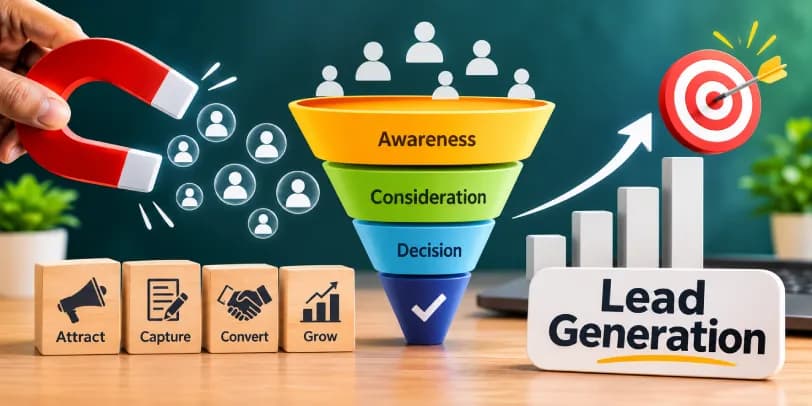
Lead generation is the process of attracting people who have shown interest in your product or service and capturing their contact details so your team can follow up. Instead of chasing strangers, you give potential customers a reason to raise their hand, whether through a form, a download, a webinar signup, or a conversation. Those people become leads, and a good lead generation system turns them into paying customers over time.
Table of contents17 sections
What Is Lead Generation? (Definition and Meaning)
Lead generation sits between marketing and sales. Marketing creates visibility and interest, and lead generation turns that interest into names, emails, and phone numbers the business can act on.
Lead Generation Definition Explained Simply
Think of a local gym offering a free week-long pass. Someone fills in their name and number to claim it, and the gym now has a person to talk to about membership. That exchange of value for contact details is lead generation. The same idea applies to a software company offering a whitepaper or a law firm offering a free consultation.
What Counts as a Lead in Marketing and Sales?
A lead is a person or company that has expressed interest in what you offer and has given you a way to reach them. A random email address pulled from a list is not a true lead, because there is no evidence of interest. A visitor who downloads your pricing guide and enters their work email is.
Context matters. In marketing, a lead might be anyone who joins your newsletter. In sales, a lead usually needs more signals, such as company size, budget, or a stated problem, before it deserves a call.
Lead Generation vs. Demand Generation: Key Differences
The two are often confused, and they work best together. Demand generation builds awareness and interest across a broad audience through content, brand campaigns, and thought leadership. Lead generation captures that interest and converts it into identifiable contacts.
Demand generation asks, “Do people know we exist and care?” Lead generation asks, “Can we start a conversation with the people who do?” Without demand, lead capture has nothing to work with. Without lead capture, demand never turns into a pipeline.
Why Is Lead Generation Important for Businesses?
A business can have a great product and still stall if nobody is entering the funnel. Lead generation provides a steady flow of people who are already open to hearing from you, and that makes forecasting and growth far more predictable.
Role of Lead Generation in the Sales Funnel
Lead generation fills the top and middle of the sales funnel. Visitors become leads, leads are nurtured and qualified, and the best ones move to the sales team. If the top is thin, the bottom suffers no matter how strong your closers are.
Impact on Revenue, Business Growth, and Customer Acquisition
Consistent lead flow supports revenue directly. More relevant leads usually mean more sales conversations, and more conversations lead to more customers. It also reduces dependence on one source, such as a single referral partner or one ad account.
Benefits of Generating Qualified Leads
Qualified leads shorten sales cycles because they already fit your target audience and have a real need. Sales teams spend less time on dead ends, and marketing can see which activities produce results. Over time, this lowers acquisition costs and improves forecasting.
How Lead Generation Fits into the Customer Journey
People rarely buy on first contact. They move through stages, and effective lead generation meets them where they are rather than pushing everyone toward a sales call.
Awareness Stage
At this stage, the person has a problem but may not know the solution. They search for answers, read blog posts, or watch short videos. Helpful educational content works best here, along with light offers like checklists or newsletters.
Consideration Stage
Now they are comparing approaches and vendors. Case studies, webinars, comparison guides, and product demos work well. This is where many people hand over contact details, because the content is worth the exchange.
Decision Stage
The buyer is close to choosing. Free trials, consultations, quotes, and testimonials help remove final doubts. Leads at this stage are often ready for a direct sales conversation.
How Lead Generation Moves Prospects Through the Buying Journey
Each offer should match the stage. Asking an awareness-stage visitor to book a demo usually fails, and offering a basic blog post to someone ready to buy wastes the moment. Tracking behavior, such as pages viewed and emails opened, helps you decide what to send next.
What Are the Different Types of Leads?
Not every lead deserves the same treatment. Classifying them helps teams prioritize and avoids sending cold prospects to busy salespeople.
Marketing Qualified Leads (MQLs) vs. Sales Qualified Leads (SQLs)
A marketing qualified lead has engaged enough, for example by downloading several resources or attending a webinar, to look like a good fit. A sales qualified lead has gone further and shown buying intent, such as requesting pricing or a demo. MQLs are handled by marketing, and SQLs are ready for a sales conversation.
Product Qualified Leads (PQLs) and Service Qualified Leads
A product qualified lead is a user who has tried your product, usually through a free trial or freemium plan, and shown behavior that suggests they would benefit from upgrading. A service qualified lead is an existing customer who asks about additional services, which makes them a strong upsell opportunity.
Sales Accepted Leads (SALs)
A sales accepted lead is an MQL that the sales team has reviewed and agreed to pursue. This step matters because it forces both teams to agree on what a good lead looks like.
Inbound Leads vs. Outbound Leads
Inbound leads come to you through content, search, social media, or referrals. Outbound leads are people your team contacts first through cold email, calling, or LinkedIn outreach. Inbound usually builds trust more slowly but at lower cost, while outbound can produce faster conversations with specific target accounts.
Cold, Warm, and Hot Leads
A cold lead matches your profile but has not engaged. A warm lead knows your brand and has interacted with you. A hot lead is actively looking to buy. Your follow-up approach should change at each temperature.
B2B vs. B2C Lead Generation: Key Differences
The principles are the same, but buyer behavior is not. Understanding the difference stops you from copying tactics that do not fit your market.
How B2B Lead Generation Works
B2B lead generation targets companies, and purchases often involve several decision-makers, longer timelines, and higher contract values. Common tactics include LinkedIn outreach, webinars, whitepapers, account-based marketing, and content syndication. Leads are typically qualified on company size, role, and budget before sales gets involved.
How B2C Lead Generation Works
B2C lead generation targets individual consumers who usually decide faster and with fewer people involved. Social media, influencer content, discount offers, quizzes, giveaways, and email signups are common. Volume tends to matter more because the order value is lower.
B2B vs. B2C Lead Generation Comparison
| Factor | B2B | B2C |
|---|---|---|
| Buyer | Teams and decision-makers | Individual consumers |
| Sales cycle | Weeks to months | Minutes to days |
| Content style | Detailed, educational | Emotional, simple |
| Main channels | LinkedIn, email, SEO, events | Social media, search, email |
| Typical lead value | Higher | Lower |
How Does the Lead Generation Process Work?
A reliable lead generation system follows a repeatable path, from attracting attention to handing off to sales.
Step-by-Step Lead Generation Process
First, a visitor discovers your business through search, social media, an ad, or a referral. Second, they land on a page with a clear offer. Third, they complete a form to receive it. Fourth, the lead enters your CRM. Fifth, you nurture the lead with relevant emails and content. Finally, qualified leads move to sales.
Lead Capture, Lead Nurturing, and Lead Scoring Explained
Lead capture is collecting contact information through forms, chatbots, or gated content. Lead nurturing is the follow-up that builds trust, usually through email sequences and useful resources. Lead scoring assigns points based on fit and behavior. A director at a target company who opens three emails and visits your pricing page should score higher than a student who downloaded one ebook.
Lead Qualification Using the BANT Framework
BANT stands for Budget, Authority, Need, and Timeline. It is a simple way to judge whether a lead is worth pursuing. Can they afford it, can they make the decision, do they have a real problem, and when do they want to solve it? Many teams adapt BANT, but the logic holds.
How Qualified Leads Are Handed Over to Sales Teams
A clean handoff includes context. Sales should see which content the lead engaged with, their score, and any notes from earlier conversations. Agreeing on criteria in advance, and setting a response time such as within 24 hours, prevents good leads from going cold.
What Are the Main Lead Generation Channels?
No single channel fits every business. Most teams use a mix, then double down on what brings the best leads.
Search Engines and Organic Content
SEO attracts people who are actively searching for answers. Helpful blog posts, guides, and service pages can bring in steady traffic without paying for each click. It takes time, but the results compound.
Social Media Platforms
LinkedIn works well for B2B, while Instagram, Facebook, and TikTok suit consumer brands. Beyond posting, you can use lead forms, direct messages, and community engagement to start conversations.
Email Marketing
Email remains one of the most reliable channels because you own the list. It is ideal for nurturing and for reaching people who already know you.
Paid Search and Display Advertising
Paid search captures people who are ready to take action, while display ads build brand familiarity and support retargeting. Businesses can use Google Ads to reach potential customers through targeted search and display campaigns. Both channels offer speed and control, but costs can rise if targeting or landing pages are weak.
Events and Webinars
Live events, trade shows, and online webinars allow real interaction. Attendees have self-selected, so the resulting leads are often warmer than average.
Referrals, Review Sites, and Online Communities
Happy customers are powerful. Referrals, review sites like G2 or Trustpilot, and communities such as Reddit or Slack groups let people discover you through trusted voices.
Content Syndication
Content syndication distributes your articles or reports through third-party platforms to reach a larger audience. It can expand reach quickly, but quality varies, so review lead sources carefully.
Effective Lead Generation Strategies and Tactics
Strategies are the plan, and tactics are the specific actions. The best lead generation campaigns combine several of these.
Content Marketing and SEO for Lead Generation
Create content that answers real questions at each stage of the journey, then optimize it so the right people can find it. Pair articles with clear calls to action so readers know the next step.
Social Media and Paid Advertising Strategies
Use social platforms to build trust and paid ads to target defined audiences. Test different creatives and offers, and send traffic to focused landing pages rather than your homepage.
Email Marketing and Marketing Automation
Automation lets you send the right message at the right time, such as a welcome series after signup or a reminder after someone abandons a form. Keep emails relevant and not too frequent.
Account-Based Marketing (ABM) for B2B Lead Generation
ABM treats chosen target accounts as individual markets. Marketing and sales identify high-value companies, then create personalized content and outreach for them. It suits B2B businesses with larger deals.
Lead Magnets and Valuable Content Offers
A lead magnet is something useful offered in exchange for contact details, such as a template, checklist, ebook, free tool, or webinar. The best ones solve a specific problem quickly. A vague “ultimate guide” rarely beats a simple, practical template.
Retargeting and Personalized Lead Generation Campaigns
Retargeting shows ads to people who visited your site but did not convert. Personalization goes further by tailoring messages to industry, role, or past behavior. Both help bring warm visitors back.
Referral-Based Lead Generation
Ask satisfied clients for introductions, and consider simple referral incentives. Referred leads often convert better because they arrive with built-in trust.
How to Optimize Lead Generation Forms and Landing Pages
Many businesses lose leads right at the finish line. A strong offer paired with a clumsy form wastes the traffic you worked to earn.
Creating Effective Lead Generation Forms
Ask only for what you genuinely need. Use clear labels, a logical order, and a simple design that works on mobile. Place the form where visitors expect it, near the offer description.
How to Write Compelling Calls to Action (CTAs)
A good CTA tells people exactly what they get. “Download the checklist” outperforms “Submit” because it describes the benefit. Use action language, keep it short, and make the button stand out visually.
Keep Forms Short and Reduce Form Abandonment
Every extra field gives people another reason to leave. For top-of-funnel offers, name and email are often enough. For higher-intent requests, such as a demo, additional questions are reasonable because the visitor expects them.
Using Progressive Forms and Form Enrichment
Progressive profiling collects small amounts of information across multiple interactions rather than all at once. Form enrichment fills in details like company size automatically from the email domain, so you gain data without asking more questions.
A/B Testing and Conversion Rate Optimization
Test one change at a time, such as a headline, button color, or form length, and let the data decide. Small improvements to a landing page can raise results significantly without extra traffic.
Lead Generation Examples in Practice
Seeing the concepts applied makes them easier to adapt.
B2B Lead Generation Example
A marketing agency publishes a detailed benchmark report on email performance and promotes it through LinkedIn and search. Visitors download it with their work email, receive a short nurture sequence, and those who engage are offered a strategy call.
B2C and E-commerce Lead Generation Example
An online skincare store offers a short skin-type quiz. Participants enter their email to get personalized product recommendations and a first-order discount. The store then follows up with tailored emails based on quiz answers.
SaaS Lead Generation Example
A project management tool offers a free 14-day trial. Users who invite teammates and create several projects are flagged as product qualified leads, and the sales team reaches out with an upgrade conversation.
What Tools and Software Are Used for Lead Generation?
The right tools save time, but they do not replace strategy. Start with what you need and add more as your process matures.
Customer Relationship Management (CRM) Software
A CRM stores lead data, tracks interactions, and shows where each lead sits in the pipeline. Platforms such as Salesforce and HubSpot are common choices. Consistent data entry matters more than the brand you pick.
Lead Generation and Prospecting Tools
Prospecting tools help find and verify contact information, build target lists, and run outreach. Examples include Apollo and LinkedIn Sales Navigator. Always respect privacy rules and send relevant messages.
Marketing Automation and Email Tools
Tools like Marketo, HubSpot, and Mailchimp automate email sequences, scoring, and segmentation. They keep nurturing consistent without constant manual work.
Analytics and Lead Tracking Software
Google Analytics, heatmaps, and call-tracking software show where leads come from and what they do on your site. This reveals which channels deserve more budget.
Integrating Lead Generation Tools with Sales Systems
Your forms, email platform, and CRM should talk to each other. When tools are connected, new leads appear instantly in the CRM with source data attached, and sales can respond quickly.
How to Measure Lead Generation Success
If you cannot measure results, you cannot improve them. Choose a handful of metrics and review them regularly.
Lead Volume and Lead Quality Metrics
Volume tells you how many leads you generate, but quality tells you whether they matter. Track the share of leads that become MQLs, SQLs, and customers. A smaller list of better leads often beats a large list of poor ones.
Lead Conversion Rate
Lead conversion rate is the percentage of visitors who become leads, or of leads who become customers. Measure both, since each reveals a different problem.
Cost Per Lead (CPL)
CPL is your total campaign spend divided by the number of leads generated. Compare it across channels, but also consider lead quality, because a cheap lead that never buys is expensive.
Customer Acquisition Cost (CAC) and Return on Investment (ROI)
CAC measures the total cost of winning a customer. ROI compares revenue gained against what you spent. Together they show whether your lead generation efforts are actually profitable.
MQL-to-SQL Conversion Rate
This metric shows how many marketing qualified leads become sales qualified. A low rate often signals misaligned definitions or weak targeting.
How to Track and Improve Campaign Performance
Use UTM tags to track sources, review dashboards weekly, and look for patterns. Pause what is not working, scale what is, and revisit your assumptions every quarter.
Common Lead Generation Challenges and How to Overcome Them
Almost every team runs into the same obstacles. Knowing them in advance makes them easier to handle.
Generating Low-Quality Leads
Low-quality leads usually come from broad targeting or offers that attract the wrong audience. Tighten your ideal customer profile, refine your messaging, and add qualifying questions to forms.
High Lead Acquisition Costs
Rising costs often point to weak landing pages, poor targeting, or too much reliance on paid channels. Improve conversion rates, invest in organic content, and use retargeting to get more from existing traffic.
Poor Marketing and Sales Alignment
When marketing counts any form fill as a win and sales only wants ready buyers, friction follows. Agree on lead definitions, share feedback regularly, and review results together.
Inconsistent Lead Follow-Up and Nurturing
Leads lose interest quickly. Respond fast, automate early follow-up, and keep nurturing leads who are not ready to buy yet.
Balancing Lead Quality vs Quantity
Chasing volume can flood your sales team, while focusing only on quality can starve the pipeline. Set targets for both, and adjust based on what turns into revenue.
Best Practices for a Successful Lead Generation Campaign
Define Your Target Audience and Buyer Personas
Know who you are trying to reach, what problems they face, and how they make decisions. Base personas on real customer conversations and data rather than assumptions.
Align Sales and Marketing Teams
Shared goals, shared definitions, and regular check-ins keep both teams working toward the same outcome.
Personalize Your Lead Generation Campaigns
Use what you know, such as industry, role, or past activity, to make messages feel relevant. Even small touches like referencing the visitor’s interest can improve response.
Continuously Test and Optimize Campaigns
Treat every campaign as an experiment. Test offers, channels, and messages, learn from the results, and keep refining.
Conclusion
Lead generation is the ongoing work of attracting interested people, capturing their details, and guiding them toward a purchase. It works best when your offers match the buyer’s stage, your forms and pages make action easy, and your marketing and sales teams agree on what a good lead looks like. Start with one or two channels, measure honestly, and improve step by step. Over time, a clear and consistent system will deliver more qualified leads and more predictable growth.
FAQs
What is lead generation in simple terms?
It is the process of attracting people who are interested in what you sell and collecting their contact details so you can follow up and turn them into customers.
What is the difference between a lead and a customer?
A lead has shown interest but has not bought. A customer has completed a purchase.
What are the four main types of leads?
The most common are marketing qualified leads, sales qualified leads, product qualified leads, and service qualified leads. Many teams also classify leads as cold, warm, or hot.
What is the difference between lead generation and demand generation?
Demand generation builds awareness and interest in your category or brand. Lead generation captures that interest as contact information you can act on.
What are the best lead generation strategies for small businesses?
Local SEO, helpful content, email marketing, referrals, and a simple offer like a free consultation or guide tend to work well with limited budgets.
How do you generate leads for free?
Publish useful content, optimize it for search, stay active on relevant social platforms, join online communities, ask for referrals, and offer a simple lead magnet.
What is the difference between B2B and B2C lead generation?
B2B targets businesses with longer sales cycles and multiple decision-makers. B2C targets individuals who usually decide faster and buy at lower values.
What is lead scoring and why is it important?
Lead scoring ranks leads by fit and engagement. It helps sales teams focus on the people most likely to buy.
What is a good lead conversion rate?
It varies by industry, offer, and channel. Instead of chasing a universal number, compare your own results over time and against similar businesses.
How long does it take to see results from lead generation?
Paid campaigns and outreach can produce leads within days or weeks. SEO and content marketing usually take several months to build momentum.
What tools are commonly used for lead generation?
Teams typically use a CRM, marketing automation software, email platforms, prospecting tools, and analytics software.
How can businesses generate high-quality leads?
Define a clear target audience, offer genuinely useful content, qualify leads with the right questions, follow up quickly, and keep testing and improving your campaigns.