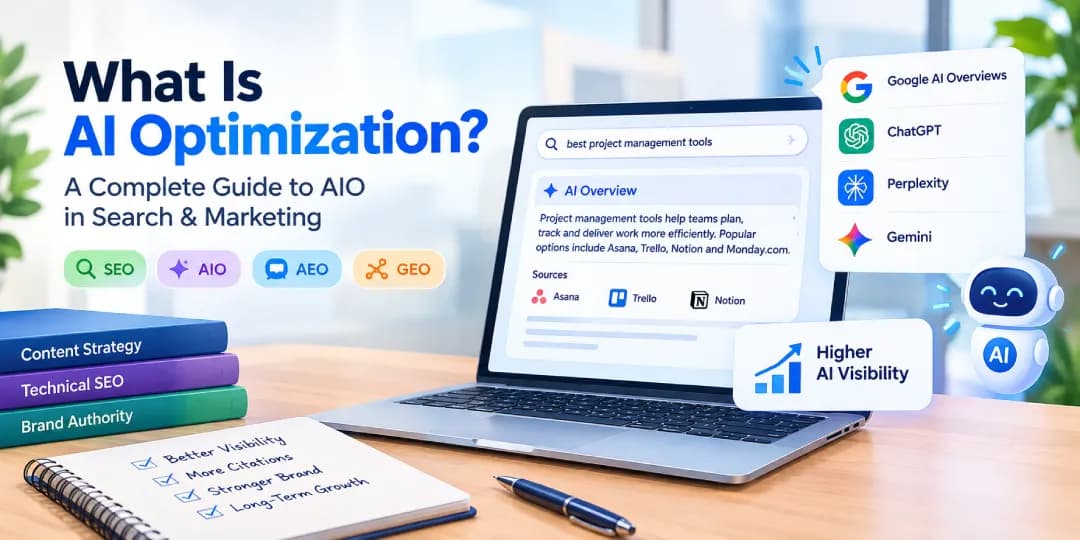
AI optimization (AIO) is the practice of making your content, website and brand easy for AI systems to find, understand and cite. Those systems include Google AI Overviews, ChatGPT, Perplexity and Gemini. In search marketing, it extends traditional SEO so your pages can appear inside generated answers, not just in a list of blue links. The term also has a technical meaning, covering how AI models and workflows are made faster and cheaper to run. This guide focuses mainly on the search side, then explains the other meanings so you can tell which one applies. It also covers how AIO compares with SEO, AEO and GEO, and how to start without overcomplicating things.
Table of contents21 sections
What Does AI Optimization (AIO) Mean?
AIO Definition in Plain English
AIO means shaping your content so AI search engines can retrieve it, trust it and use it in their answers. Think of it as optimizing for being quoted rather than only being ranked.
AIO Meaning: Breaking Down the Term
“AI” refers to the generative and retrieval systems that produce answers. “Optimization” is the work of improving clarity, structure, authority and accessibility so those systems pick your page. The AIO definition therefore sits somewhere between content strategy and technical SEO.
Why “AIO” Is Becoming a Common Industry Term
Marketers needed a short label for work that goes beyond rankings. Terms like GEO, AEO and AI search optimization overlap heavily, and AIO has become a convenient umbrella for all of them, though usage still varies between teams.
How AI Optimization Differs From AI-Assisted Content Optimization
These two get confused constantly. AI optimization is about being visible to AI systems. AI-assisted content optimization means using AI tools to improve your own content, such as finding gaps or tightening copy. One is the goal, the other is a method.
Types of AI Optimization and Their Applications
The phrase means different things depending on who is using it. Here are the main contexts.
AI Optimization in Search & Content Marketing
This is the context of this article: optimizing pages for AI Overviews, AI Mode, ChatGPT search and similar tools so your brand gets cited and mentioned accurately.
AI Optimization as a Technical/Applied AI Field
In research and engineering, optimization means using AI to solve complex computational problems or to make models run more efficiently. It is a different discipline with a different audience.
AI Model Optimization
Model optimization reduces the cost and size of running AI systems while keeping quality acceptable.
Model Quantization
Quantization stores model weights at lower precision, which shrinks memory use. Formats such as GGUF are common examples in local model deployment.
Model Pruning
Pruning removes parameters that contribute little to the output, which makes the model lighter.
Knowledge Distillation and Fine-Tuning
Distillation trains a smaller model to imitate a larger one. Fine-tuning adapts an existing model to a specific task or domain.
Inference and Resource Optimization
This covers batching, caching and hardware choices that lower the cost of generating each response.
AI Process Optimization and Business Automation
Here, AI is used to improve how a business operates, from supply chain and inventory to pricing and ad campaigns.
AI-Powered Workflow Automation
AI can route tickets, draft reports, score leads and handle repetitive steps that once needed manual effort.
Agentic AI and Process Redesign
Agentic systems take multi-step actions toward a goal. Used well, they let teams redesign a process rather than just speed up the old one.
AI Optimization vs. Traditional Automation
Traditional automation follows fixed rules. AI-driven optimization can adapt to patterns and exceptions, though it needs more oversight.
AI-Driven Website and Search Optimization
This sits where the two worlds meet: using AI to improve site performance, content quality and search visibility together.
Benefits of Different Types of AI Optimization
Search-focused AIO improves discoverability. Model optimization lowers cost. Process optimization saves time and reduces errors. The benefit depends entirely on the context you are working in.
How to Tell Which AI Optimization Context Applies
Look at the surrounding words. Mentions of citations, AI Overviews or brand visibility point to search. Mentions of latency, GPUs or quantization point to engineering. Mentions of workflows, forecasting or routing point to operations.
AI Optimization vs. SEO vs. AEO vs. GEO
How Traditional SEO Works
Traditional search engine optimization focuses on crawlability, relevance, backlinks and user experience so pages rank in search results. Google’s Search Essentials describe the baseline.
How AI Search Optimization Works
AI search engine optimization adds another layer. It asks whether a system can extract a clear, trustworthy answer from your page and whether your brand is recognized as a credible source on the topic.
What Is Answer Engine Optimization (AEO)?
AEO focuses on being the direct answer to a question, whether in a featured snippet, a voice assistant response or an AI answer box.
What Is Generative Engine Optimization (GEO)?
GEO, short for generative engine optimization, targets generative systems that synthesize responses from several sources. The goal is inclusion and accurate representation in those synthesized answers.
Key Differences Between SEO, AIO, AEO and GEO
In practice the lines blur, but the emphasis differs.
Ranking Signals and AI Visibility
SEO leans on rankings, links and technical health. AI visibility depends on whether your content is retrievable, clear and corroborated elsewhere.
Search Results vs. AI-Generated Answers
A search result sends a click to you. A generated answer may summarize you without one, so presence matters even when traffic does not follow.
Keywords vs. Entities and Semantic Context
Keywords still help, but AI systems work with entities, relationships and meaning. Covering a topic thoroughly matters more than repeating a phrase.
Traffic, Citations and Brand Mentions
SEO measures traffic. AIO adds citations (a linked source) and brand mentions (your name appearing in the answer).
Why Businesses Need Both SEO and AIO Today
AI features draw on pages that are already indexed and trusted. Without solid SEO, AIO has little to build on. Without AIO thinking, good rankings may not translate into AI visibility.
Why AI Optimization Matters for Businesses
The Rise of Generative Search and AI Answers
Google’s AI Overviews and AI Mode, ChatGPT search and Perplexity now answer many questions directly. Generative search is becoming a normal part of how people look things up.
How Consumer Search Behavior and Expectations Are Changing
People ask longer, more conversational questions and expect a useful answer immediately. They also compare options inside the AI interface before visiting any site.
Increased Visibility in AI-Generated Answers
Being named or cited in an answer puts your brand in front of people at the moment of decision.
Building Brand Authority, Trust and Accurate Representation
When AI describes your company, you want it to be right. Consistent, well-sourced information across your site and the wider web reduces the chance of errors.
Lead Generation and Customer Discovery
Prospects increasingly discover vendors through AI recommendations. Visitors who arrive this way have often done much of their research already.
Zero-Click Searches and Brand Awareness
Many searches end without a click. Even then, repeated appearances in answers build familiarity that can pay off later.
Benefits of AIO for Small Businesses and Enterprises
Small businesses can compete on specific expertise and local relevance. Enterprises benefit from consistent brand information across many products and regions.
How AIO Changes the Customer Journey
Discovery, comparison and shortlisting can all happen inside an AI conversation, so the journey often starts earlier and shorter than before.
Business ROI and Long-Term Marketing Value
Returns are harder to attribute than with paid ads, but the work overlaps with content quality, technical health and authority, which keep paying off.
How AI Search Engines and AI Assistants Find and Use Content
How AI Models Retrieve and Interpret Information
AI systems either rely on what they learned during training or fetch fresh pages at query time. Search-connected tools mostly do the latter.
How Retrieval-Augmented Generation (RAG) Works
Retrieval-augmented generation pairs a language model with a retrieval step. The model answers using documents it has just fetched.
Crawling and Indexing
Bots discover and store pages. If your content is not accessible and indexable, it cannot enter the pool.
Retrieving Relevant Content
When a question arrives, the system searches that pool for passages that match its meaning.
Extracting Information and Generating Answers
The model reads the retrieved passages and composes a response. Clear, self-contained passages are easier to use.
Source Citations and Attribution
Many tools then link the sources they relied on, which is where citations come from.
The Role of Structured Data and Entities
Structured data helps machines identify who and what a page is about. Clear entities, such as your organization, authors and products, reduce ambiguity.
Natural Language Processing (NLP) and Understanding (NLU)
NLP lets systems parse text, and NLU helps them grasp intent and context. This is why natural language usually beats awkward keyword phrasing.
How AI Tools Decide What to Cite or Summarize
No one outside these companies knows the exact formula. Observable patterns include relevance to the question, clarity, apparent expertise and agreement with other sources.
Context, Credibility and Relevance in Source Selection
A page that answers the exact question, comes from a recognizable source and is consistent with other reliable information tends to fare better.
AI Search Retrieval vs. Model Training Data
Training data shapes what a model generally “knows.” Retrieval brings in current information. Optimizing for retrieval gives you more direct influence.
How AI Recommendation Engines Use Content
Recommendation features draw on product details, reviews and descriptions. Accurate, structured information helps your offerings appear in the right comparisons.
Major AI Search Platforms and Their Differences
Google AI Overviews
AI Overviews appear above traditional results for some queries. Google has said the usual SEO fundamentals apply, and eligible pages need to be indexed and snippet-eligible.
Google AI Mode
AI Mode offers a more conversational, multi-step search experience inside Google, often handling follow-up questions.
ChatGPT Search
ChatGPT can search the web and cite sources. Its crawler, OAI-SearchBot, is separate from the one used for model training.
Perplexity AI
Perplexity is built around cited answers, so source links are a prominent part of every response.
Google Gemini
Gemini is Google’s assistant and model family. It connects to Google’s search and ecosystem, though its behavior differs from AI Overviews.
Microsoft Copilot and Bing AI Search
Copilot draws on Bing’s index, which makes Bing indexing worth checking alongside Google.
Other AI Assistants and Answer Engines
Other assistants and answer engines keep appearing, each with its own retrieval method and citation habits.
How AI Search Visibility Differs Across Platforms
Each platform uses different sources and displays citations differently. A page cited in one may be absent in another, so test more than one.
Core Components of AI Content Optimization
Content Clarity and Answer-First Structure
Lead with the answer, then explain. A reader or a model should grasp the point within the first lines of a section.
Topical Authority and Entity Coverage
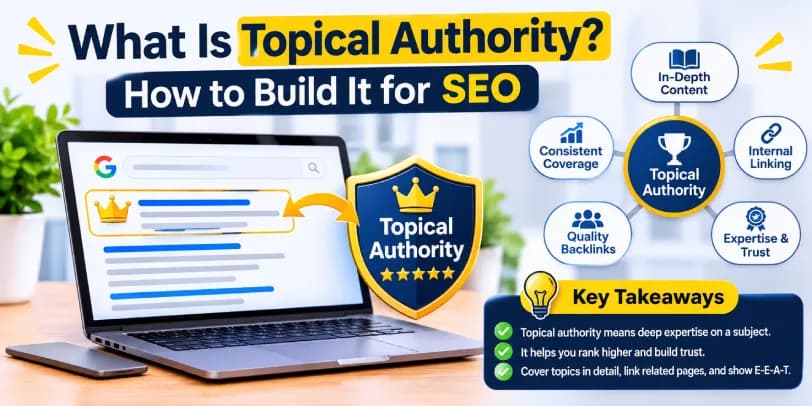
Cover a subject from several angles and connect related concepts. Depth signals that you actually know the topic.
Structured Data and Machine Readability
Clean headings, lists, tables and schema make pages easier to parse correctly.
Authoritativeness and Trust Signals (E-E-A-T)
Real authors, firsthand experience, credentials and reliable sourcing support trust. Google’s helpful content guidelines emphasize this.
Freshness and Content Accuracy
Outdated statistics and old product details weaken trust. Review important pages on a schedule.
Semantic Relevance and Search Intent Alignment
Match the reason behind the query. Someone asking for a definition wants a short answer first, not a sales pitch.
Conversational Language and Natural Answers
Write the way people ask questions. Plain phrasing is easier for both humans and models to match.
Brand Consistency and Accurate Representation
Keep your name, descriptions and key facts consistent across your site and profiles so AI systems form a stable picture of you.
Accessibility and Content Adaptability Across AI Platforms
Make content readable without scripts or special interactions, so different systems can all access it.
How to Optimize Content for AI Search (Practical Framework)
Step 1 — Structure Content for Direct Answers
Use Question-Based Headings
Phrase headings the way users ask, such as “How does RAG work?”
Add Concise Definitions and Summaries
Put a one or two sentence definition right under the heading.
Improve Content Scannability and Extraction
Short paragraphs, lists and tables make passages easier to lift.
Step 2 — Strengthen Entities and Topical Depth
Build Topic Clusters and Pillar Pages
Link a broad pillar page to detailed supporting articles.
Use Semantic Keywords and Related Concepts
Include related terms where they fit naturally, rather than repeating one phrase.
Improve Internal Linking
Descriptive internal links show how your pages relate to each other.
Step 3 — Use Schema Markup and Semantic HTML
Article, Organization and Relevant Schema Types
Mark up articles, your organization, products, FAQs and authors where they genuinely apply.
Proper Heading Hierarchy and Semantic HTML
Use a single H1 and logical H2 and H3 levels, with proper list and table elements.
Validate Structured Data
Check markup with Google’s Rich Results Test or the Schema Markup Validator.
Step 4 — Build Authority Signals AI Systems Trust
Cite Credible and Primary Sources
Link to original research and official documentation.
Demonstrate Firsthand Experience and Expertise
Share real processes, data you collected and lessons from actual work.
Build Brand Mentions and Digital PR
Mentions on respected sites help models recognize your brand as legitimate.
Step 5 — Optimize for Conversational Search Intent
Research Questions Users Ask AI Assistants
Use customer support logs, sales calls, People Also Ask and forums.
Identify Conversational and Long-Tail Queries
Longer, natural questions often reveal specific needs your competitors overlook.
Match Content to Informational and Commercial Intent
Separate learning queries from buying queries and serve each properly.
Step 6 — Improve Technical Accessibility for AI Crawlers
Make sure important pages return clean status codes, load without blocking resources and are not accidentally blocked by robots.txt or noindex tags.
Step 7 — Test and Monitor AI Search Visibility
Run your target prompts across platforms regularly and record whether you are cited or mentioned. Section 13 covers the metrics.
AI-Assisted Content Optimization Techniques
Using AI to Identify Content Gaps
Compare your coverage against top results and AI answers to see which subtopics you are missing.
Optimizing Title Tags and Meta Descriptions With AI
AI can draft variations quickly. Choose the one that is accurate and compelling.
Finding Related Queries and Keyword Clusters
AI helps group queries by meaning, which makes planning topic clusters faster.
Discovering Internal Linking Opportunities
Tools can surface pages that should link to each other based on topical overlap.
Analyzing Search Intent With AI Tools
Feed in a query’s top results and ask what the searcher likely wants. Verify the conclusion yourself.
Improving Readability and Content Clarity
AI is useful for spotting long sentences and unclear phrasing in an existing draft.
AI-Assisted Content Audits and Benchmarking
Use AI to review large sets of pages for thin sections, outdated claims and missing elements.
Human Review, Fact-Checking and Editorial Quality Control
AI makes mistakes and invents details. A person should check every fact before publishing.
Optimizing Existing Content vs. Creating New Content
Updating a page that already ranks is often faster than starting fresh. Create new content only when a real gap exists.
Voice Search and Multimodal AI Optimization
What Is Multimodal AI Search?
Multimodal search lets people combine text, images, voice and video in one query.
How Voice Search Changes Query Patterns
Spoken queries are longer and more natural, and often phrased as full questions.
Optimizing Images for AI Search
Use descriptive file names, accurate alt text and relevant surrounding copy.
Optimizing Video Content for AI Discovery
Add transcripts, clear titles and chapters so systems can understand what the video covers.
Conversational Answers for Voice Assistants
Keep answers short and direct, ideally one or two sentences that read well aloud.
Mobile-Friendly Content and Accessibility
Most voice and visual searches happen on phones, so readable layouts matter.
Visual and Product Discovery Through AI
Clear product images and accurate attributes help AI surface items in visual searches.
Technical AI Optimization and Website Accessibility
AI Search Content Eligibility and Indexing Requirements
If a page is not indexed or is blocked from snippets, it generally cannot be featured in Google’s AI features. Check Search Console first.
AI Crawlers, Robots.txt and Bot Access
Different bots serve different purposes, and your robots.txt choices should reflect that.
Googlebot and Google Search Controls
Googlebot handles Search indexing. Standard directives such as noindex and snippet controls shape what appears.
OAI-SearchBot and GPTBot: Different Purposes
OpenAI says OAI-SearchBot is used for surfacing sites in ChatGPT search, while GPTBot relates to training data collection. Blocking one does not block the other.
Other AI Crawlers and Platform Controls
Other companies publish their own user agents and controls. Review their documentation before blocking anything.
JavaScript Rendering and AI Content Discovery
Some crawlers handle JavaScript poorly. Serving key content in the initial HTML is the safer choice.
How Website Speed and Core Web Vitals Affect User Experience
Fast, stable pages keep visitors engaged. Core Web Vitals measure loading, responsiveness and visual stability.
Traditional Website Performance Techniques
Image Optimization and Lazy Loading
Compress images and load off-screen ones later.
Minification, Caching and CDNs
Smaller files, browser caching and a content delivery network reduce load times.
Server-Side Optimization
Efficient hosting, database queries and server response times all contribute.
AI-Powered Website Performance Optimization
Predictive Loading
Some tools predict the next page a visitor will open and preload it.
Automated Media and Code Optimization
Automation can resize images and trim code without manual work.
Real-Time Monitoring and Intelligent Caching
AI-driven monitoring flags slowdowns early and adjusts caching rules.
Best AI Optimization Tools and Platforms
Features, pricing and availability change often, so verify details on each vendor’s site before you choose.
AI Visibility Tracking Tools
These track whether your brand is mentioned or cited across AI platforms for chosen prompts.
AI Content Optimization Tools
They suggest topics, entities and structure improvements for drafts and existing pages.
Technical SEO and Structured Data Tools
Crawlers, schema validators and log analyzers confirm that machines can access your site.
AI-Powered Website Performance Tools
These handle image optimization, caching and monitoring.
Popular AI Optimization Platforms
Profound
Profound focuses on AI search visibility tracking, mainly for larger brands.
Bluefish AI
Bluefish AI targets enterprise brand representation in AI answers.
Evertune
Evertune analyzes how AI models perceive and describe brands.
Scrunch AI
Scrunch AI monitors AI visibility and helps make sites more accessible to AI agents.
LLMrefs
LLMrefs tracks keyword-style visibility across language models.
Clearscope
Clearscope is a content optimization tool known for topic coverage guidance.
Semrush
Semrush offers a broad SEO suite with growing AI visibility features.
How to Choose the Right AI Optimization Tool
Start with your goal, such as tracking, content guidance or technical auditing. Then check platform coverage, data transparency and reporting.
Free vs. Paid AI Optimization Tools
Free options work for small tests and manual checks. Paid platforms make sense once you need scale, history and competitor benchmarking.
How to Measure AI Optimization Success
AI Search Visibility and Citation Frequency
Count how often your pages are cited for your target prompts.
AI Citations vs. Brand Mentions
A citation links to you. A mention names you without a link. Track both.
AI Share of Voice
Compare your presence against competitors across the same set of prompts.
AI Referral Traffic and Conversions
Segment analytics by AI sources where referrers are available, and watch conversion rates.
Tracking Target Prompts Across AI Platforms
Keep a fixed list of prompts and test them on a regular schedule.
Measuring Brand Sentiment and Answer Accuracy
Read the actual answers. Note tone and factual mistakes about your brand.
AI Visibility Benchmarking Against Competitors
Record which competitors appear most and what content earns them those spots.
Measuring ROI and Business Outcomes
Connect visibility to leads, sales conversations and assisted conversions where you can.
How to Evaluate Results With Limited Referral Data
Many AI visits arrive without clear referrers. Use trends, branded search growth and self-reported attribution forms.
AI Search Testing and Experimentation
Change one element at a time, such as a definition or schema type, and compare results over several weeks.
Limitations of AI Visibility Tracking
AI answers vary by user, location and moment, so any single snapshot is imperfect. Treat the numbers as directional.
Building an AI Optimization Reporting Dashboard
Combine citations, mentions, share of voice, referral traffic and conversions in one view, reviewed monthly.
Common Mistakes, Risks and Limitations of AI Optimization
Treating AIO as a Replacement for SEO
AIO builds on SEO. Dropping the fundamentals weakens both.
Ignoring Structured Data and Technical SEO
Great content is useless if crawlers cannot reach or interpret it.
Writing for Keywords Instead of Meaning
Repeating phrases does not help. Clear explanations that cover the subject do.
Overlooking E-E-A-T Signals
Anonymous, unsourced content struggles to earn trust from people or machines.
Publishing Unverified AI-Generated Content
Google’s guidance targets low-value content made at scale, whether or not AI wrote it. Review everything you publish.
Ignoring Search Intent and Conversational Queries
Pages that miss the real question rarely get cited.
Failing to Monitor AI Citations and Brand Mentions
If you never check, you will not notice errors or lost visibility.
Overlooking Content Accessibility and Indexability
Accidental blocks and heavy scripts quietly remove pages from consideration.
Relying on a Single AI Search Platform
Platforms change quickly. Spread your efforts.
Overusing Schema or Manipulative Optimization Tactics
Marking up content that is not on the page, or stuffing prompts into hidden text, can backfire.
Neglecting Content Freshness
Stale pages lose ground, especially on fast-moving topics.
AI Search Hallucinations and Brand Misinformation
AI can state wrong facts about your company. Publish clear, authoritative information and correct errors where you can.
Why AIO Cannot Guarantee Citations or Rankings
No one controls these systems. Good optimization improves your odds without guaranteeing results.
Common AI Optimization Myths
Two common ones are that special files or tricks unlock citations, and that SEO no longer matters. Neither holds up.
AI Optimization in Marketing: Where It Fits in Your Strategy
Integrating AIO Into an Existing SEO Strategy
Add AI checks to your current workflow: answer-first formatting, entity clarity and prompt testing.
Aligning AIO With Content Marketing and Digital PR
Third-party mentions and original research strengthen both PR and AI visibility.
Building an AI-First Content Strategy
Plan content around questions and topics, with each page written to be useful on its own.
Prioritizing Pages and Topics for AI Visibility
Start with pages tied to revenue and questions customers actually ask.
AI Optimization for Local Businesses
Keep business details, reviews and service descriptions accurate and consistent everywhere.
AI Optimization for Ecommerce and SaaS Websites
Detailed product data, comparison pages and clear documentation help assistants recommend you.
AI Optimization for Enterprise Marketing
Governance matters most: consistent messaging, structured data at scale and regular monitoring.
When AI Optimization Should Not Be Your First Priority
If your site has indexing problems, thin content or no authority, fix those first.
Enterprise AI Optimization and Business Processes
AI Optimization for Enterprise Operations
Large organizations use AI to improve forecasting, logistics, support and internal workflows.
AI Infrastructure and Computing Requirements
Performance depends on compute, storage and networking choices made early.
AI Model Efficiency and Resource Allocation
Right-sizing models and sharing resources keeps costs under control.
Agentic AI and Workflow Automation in Practice
Agents work best on well-defined tasks with clear checks and human approval for risky steps.
Data Quality, Security and AI Governance
Poor data leads to poor results. Access controls and policies reduce risk.
Measuring Enterprise AI Optimization ROI
Track cost savings, time saved and error reduction against a baseline.
Why Enterprise AI Optimization Projects Fail
Common causes include unclear goals, messy data, weak ownership and no plan for adoption.
Practical AI Optimization Examples and Use Cases
The examples below are hypothetical illustrations, not verified case studies, and they include no performance claims.
Example 1 — Optimizing a Blog Post for AI Search
Add a two-sentence definition under each question heading, a short summary near the top and a sources section.
Example 2 — Improving Brand Visibility in ChatGPT and AI Overviews
A company tests twenty target prompts, finds outdated descriptions and updates its about page, product pages and profiles to match.
Example 3 — Building Topical Authority With Content Clusters
A SaaS team builds one pillar page on a core topic and eight supporting articles linked together.
Example 4 — Using AI to Improve Existing SEO Content
An editor uses AI to flag missing subtopics in an old guide, then writes and fact-checks the additions personally.
Example 5 — Optimizing Ecommerce Product Information
A store standardizes specifications, adds product schema and writes clear comparison tables.
Example 6 — Improving Website Speed With AI
A site uses automated image compression and predictive preloading, then rechecks Core Web Vitals.
Before-and-After AIO Content Optimization Example
Before: a vague opening paragraph that circles the topic. After: a direct definition in the first sentence, followed by context, a short list and a cited source.
The Future of AI Optimization and Digital Discovery
The Evolution of AI-Powered Search
Search is shifting from lists of links toward conversations and direct answers.
The Future of GEO, AEO and AIO
These labels may merge or fade, but the underlying work of being clear, credible and accessible will remain.
AI Agents and Autonomous Search Experiences
Agents may research and compare options on a person’s behalf, which makes machine-readable information more important.
AI Commerce and Personalized Product Discovery
Assistants may increasingly recommend and even purchase products, favoring brands with clean product data.
Voice, Video and Multimodal AI Trends
Expect more queries that blend images, speech and text.
How AI Optimization May Change SEO Strategies
Expect greater emphasis on brand mentions, original insight and measuring visibility beyond clicks.
Preparing Your Website for AI-First Search
Keep the site accessible, structured and factually current, and keep testing.
AI Optimization Checklist: How to Get Started
Audit Your Existing SEO and AI Visibility
Check indexing, rankings and how AI tools currently describe you.
Identify High-Value Questions and Search Intent
List the questions your customers ask and group them by intent.
Improve Content Structure and Entity Coverage
Add direct answers, clear headings and missing related topics.
Strengthen Technical SEO and Structured Data
Fix crawl issues, add relevant schema and confirm bot access.
Build Trust and Brand Authority
Add author details, cite sources and earn mentions on reputable sites.
Test Your Content Across AI Search Platforms
Run your priority prompts on several platforms and log the results.
Monitor Performance and Continuously Improve
Review monthly, update what is stale and repeat.
Conclusion
AI optimization does not replace SEO. It extends it into a world where answers are generated, not just listed. The practical priorities are simple: make sure your pages are indexable, answer real questions clearly, back claims with credible sources and keep your brand information consistent. Expect gradual progress, not guaranteed citations, because no one controls what these systems choose to show. Start with your most important pages, test regularly and refine from what you learn.
Frequently Asked Questions (FAQs)
What does AIO stand for?
In marketing, AIO usually means AI optimization, though some people use it for “AI Overviews.”
What is the difference between SEO, AIO, AEO and GEO?
SEO targets rankings, AEO targets direct answers, GEO targets generative responses and AIO is the broader umbrella.
How do you optimize content for ChatGPT, Google AI Overviews and AI Mode?
Write answer-first content, cover the topic in depth, use structured data and keep pages crawlable and credible.
How does AI optimization improve brand visibility?
It increases the chances your brand is cited or mentioned accurately in AI-generated answers.
ow do AI search engines choose which websites to cite?
The exact methods are not public, but relevance, clarity, authority and corroboration appear to matter.
What are the best AI optimization tools?
It depends on your goal. Visibility trackers, content optimizers and technical SEO tools each serve different needs.
How can you measure AI optimization success?
Track citations, mentions, share of voice, referral traffic and conversions across a fixed set of prompts.
What is the difference between AI content optimization and AI search optimization?
One uses AI to improve content, and the other improves visibility in AI search.
How can AI help identify content gaps?
It can compare your coverage with top results and highlight missing subtopics.
Can AI optimization increase website traffic and conversions?
It can help, but results vary and click-through from AI answers is often lower than from classic results.
Can AI optimization guarantee citations in AI-generated answers?
No. It only improves the likelihood.
Do you still need traditional SEO when using AI optimization?
Yes, since AI features rely on indexed, trusted pages.
How does AI optimization help with voice search?
Concise, conversational answers suit spoken queries.
Is AI optimization necessary for small businesses?
It is useful, especially for local and niche expertise, but basic SEO comes first.
Can AI tools optimize existing website content?
Yes, with human review for accuracy.
Does website speed affect AI search optimization?
Speed mainly affects user experience, though accessibility to crawlers still matters.
What is an answer engine?
A search tool that returns direct answers instead of only links.
What is natural language processing in AI optimization?
It is how systems interpret human language, which is why natural writing works well.
How does AI optimization differ from traditional automation?
AI adapts to patterns, while traditional automation follows fixed rules.
How often should AI-optimized content be updated?
Review key pages at least quarterly, and sooner when facts change.
How do Google’s content quality guidelines apply to AI-generated content?
Google evaluates quality and helpfulness, not how the content was produced.
What are the most common AI optimization mistakes?
Treating it as an SEO replacement, publishing unchecked AI text and ignoring technical access.
What is the difference between GPTBot and OAI-SearchBot?
According to OpenAI, GPTBot relates to training data and OAI-SearchBot supports ChatGPT search results.
What are model quantization, pruning and distillation?
They are techniques for making AI models smaller and faster by reducing precision, removing parameters or training smaller models from larger ones.