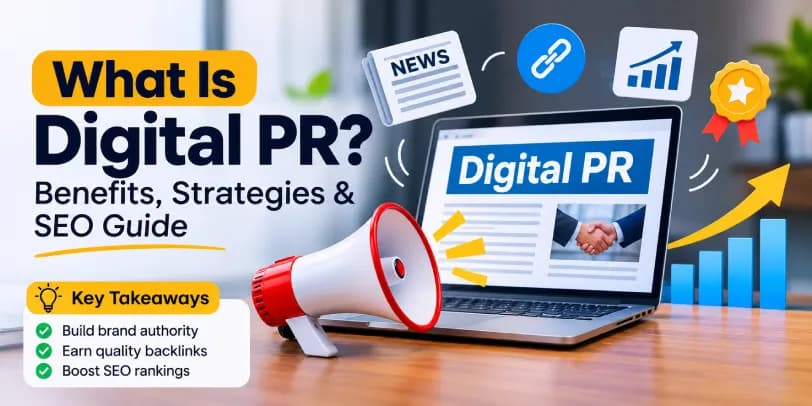
Digital PR is an online public relations strategy that earns coverage, brand mentions, and backlinks from trusted websites, news outlets, and industry publications. Instead of paying for placement, you create stories, data, or expert commentary that journalists want to publish. The result is stronger brand visibility, higher domain authority, and better search rankings. This guide explains how it works, which tactics matter, and how to run a campaign yourself.
What Is Digital PR? (Definition and Core Concepts)
Digital PR Meaning Explained in Simple Terms
Think of digital PR as public relations built for the internet. You give journalists and editors a reason to write about your brand, and they link to you when they do. The coverage is earned, not bought.
How Does Digital PR Work?
A team finds a newsworthy angle, builds content around it, and pitches it to relevant journalists. If the story fits their audience, they publish it. The published piece can bring a backlink, referral traffic, and brand mentions that search engines notice.
How Digital PR Fits Into Digital Marketing
Digital PR sits alongside content marketing, SEO, and social media marketing. It supplies the third-party credibility that your own channels cannot create. That is why many agencies now sell digital marketing and PR as one package.
Common Misconceptions About Digital PR
Some people assume it is only press release distribution. Others think it guarantees links. In practice, it is relationship-driven work, and results depend on the quality of the story.
Digital PR vs. Traditional PR, Brand PR, and Link Building
Digital PR vs. Traditional PR
Traditional PR focuses on print, TV, and radio, and success is often measured by reach. Digital PR targets online publications and measures links, traffic, and search impact as well. The two can overlap, but the goals differ.
Digital PR vs. Link Building
Link building is the goal of acquiring links. Digital PR is a method that earns them through real stories. Traditional link building often relies on direct requests, while PR relies on editorial interest. If you want to explore different ways to earn quality backlinks, check out our guide to link building strategies.
You will also hear the term SEO PR. It usually describes PR work planned mainly around search results, where the target publication, anchor, and landing page are chosen for ranking impact first. Digital PR is broader. A good campaign can serve search goals, but it also has to make sense as a story for the publication’s readers.
Digital PR vs. Brand PR
Brand PR shapes how the public perceives a company, usually through announcements, events, and relationships. Digital PR shares that aim but also pursues measurable SEO outcomes. Put simply, brand PR builds reputation, and digital PR builds reputation you can track in search.
General online publicity is different again. Publicity is any attention your brand receives online, whether you planned it or not. Digital PR is the planned, strategic version, with defined audiences, targets, and measurement. A viral mention can be publicity. A researched campaign aimed at specific publications is digital PR.
Digital PR vs. Paid Media and Press Release Syndication
Paid media buys attention, and syndicated press releases push the same text across distribution networks. Neither earns the editorial trust that a journalist’s own story does. Search engines also tend to treat paid or syndicated links cautiously.
The distinction matters for coverage too. Original editorial coverage is written by a journalist for their own publication. Syndicated or republished coverage is a copy of that story, or of your release, placed on other sites. Those copies rarely add independent SEO value, because they carry substantially similar text and often point back to the same source. We return to how to tell them apart in the measurement section.
Why Digital PR Matters: Key Business Benefits
Building Brand Awareness, Trust, and Online Reputation
Appearing in respected publications puts your name in front of new audiences. People trust what others say about you more than what you say about yourself.
Earning Quality Backlinks and Improving Search Rankings
Links from relevant publications signal authority to search engines. Over time, this supports stronger rankings across your site.
Driving Referral Traffic, Leads, and Sales
Good coverage sends readers straight to your site. Some of those visitors convert, especially when the article matches your product.
Establishing Thought Leadership and Brand Authority (E-E-A-T)
Regular expert commentary shows real experience and expertise. That supports the trust signals Google looks for.
Building Social Proof and Customer Loyalty
Press mentions reassure existing and prospective customers. They also give your social media channels credible content to share.
Attracting Investors and Business Partnerships
Visible coverage helps investors and partners see a company as established. It is a smaller benefit, but a real one.
How Digital PR Supports SEO and AI Search Visibility
The Role of Digital PR in Off-Page SEO
PR for SEO is largely off-page work. You earn links and mentions on other sites rather than changing your own pages.
One detail trips people up. Not every link you earn will pass ranking signals. Publishers can tag links with rel="nofollow", rel="sponsored", or rel="ugc". Google treats these as hints rather than strict rules. Sponsored is meant for paid placements, ugc for user-generated content, and nofollow for links the publisher does not want to vouch for. Many news sites apply nofollow to outbound links as a matter of policy.
An editorially earned link, one a journalist chose to include without payment, is what Google’s guidelines expect. A paid placement is different, and Google’s link spam policies say links bought to influence rankings should be marked accordingly. A nofollow link from a major publication can still bring traffic, brand recognition, and trust, so judge coverage by more than the link attribute.
How Digital PR Improves Organic Rankings and Brand Mentions
Authoritative links and mentions build trust over time. Many teams also see branded search volume grow after major coverage.
Linked vs. Unlinked Brand Mentions
A linked mention passes authority directly, while an unlinked mention still builds recognition. Both matter, and unlinked mentions can often be converted into links with a polite request.
Aligning Digital PR With Content Marketing
Strong campaigns start with strong content. Your content marketing team can supply the research, visuals, and landing pages that journalists will want to reference.
How Digital PR Supports Google AI Overviews and AI Search
It helps to know how these systems find brands in the first place. Most generative search tools work by retrieval. They rewrite the user’s question into search queries, pull pages from the web, and then write an answer from what they retrieved. Research on this process also suggests retrieval does not simply mirror classic search rankings, so ranking well in Google does not guarantee you appear in an AI answer.
Digital PR matters because it puts your brand on the pages those systems retrieve. Audits have also found a strong preference for third-party earned media over brand-owned content. In other words, what reputable publications say about you often carries more weight than what you say yourself.
The Role of Third-Party Citations in AI Search
Two things are easy to confuse here. A mention happens when an AI answer names your brand. A citation happens when it links to your page as a source. Mentions can come from training data or live search, while citations come from live search.
The overlap is smaller than most people expect. In a BuzzStream study of 12,000 AI responses, only 23.1% of brand mentions were backed by a citation, while 69.9% of citations included the brand’s name. Semrush found a related pattern it calls ghost citations, where a source is linked but the brand is never named, which happened in roughly 62% of the appearances it studied. Being used as a source does not automatically make your brand visible.
Mentions also work through association. When several independent publications connect your brand name with the same subject, such as a scheduling tool with resource planning, AI systems learn to link the two. That is why coverage spread across different outlets tends to help more than repeated coverage on one. One Ahrefs analysis of 75,000 brands found branded web mentions correlated with AI Overview visibility at 0.664, against 0.218 for backlinks. Ahrefs itself notes that this is correlation, not proof of cause.
How Digital PR Supports Generative Engine Optimization (GEO)
GEO aims to make your brand visible inside AI-generated answers. Consistent, accurate coverage across authoritative publications helps models associate you with your topic.
Expect uneven results, though. Visibility varies by platform. In one analysis, nearly 70% of brands appeared in only one AI search platform, and Conductor’s seven-month study found each engine has its own source preferences. It also varies by question. Semrush reported that comparative queries such as “best” or “vs” produced 2.4 times more brand mentions than informational ones.
There are limits to measuring any of this. Answers change by prompt, platform, and over time, and most studies and tools sample a limited set of prompts. Treat any single figure as a snapshot. The practical takeaway is steady and modest: earn relevant coverage in several credible places, keep your facts consistent across them, and track mentions and citations separately.
Types of Digital PR Campaigns
Proactive Digital PR Campaigns
These are planned in advance around a story you control, such as a study or product launch. They need time but deliver the most predictable results.
Reactive Digital PR Campaigns
Reactive campaigns respond to breaking news or trends. Speed matters here, often hours rather than days.
Research-Led and Data-Driven Campaigns
Original data gives journalists something new to report. Surveys and analyses of public datasets are common starting points. Because the whole story rests on the numbers, the data has to survive scrutiny, which we cover in the linkable assets section below.
Expert Commentary and Thought Leadership Campaigns
Here, a spokesperson offers informed opinions on industry issues. Journalists value quick, clear quotes from people who know the subject.
Product- and Service-Focused Campaigns
These highlight what you sell through reviews, roundups, or launches. They work best when the product solves a visible problem.
Creative and Viral Digital PR Campaigns
Interactive stunts, visuals, and bold ideas can spread widely. They are riskier, since public reaction is harder to predict, but when they work they travel far.
Local and Community-Based Campaigns
Local news sites and community groups are often easier to reach. For businesses serving one area, this is a practical starting point.
Partnership and Sponsorship Campaigns
Working with charities, events, or other brands can create shared coverage. It is a smaller tactic but useful for credibility.
Effective Digital PR Tactics and Techniques
Original Research, Surveys, and Industry Reports
Publish something journalists cannot get elsewhere. A clear headline statistic makes the story easy to write.
Press Releases and Media Outreach
Press releases still help for genuine announcements. Personal media outreach usually performs better than mass distribution.
Newsjacking and Trend-Based PR
Tie your expertise to a story already in the news. Add a fresh angle rather than repeating what is known.
Journalist Requests and Expert Quotes
Platforms that connect reporters with sources let you respond to live requests. Short, useful answers sent quickly tend to win placements.
Influencer and Media Personality Relations
Working with respected voices expands reach. Choose people whose audience matches yours.
Product Reviews and Editorial Roundups
Getting included in review articles builds both links and buyer trust. Offer samples or information that makes the writer’s job easier.
Podcasts, Guest Appearances, and Industry Awards
These raise visibility and credibility over the long term. Results are slower but compound.
Digital PR Channels and Distribution Platforms
Online News Publications and Industry Blogs
These are the core targets. Relevance to your sector matters more than size alone.
Journalist Networks and Media Databases
Databases help you find contacts and beats. Always verify what a journalist actually covers before pitching.
Social Media and Influencer Platforms
Social platforms help you amplify coverage and spot reporters’ interests. They also support social media engagement around your story.
Podcasts and Online Communities
Niche communities can bring highly relevant attention. They are useful for specialist topics.
Owned, Earned, Shared, and Paid Media (PESO Model)
The PESO model groups channels into owned, earned, shared, and paid. Digital PR focuses on earned media but works best when the other three support it.
How to Build a Digital PR Strategy (Step-by-Step)
Step 1: Define Campaign Goals and KPIs
Decide whether you want links, traffic, brand awareness, or leads. Clear goals shape every later decision.
Step 2: Research Your Target Audience
Learn what your audience reads and shares. That tells you which publications matter.
Step 3: Analyze Competitors’ Digital PR Campaigns
Look at where competitors earn coverage and which angles worked. This reveals gaps you can fill.
Step 4: Identify Newsworthy PR Opportunities
Ask what is new, surprising, or useful about your brand or data. If you cannot answer, the story needs work. Editors tend to judge stories against a familiar set of news values:
- Timeliness and relevance: Does it connect to something people care about right now?
- Uniqueness and novelty: Is it genuinely new, or has it been said many times?
- Impact and significance: How many people does it affect, and how much?
- Human interest and emotional appeal: Does it make readers feel something or recognize themselves?
- Local or industry relevance: Does it matter to this publication’s specific audience?
A story rarely needs all five. Two or three strong ones are usually enough, and being honest about which ones you have saves a lot of wasted outreach.
Step 5: Create Link-Worthy Content and Story Angles
Build assets that support the story, such as a study, a tool, or a visual. Make them easy to cite.
Step 6: Build a Targeted Media List
Choose a manageable group of relevant journalists. A focused list beats a long, generic one.
Step 7: Write Personalized Media Pitches
Keep pitches short and specific to the reporter’s work. Lead with the story, not the company.
Step 8: Launch and Distribute Your Campaign
Send pitches, publish the content, and share it on social media. Timing around news cycles can help.
Step 9: Follow Up and Build Journalist Relationships
One polite follow-up is usually enough. Thank journalists who cover you and stay useful to them.
The work does not end when a story goes live. Repurpose the coverage on your own channels. Share it in newsletters and on social media, add the press mentions to relevant landing pages, and reuse the campaign findings in future blog posts and reports. Also watch for secondary coverage, because other outlets often pick up a story days later.
Step 10: Measure Results and Optimize Future Campaigns
Review what earned coverage and what did not. Track follow-on mentions as well as the first placement, since a single story can generate several. Use those lessons to improve the next campaign.
How to Find Digital PR Opportunities
Researching Competitor Media Coverage
Search for competitor names and see who wrote about them. Those writers are possible contacts for you.
Finding Relevant Journalists and Publications
Read recent articles on your topic and note the authors. Their bylines tell you what they actually cover.
Identifying Trending Industry Stories
Monitor news and social conversations daily. Trends show where your expertise can add value.
Finding Expert Commentary Opportunities
Track reporter requests in your field. Prepare quotable answers in advance.
Discovering Unlinked Brand Mentions
Search for mentions of your brand without links. A friendly message often turns them into backlinks.
Finding Industry Events and Awards
Events and awards offer chances for speaking, nominations, and coverage. They are lower priority but easy wins.
How to Create Linkable Assets for Digital PR
Original Research and Data Studies
Studies with clear findings attract citations, but only if journalists can trust them. A few checks make a real difference:
- Know your data type. Primary data is collected by you, such as a survey. Secondary data comes from existing sources, such as government statistics. Each has a place, but label them clearly.
- Check source credibility. Use recognized datasets and name them.
- Watch sample size and bias. A survey of 80 people, or one that leads respondents toward an answer, will not hold up. State who was surveyed and how.
- Explain your methodology and its limits. Journalists respect honesty about what the data cannot show.
- Fact-check every statistic before publication. One wrong number can sink the story and damage your credibility with the reporters you want to work with again.
Interactive Tools and Calculators
Useful tools earn links because people reference them. Keep them simple and accurate.
Infographics and Visual Content
Visuals make complex data easy to understand. Provide them in formats publishers can reuse.
Industry Reports and Whitepapers
In-depth reports show authority. They work well for B2B audiences.
Expert Interviews and Opinion Pieces
Insight from real practitioners adds credibility. Keep opinions specific and defensible.
SEO-Optimized Campaign Landing Pages
A dedicated page gives journalists one place to link. Include key findings, visuals, and a clear summary. Once coverage arrives, add a short list of the publications that featured the story. It builds trust with new visitors.
Turning One Story Into Multiple Media Angles
A single study can support national, regional, and trade angles. Tailor each pitch to the audience.
Digital PR Outreach and Media Relationship Best Practices
Writing Personalized Pitches That Get Responses
Mention a recent article by the journalist and explain why your story fits. Skip long introductions.
Choosing the Right Time to Contact Journalists
Mornings during the working week often work better than late days or weekends. Avoid deadlines and big news days.
Following Up Without Spamming
Wait a few days, send one short reminder, then move on. Repeated emails damage relationships.
Building Long-Term Media Relationships
Share useful information even when you are not asking for coverage. Trust builds slowly.
Creating a Digital Press Kit
Gather logos, bios, photos, and facts in one place. It saves journalists time.
Managing Journalist Feedback and Responses
Respond quickly and politely, even to rejections. Feedback often shows how to improve.
Essential Digital PR Tools and Platforms
Media Database and Journalist Research Tools
These tools help you find contacts and beats. Verify details before sending.
Journalist Outreach and Email Tracking Tools
Outreach platforms track opens and replies. They help you manage follow-ups at scale.
Social Listening and Media Monitoring Tools
Social listening tools show who is talking about your brand. They also flag trends worth reacting to.
Backlink Analysis and SEO Tools
Backlink checkers confirm which links you earned and how strong they are. They also show whether a link is followed or tagged nofollow, sponsored, or ugc, and they reveal competitor link profiles.
CRM Tools for Media Relationship Management
A CRM keeps notes on each journalist and past conversations. That prevents repeated or irrelevant pitches.
Content Research and Data Visualization Tools
These help you find data and present it clearly. Good visuals improve the chance of pickup.
Brand Mention and AI Visibility Monitoring Tools
Newer tools track how often AI answers mention or cite your brand. They are useful for spotting changes in visibility. Keep their limits in mind, though. They run a fixed set of prompts, and AI answers shift between platforms and over time, so the numbers show direction rather than exact reach.
How to Measure Digital PR Success and ROI
Key Digital PR KPIs and Performance Metrics
Media Coverage and Publication Quality
Count placements, but look past domain authority when judging them. Ask who actually reads the publication, and whether the article is topically relevant to your business. Check that the outlet is editorially independent rather than a pay-to-publish site. Look at where the link sits, since a link inside the body text means more than one in a footer or author box. Confirm the page is indexed and accessible to readers and search engines. For local campaigns, check that the readership is in the right geography.
It also helps to identify the original source of each story. The original publisher is usually the outlet that first ran it, often shown by earlier publication dates, a byline, an “originally published” note, or a canonical tag. Syndicated and republished versions of the same text should be counted as one placement, not several.
Backlink Quality and Relevance
A few strong, relevant links beat many weak ones. Also record each link’s attribute, because followed and nofollow links play different roles.
Referral Traffic and Website Visits
Check how many visitors arrive from coverage and what they do next.
Organic Rankings and Search Visibility
Watch target keywords before and after campaigns.
Brand Mentions and Branded Search Growth
Rising branded searches suggest growing awareness.
Leads, Conversions, and Sales
Connect coverage to form fills, signups, or purchases where you can. Keep in mind that few customers convert after a single exposure, which is why attribution deserves a closer look below.
AI Search Mentions and Share of Voice
Compare how often your brand appears versus competitors in AI answers and media. Record mentions and citations as separate numbers, since one does not imply the other. Use the same set of prompts each month so changes mean something, and read the result as a trend rather than an exact score.
Tracking Results With Analytics and UTM Parameters
Use UTM tags and analytics to see which stories drive visits. Clean tracking makes reporting credible.
Attribution is where it gets messy. First-touch attribution credits the first interaction, last-touch credits the final one, and multi-touch spreads credit across the journey. Digital PR often shows up in the middle, as an assisted conversion. A reader might see your brand in an article, search for you by name a week later, and buy after clicking an ad. Last-touch would credit the ad, and PR would look worthless.
To get a fairer picture, track assisted conversions in your analytics. Also watch direct and branded search visits after coverage goes live. Be honest about the limits. Brand awareness and indirect influence cannot be fully measured, so treat the numbers as evidence, not proof.
Calculating Digital PR Return on Investment
Compare campaign costs with the value of links, traffic, and conversions. Because some benefits are indirect, treat the figure as an estimate, and use the attribution approach above to avoid undercounting.
Setting Realistic Campaign Timelines and Expectations
Results can take weeks or months. Link and ranking gains usually build gradually.
Digital PR and Social Media
What Does PR Mean in Social Media?
In social media, PR means managing reputation and communication with your audience. It includes how you share news, respond to comments, and handle criticism.
Using Social Media to Amplify Earned Media Coverage
Share published articles, tag the journalist, and add your own commentary. This extends reach and supports the relationship. Newsletters work the same way, and a short roundup of recent coverage gives subscribers a reason to trust you.
Social Media Monitoring and Reputation Management
Watch mentions and sentiment so you can respond early. Small issues are easier to handle before they spread.
Digital PR and Crisis Management
Protecting Brand Reputation During a Crisis
Respond quickly with facts and a clear point of contact. Silence often makes things worse.
Managing Negative Media Coverage and Public Responses
Correct errors politely and avoid arguments. Offer context rather than defensiveness. Sometimes the crisis comes from your own campaign, such as a stunt that is misread or a dataset that is challenged, so have a response ready before launch.
Rebuilding Customer Trust After a Reputation Crisis
Show what changed and keep communication honest. Trust returns through consistent action.
Digital PR for Different Business Types
Digital PR for Small and Local Businesses
Local news, community stories, and niche blogs offer realistic targets. A small budget can still deliver good coverage.
Digital PR for B2B Companies
Focus on trade publications and expert insights. Decision makers read industry sources closely.
Digital PR for Enterprise Brands
Large brands often need coordinated campaigns across regions and teams. Governance and consistency matter.
International and multilingual work adds another layer. Target media country by country, because a publication that matters in one market may be unknown in another. Language is only part of it. Cultural references, humor, and even data norms differ, so a campaign often needs a local rewrite, not a translation. Local journalist relationships carry real weight here, and regional news angles usually outperform a single global story. Check each publication’s geographic audience before pitching.
Digital PR for Ecommerce and Product-Based Businesses
Product roundups, gift guides, and data stories fit well. Make products easy to feature.
Is Digital PR Right for Your Business?
If you have a story to tell and a site worth linking to, it is worth considering. If your site or offer is not ready, fix that first.
In-House Digital PR vs. Hiring a Digital PR Agency
When to Build an In-House Digital PR Team
An in-house team knows your brand deeply. It suits companies with ongoing PR needs.
When to Outsource Digital PR Campaigns
A digital PR agency brings existing contacts and experience. Outsourcing suits teams that need results without hiring.
What to Look for in a Digital PR Agency or Consultant
Look for relevant case studies, transparent reporting, and ethical link practices. Ask how they find stories.
How Much Does Digital PR Cost?
Costs vary widely by scope, location, and agency. Monthly retainers and per-campaign pricing are both common, so request clear deliverables.
Questions to Ask Before Hiring a Digital PR Agency
Ask about past results, reporting, media relationships, and how they handle failed campaigns. Their answers reveal how they work.
Real-World Digital PR Examples and Case Studies
Data-Driven Digital PR Campaign Examples
One note before the examples. The figures below were reported by the agencies or practitioners who ran each campaign, and I could not audit them independently. Read them as documented claims, not verified benchmarks.
Self Financial worked with Root Digital on a study of how much tax the average person pays over a lifetime in each US state. It drew on American Community Survey and Consumer Expenditure Report data and factored in different taxes and life stages, such as home ownership. The practitioner reported 727 backlinks from outlets including Yahoo, USA Today, and CNBC, about 26,000 page visits, and a US Search Award. A state-by-state breakdown gives every regional newsroom a local hook, which is a big part of why this format travels.
Reckon, an Australian accounting software brand, used Prosperity Media for its Startup Cities campaign. It ranked the best Australian cities for startups using government data, ABS census figures, and over 800 small business owner surveys, and it targeted regional journalists. The reported outcome was 91 media features, 73 backlinks, and a reach of 55.8 million, with coverage from the Canberra Times and 7 News and an ABC radio interview with Reckon’s CEO. Notice the ratio. Only 73 links came from 91 features, yet the reach was huge. Counting links alone would have undersold the result.
Creative and Viral Digital PR Campaign Examples
Vanarama, a UK vehicle leasing company, worked with UpShift on a 3D visualization of what an Apple car might look like, built from publicly available patents. It was interactive, covered by sites such as Hypebeast, Mashable, and Tech Times, and reportedly earned more than 1,200 backlinks. The idea tied neatly to Vanarama’s interest in technology and electric vehicles.
Reboot took a lighter route with a playful ranking of bald celebrities using tongue-in-cheek criteria. It reported 13.8K Twitter mentions, 348 TV and radio features, over 620K engagements, and 13,800 visits to the campaign page, with Shaquille O’Neal and Dwayne Johnson engaging online. Humor worked here because it was clearly a fun story, not a disguised sales pitch.
Newsjacking and Reactive PR Examples
Rise at Seven created a hedgehog holiday park for Parkdean Resorts, building miniature versions of the brand’s Lake District lodges as hibernation shelters. The campaign tapped into UK interest in hedgehog conservation and reportedly earned 227 backlinks from outlets such as Mashable and CNN, 50,000 video views, and a 27% rise in branded search. It is a good example of riding a topic already in public conversation, and the branded search lift is the kind of indirect result worth tracking.
Small Business Digital PR Examples
Resource Guru is a London resource management software company with 11 to 50 employees, so it makes a useful example for smaller teams. Position Digital built the Agency Overworking Report 2025, a data-led report with clear takeaways and statistics, then pitched it to publications covering workforce trends, productivity, and agency life, prioritizing quality over volume. In three months it reported 50+ backlinks, including 17 from targeted outreach with combined page views above 3 million, 33+ natural links, a Forbes feature, and a domain rating of 70\. One well-built report, aimed at a clearly defined audience, was enough. The natural links followed after the outreach created visibility.
Successful Campaign Results and Key Lessons
Look across these examples and the pattern is consistent. Each had a clear audience, a data or visual hook that made the story easy to write, and outreach aimed at publications that already cover the topic. None relied on a press release alone.
Strong campaigns share a clear angle, relevant targets, and patient follow-up. Weak ones usually fail for a handful of reasons:
- There is no genuinely newsworthy angle.
- The data is weak or unsupported.
- The publications or journalists were poorly chosen.
- The public reaction was negative or unexpected.
- The campaign overlooked copyright, privacy, or data-protection rules, such as using images without permission or publishing personal data.
- A controversial idea damaged the brand’s reputation.
Most of these can be caught before launch with an honest review of the angle, the sources, and the possible reactions.
Digital PR Best Practices and Common Mistakes
Prioritize Relevant Media Coverage Over Link Quantity
One relevant placement is worth more than many unrelated links. Quality builds trust.
Focus on Genuine Editorial Coverage and Original Insights
Offer something new. Journalists can tell when content only exists to get a link, and a campaign with no real news value will struggle however well it is pitched.
Avoid Generic Pitches and Irrelevant Publications
Mass emails get ignored. Research the outlet before reaching out, because poor targeting is one of the most common reasons good stories go unpublished.
Maintain Consistent Brand Messaging
Keep your claims and tone aligned across coverage. Consistency strengthens recognition, and it reduces the reputational risk of a campaign that drifts from what your brand stands for.
Avoid Paid Link Schemes and Manipulative PR Tactics
Buying links can violate Google’s link spam policies. Earn coverage honestly, and if a placement involves payment, make sure the link is marked sponsored or nofollow.
Track Performance and Set Realistic Expectations
Measure what you can and be open about what takes time. Honest reporting builds confidence.
Digital PR Trends and Future Opportunities
Evolving Journalist and Media Expectations
Reporters want faster, clearer, and more relevant pitches. Short emails with supporting data stand out.
Growing Demand for Original Data and Expert Insights
Original data and credible expertise are harder to copy. They remain valuable to editors.
AI-Powered Media Monitoring and Outreach Tools
AI tools speed up research and monitoring. Human judgment is still needed for storytelling and relationships.
The Future of Digital PR in Search and Brand Discovery
As AI search grows, brand mentions across trusted sites may matter even more. Digital PR is well positioned to support that.
Digital PR Glossary: Essential Terms
Earned Media
Coverage you gain through merit rather than payment.
Media Outreach
Contacting journalists and publishers to pitch stories.
Newsjacking
Linking your expertise to a breaking news story.
Linkable Assets
Content created to attract links, such as studies or tools.
Brand Mentions
References to your brand online, with or without links. In AI search, a mention means the brand is named in the answer, which is different from a citation.
Media Coverage
Articles, features, or mentions published by media outlets, whether original editorial pieces or syndicated copies.
Share of Voice
Your visibility compared with competitors in media or search.
Conclusion
Digital PR combines storytelling, relationships, and SEO to earn trust online. It rewards brands that publish original insights and treat journalists as partners. Start with one clear story, check your data, build a focused media list, and measure honestly. Over time, the coverage adds up to stronger authority and visibility.
FAQs
What is the difference between digital PR and traditional PR?
Traditional PR focuses on print, TV, and radio. Digital PR targets online media and also measures links, traffic, and search impact.
Is digital PR the same as SEO or link building?
No. It supports both, but it works through earned media and storytelling rather than direct link requests. SEO PR is a narrower, search-first version of the same idea.
How does digital PR work?
You create a newsworthy story, pitch it to relevant journalists, and earn coverage that may include backlinks and mentions.
What are the most effective digital PR tactics?
Original research, expert commentary, reactive newsjacking, and responses to journalist requests tend to perform well.
How much does digital PR cost?
It depends on scope and provider. Retainers and campaign-based pricing are both common, so compare deliverables, not just price.
How long does it take to see results from digital PR?
Coverage can appear within weeks, but ranking and authority gains usually take several months.
How do you measure digital PR success?
Track coverage quality, backlinks, referral traffic, rankings, branded search, conversions, and AI mentions. Use assisted conversions to capture indirect impact.
Is digital PR worth investing in?
For brands with a real story and a site worth linking to, it usually is. Results compound over time.
How does digital PR improve AI search visibility?
Mentions on trusted third-party sites give AI systems more evidence to retrieve, cite, and associate with your brand. Being named in an answer and being cited as a source are separate outcomes, and results vary by platform and query.
Can small businesses benefit from digital PR?
Yes. Local media and niche publications are accessible and often very relevant.
Is digital PR suitable for B2B businesses?
Yes. Trade publications and expert content suit B2B audiences well.
What tools do digital PR specialists use?
Media databases, outreach platforms, backlink checkers, social listening tools, and CRMs.
How do you find journalists for digital PR?
Read relevant articles, check bylines, use media databases, and follow reporters on social media.
Can digital PR generate leads and sales?
Yes, especially when coverage sends targeted visitors to a well-prepared page.
Does digital PR work without backlinks?
Yes. Brand mentions, awareness, and reputation still deliver value even without links, and some earned links will be nofollow anyway.