Understanding CLS: Meaning, How It Works, Currencies, Benefits, and Financial Market Impact
What Does CLS Stand For? (Quick Definition)
There are many definitions for CLS. It can refer to a financial settlement system, a healthcare credential, something totally different, or even all of the above and more. Here are the top two interpretations of CLS that people search for.
CLS Meaning in Finance and Foreign Exchange
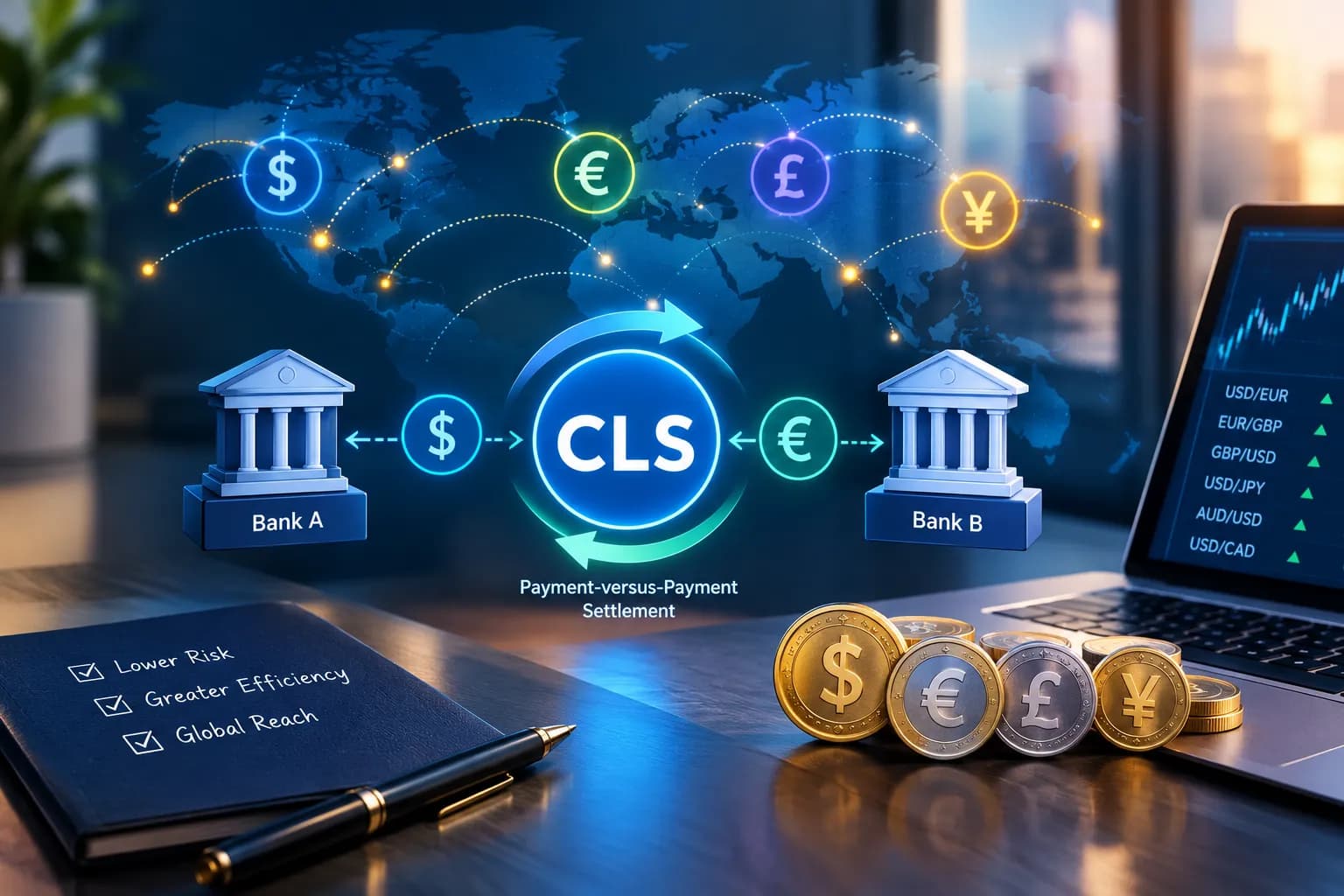
The acronym CLS in financial markets and banking refers to the Continuous Linked Settlement system. It is used for settling Foreign Exchange transactions among banks. If Bank A sells dollars to Bank B and buys Euros from them, there is always the risk that Bank B sends the payment to Bank A. Because of this, CLS systems join both payments; both payments either happen or both payments don't happen.
Other Common Meanings of "CLS" (Clinical Laboratory Scientist, Mercedes CLS, etc.)
Beyond finance, "CLS" may be short for Clinical Laboratory Scientist. These are licensed medical professionals who test blood and tissue samples and other specimens. You might also see "CLS" refer to a model of Mercedes-Benz, but none of these instances of the term "CLS" refer to finance or medicine. Commonly, the target definition is apparent with context.
What Is CLS (Continuous Linked Settlement) in Finance?
Now let's get into the financial side of things, since this is what most people searching "what is CLS" actually want to understand.
CLS Bank International — Ownership and Structure
CLS Bank International is a US-based, limited purpose bank which specializes in settling foreign exchange transactions. The Federal Reserve is the principal regulator and supervisor of CLS Bank International in the United States. CLS Bank International has an extensive network of relationships with the central banks of the countries whose currencies it settles internationally. Similar to a traditional commercial bank, CLS Bank International does not take customer deposits or originates commercial loans to customers. Its primary purpose is settlement.
CLS Group and CLS Services Ltd Explained
CLS Bank is an important part of the CLS Group, which encompasses CLS Services Ltd and CLS UK Intermediate Holdings. All of these businesses are often referred to as CLS or the CLS Group. Major international banks, such as BNP Paribas and larger banks, outsource their service for settling foreign exchange trades to CLS.
Why CLS Is Considered Financial Market Infrastructure
CLS has become such a large component of currency settlement that it has been deemed critical financial market infrastructure. In the event that CLS goes down or experiences a considerable disruptive event, there would be a substantial impact on the international foreign exchange market. This is why CLS has a deliberate regulatory oversight located around the infrastructure.
How Does the CLS Settlement System Work?
Understanding the mechanics helps explain why CLS matters so much to banks and financial institutions.
Payment-versus-Payment (PvP) vs Versus Payment Models
CLS uses the payment-versus-payment (PvP) model. What this means is that with currency transactions, both sides need to settle the payment at the same time, or neither side settles. With PvP, this means that the exposure time is eliminated, which is an improvement on the older methods of payments and settlements, where the time of one payment could be made before the other payment and thus create exposure.
Real-Time Gross Settlement and Multi-Currency Netting
CLS provides a netting and multi-currency system that draws from the real-time gross settlement system. It combines multiple transactions that would, in theory, take place individually throughout the day, frequently resulting in significant cash flows. Instead of forcing each transaction to happen individually, CLS consolidates them. This multi-currency netting improves system efficiency without compromising security.
The Role of Central Banks and the US Federal Reserve
Central banks provide accounts through which settlement occurs in the CLS system. The US Federal Reserve does this along with other central banks. Funds get properly transferred once CLS Bank confirms the two sides of a trade are set to settle.
Why Was CLS Created? Understanding FX Settlement Risk
CLS wasn't built out of convenience. It was built to solve a real and costly problem in the foreign exchange market.
Settlement Risk vs Credit Risk vs Liquidity Risk
The risk of one side settling their obligation while the other side of the trade does not, is called settlement risk. This is different from credit risk (counterparty default risk) and liquidity risk (having sufficient cash on hand). CLS is focused on settlement risk. However, a reduction in settlement risk also helps to manage exposure to the other two.
Cross-Border FX Transactions Before CLS Existed
Before 2002, cross-border FX transactions were risky. At the time, the processing of these transactions was dependent on the time zones of the involved parties. For instance, a bank could send a payment in the morning in one country, and by the time the receiving bank in the other country would be able to process the payment, it could be too late. Banks were, in fact, losing money, which prompted industry players to reach a critical mass with the same solution.
Which Currencies Does CLS Settle?
CLS settles a wide range of currencies used in daily forex transactions.
Major Settlement Currencies (US Dollar, Euro, Canadian Dollar, Australian Dollar, Swiss Franc)
CLS processes the highest volume of currency transactions involving the US dollar, euro, Canadian dollar, Australian dollar, and Swiss franc. These currencies account for a large fraction of global Foreign Exchange (FX) market volume.
Additional Currencies (Hong Kong Dollar, Mexican Peso, Korean Won, Danish Krone, Swedish Krona, South African Rand, Singapore Dollar, Norwegian Krone, Israeli Shekel, New Zealand Dollar)
CLS covers a variety of currencies beyond the majors such as the Hong Kong Dollar, Mexican Pesos, South Korean Won, Danish Krone, Swedish Krona, South African Rand, Singapore Dollar, Norwegian Krone and New Zealand Dollar, amongst others. The wide variety of currencies it offers is one of many reasons why institutions involved in international trade find CLS so useful.
Who Uses CLS Services?
Banks and Financial Institutions Participating in CLS
CLS provides services that major banks and their clients rely on globally. As direct members, some trade settlements are done by members themselves. They often extend their services to smaller clients whose direct membership is not offered.
How Central Banks Oversee CLS Operations
Since it was founded, CLS has been under the scrutiny of central banks to protect the stability of the entire financial system. This shared responsibility model of CLS Bank and numerous central banks has built trust of the system by the banking industry.
Benefits of CLS for the Foreign Exchange Market
Mitigating FX Settlement Risk
The clearest benefit is risk reduction. By linking payments together, CLS helps mitigate settlement risk that once threatened individual banks and, at times, the wider financial market.
Improving Liquidity and Confidence in Financial Markets
CLS reduces risk and increases liquidity in the FX market by netting trades. This means fewer cash flows need to be managed by banks, which in combination with low risk, encourages market participants to engage in the FX market.
CLS by the Numbers: Scale and Market Impact
Daily Transaction Volumes and Record Settlement Days
Classes like Central Limitry Settlement (CLS) settle millions or even billions of transactions daily. CLS has reported record-setting daily transactions in the trillions of dollars amidst days of elevated market activity. This underscores the importance CLS has developed around the world when it comes to settling foreign currency transactions.
How CL S Performed During the COVID-19 Crisis (BIS Quarterly Review Insights)
The need for FX markets to function during the COVID crisis actually used CLS as a stress test. Volumes skyrocketed and showed that the CLS settlement service was infallible. This strengthened its reputation as reliable and dependable settlement infrastructure during periods of market stress.
CLS vs MLS: Understanding the Difference
Some people mix up CLS and MLS, but the two are unrelated. CLS refers to Continuous Linked Settlement in finance, and in real estate (or in other contexts), MLS typically stands for either Multiple Listing Service or Major League Soccer. When you do your research on foreign exchange settlement, MLS will not be helpful in your search.
How Banks and Financial Institutions Access CLS Services
CLS settlement is available to banks through direct membership or third-party relationships. Some financial and operational standards need to be met personally by banks before they can become a member. Any agent bank that has a relationship with CLS Bank can provide settlement to members through third-party access. Third-party access allows smaller institutions to benefit from CLS settlement without becoming full members.
CLS in Other Contexts
Clinical Laboratory Scientist Certification and Licensing
Clinical Laboratory Scientists are healthcare professionals who obtain certifications to analyze biological samples in laboratory settings. Certifications are usually offered by credentialing bodies and require licensure issued by individual state governments. Medical laboratory assistants are less specialized roles that have less responsibilities.
CLS as Explained in Educational Videos
If you came here after watching a video, you probably understood that in that context, CLS described a general phenomenon or process. In that case, in order to understand what CLS means in that video, you should look at the video description and the source of the video definition, as the meaning of CLS changes a lot between fields.
Conclusion
The meaning of CLS varies depending on context; however, in finance, it nearly always refers to Continuous Linked Settlement. This settlement system ensures the foreign exchange market is safe from credit risk by simultaneously settling both sides of a trade. Banking professionals, or anyone else who is not familiar with settlement infrastructure and sees the term, will know instantly what it is if the context is given.
FAQs
What does CLS stand for in banking and finance?
CLS stands for Continuous Linked Settlement, a system that settles foreign exchange trades by linking both payment legs together.
Is CLS Bank a regular commercial bank?
No. CLS Bank International is a limited purpose bank focused solely on settling FX transactions, not on deposits or lending.
How many currencies does CLS currently settle?
CLS settles a wide range of major and secondary currencies, including the US dollar, euro, Canadian dollar, Hong Kong dollar, and South African rand, among others.
What is the difference between CLS and MLS?
CLS relates to financial settlement, while MLS usually refers to real estate listing services or sports leagues, depending on context.
Who regulates or oversees CLS Bank International?
The US Federal Reserve oversees CLS Bank, working alongside other central banks whose currencies are settled through the system.
What is settlement risk, and how does CLS reduce it?
Settlement risk is the danger that one party in a trade pays while the other fails to deliver. CLS reduces this through payment-versus-payment settlement, where both sides complete simultaneously.
Is CLS certification the same as Clinical Laboratory Scientist licensing?
Not exactly. Certification confirms professional competency, while licensing is a separate state-level requirement needed to legally practice.
How is CLS different from a standard clearing house?
A clearing house typically nets and settles a broader range of financial obligations, while CLS focuses specifically on foreign exchange settlement using its payment-versus-payment model.