Off-page SEO strategies are the actions you take outside your own website to build authority, trust, and visibility in search engines. They include link building, digital PR, brand mentions, reviews, and content promotion. Search engines treat these signals as proof that other people value your site, so the stronger they are, the better your pages tend to rank. This guide covers the off-page SEO strategies that work in 2026, the ranking factors behind them, and a step-by-step way to put them into practice.
Table of contents16 sections
What Are Off-Page SEO Strategies?
Off-page SEO (also written offpage SEO, offsite SEO, or off-site SEO) covers everything that happens beyond your website that affects how search engines see it. Backlinks are the biggest part, but they are not the whole picture. Mentions, reviews, social activity, and media coverage all play a role, though not all of them in the same way.
How Does Off-Page SEO Work?
Google can read your content, but it cannot judge on its own whether the content deserves trust. So it looks for outside confirmation. When a respected website links to your page, that link works like a recommendation. When people search for your brand by name, or journalists quote you, those are additional signs that you are a real, credible source.
It helps to be honest about what is confirmed and what is not. Links are the one off-page signal Google has openly described as a ranking input, and PageRank, built on links, is part of how the system works. Unlinked brand mentions, branded search volume, and social activity are different. Google has not confirmed any of them as direct ranking factors. They still matter, because they build awareness, help search engines connect your brand name with your topic as an entity, and often lead to the links that do count. Think of links as a ranking signal and mentions as a credibility and discovery signal. Treating them as the same thing is how people end up chasing metrics that do not move rankings.
Over time, these signals add up. A page with solid content and strong external support will usually outrank an equally good page that nobody has referenced.
On-Page vs Off-Page vs Technical SEO
On-page SEO is what you control directly: content, titles, headings, internal linking, and page structure. Technical SEO covers crawlability, site speed, mobile usability, and indexing. Off-page SEO is the work done elsewhere to earn trust.
Think of it this way. On-page and technical work make your site worth ranking. Off-page work convinces search engines that other people agree. If you are comparing on page and off page SEO, you need both. Strong backlinks cannot rescue a slow, confusing site, and a perfect site with no external signals will struggle in competitive niches.
Main Elements of Off-Page SEO
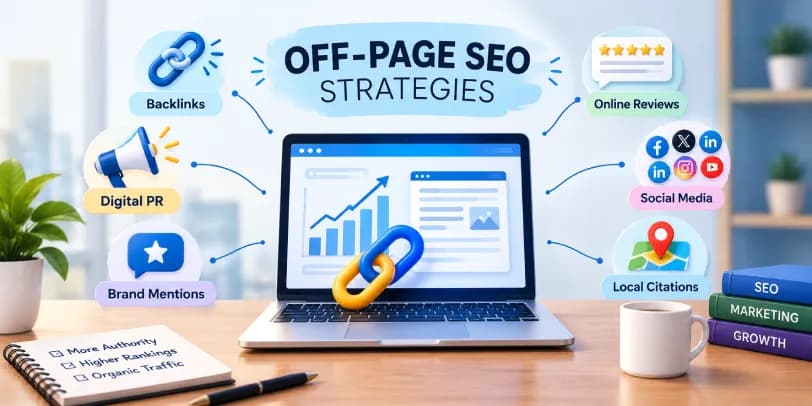
The main elements are backlinks, brand mentions, digital PR, social media engagement, influencer collaborations, local citations, online reviews, and community participation. Each one is covered in the sections below.
Why Are Off-Page SEO Strategies Important?
Rankings are competitive, and most sites in the top results already have decent on-page optimization. Off-page signals are often what separates position three from position nine.
Building Website Authority and Trust
Every quality link and credible mention adds to your site authority. That authority carries across your whole domain, so one strong piece of coverage can help several pages at once.
Improving Search Visibility and Organic Traffic
Pages supported by relevant backlinks tend to rank for more keywords and hold those positions longer. Better rankings bring more organic traffic without extra advertising spend.
Increasing Brand Awareness and Referral Traffic
A link on a respected site sends visitors, not just ranking signals. Those readers often arrive already interested, which makes referral traffic valuable beyond SEO.
Supporting Leads and Conversions
People trust brands they see in multiple places. Mentions in articles, podcasts, and review sites make a prospect more comfortable by the time they land on your site, which often improves conversion rates.
Key Off-Page SEO Factors That Influence Rankings
Understanding off page SEO ranking factors helps you spend effort where it counts.
Backlink Quality, Relevance, and Referring Domains
One link from a relevant, trusted site is worth more than dozens from weak ones. Relevance matters at several levels, not just the site as a whole. A link to a SaaS tool from a software publication means more than one from an unrelated blog. Beyond that, the page itself should cover a related topic, the text around the link should make sense for the destination, and the anchor text should describe what the reader will find.
Placement matters too. A link inside the main body of an article, surrounded by relevant text, reads as an editorial choice. Links in footers, sidebars, navigation menus, and author bios are common and not harmful, but they are usually site-wide or templated, so they tend to carry less weight and say less about your page specifically. When you evaluate an opportunity, ask where on the page your link will sit and whether a reader would realistically click it.
Relevance also works at the page level, not only the domain level. Domain-level relevance asks whether a publication covers your industry. Page-level relevance asks whether the specific page being linked to fits what the reader of that article wants next. If an article explains how to compare payroll software and links to your homepage, the reader lands on a general page and has to search for what they came for. If it links to your payroll comparison guide, the visit matches the intent that brought them there, and Google sees a tighter connection between the two pages.
This is why homepage links are not always the best choice. They are easy to get and good for brand visibility, but they rarely help a specific service page, product page, or guide rank for the terms that drive revenue. Deep links to relevant research, guides, and commercial pages usually give more contextual value. A healthy profile still includes homepage links, since that is where many natural links point, but aim to direct most outreach at the page that best serves the audience of the linking article.
Referring domains, meaning the number of unique websites linking to you, usually matter more than the raw total of links. Fifty links from one site are closer to one vote than fifty.
PageRank and Link Equity
PageRank is Google's method of passing value through links. The value a link passes, often called link equity, depends on the authority of the linking page and how many other links sit on it. A link from a page with few outbound links usually passes more than one buried in a long list.
Anchor Text and Natural Link Patterns
Anchor text is the clickable text of a link. A natural profile mixes branded anchors, naked URLs, generic phrases, and some descriptive text. If most of your links use the same exact-match phrase, it looks engineered. Google also reads the words around the anchor, so a descriptive sentence that surrounds a branded link can still tell it what the destination is about.
Domain Authority vs Page Authority
Domain authority and page authority (often shortened to DA and PA, with Ahrefs using DR and UR) are third-party scores from tools like Moz and Ahrefs. Google does not use them. They are useful for comparing sites and filtering prospects, but they are estimates, not ranking factors. A site can have a high score and still be a poor place to earn a link, which the quality section below explains.
Brand Mentions, Reputation, and Branded Searches
When people search for your brand name, that signals real demand. Brand mentions, even without links, help search engines connect your name with your topic. Keep the expectation realistic, though. Google has not said that unlinked mentions pass ranking value the way links do. Their practical value is in entity recognition, reputation, and the chance to turn a mention into a link through a polite request.
E-E-A-T and Off-Page Trust Signals
E-E-A-T stands for experience, expertise, authoritativeness, and trustworthiness. It is a quality framework used by Google's raters, not a single score or a direct ranking factor. Much of it is judged off your site: who cites you, who reviews you, and who recommends you. Author bios help, but external validation carries more weight.
Social Signals and Their Indirect SEO Impact
Likes and shares are not a direct ranking factor. However, social activity helps content get seen, and content that gets seen is more likely to earn links. That is the whole mechanism, and it is an indirect one.
Types of Backlinks Used in Off-Page SEO
Natural, Manually Acquired, and Self-Created Backlinks
Natural links come without asking, usually because someone found your content useful. Manually acquired links come from outreach, guest posts, and partnerships. Self-created links come from things like directory listings, profiles, or comments. Natural and manually earned links carry the most value. Self-created ones carry the least and carry the most risk when overdone.
Follow, Nofollow, Sponsored, and UGC Links
A standard link is followed. Google also recognizes rel="nofollow", rel="sponsored" for paid placements, and rel="ugc" for user-generated content such as forum posts and comments. Since 2019, Google has treated all three attributes as hints rather than strict commands. In practice, that means Google may still use a nofollowed link to discover pages or understand context, and it does not promise to ignore it for every purpose. Even so, you should not plan around the idea that a nofollow link passes full value. Plan for the opposite, and treat any value as a bonus alongside referral traffic and visibility.
The more important question is how to label links correctly, because that is where policy trouble starts.
- Paid placements and sponsored content: If you pay for a placement, or the publisher is compensated in any form, the link should carry rel="sponsored". A paid guest post with a plain followed link is exactly what Google's link spam policies describe.
- Affiliate links: These should also use rel="sponsored" (rel="nofollow" is acceptable). Affiliate sites that disclose clearly and label links properly are fine. Problems come from thin pages built only to carry affiliate links.
- User-generated links: Forums, comments, and profile pages should use rel="ugc" or nofollow. If you run such a site, this protects you. If you leave links there on someone else's site, expect them to be treated that way.
None of this means sponsored coverage is off limits. Advertising and paid partnerships are normal. They just should not be disguised as editorial endorsements to pass ranking value.
High-Quality vs Low-Quality Backlinks
High-quality backlinks come from relevant, editorially controlled sites with real audiences. Low-quality ones come from link farms, spammy directories, and sites that exist only to sell links. A few weak links will not hurt you, but a pattern of them can.
Metrics alone cannot tell the two apart, so use a wider checklist before you pursue a link.
- Organic traffic trend: Does the site get steady or growing search traffic? A high DR with traffic that has collapsed is a red flag.
- Topical relevance: Does the site consistently cover your subject, or does it publish on everything?
- Real audience: Look for comments, social following, newsletter signups, and signs that people actually read it.
- Traffic quality: Is the traffic from countries and languages that fit the site, or does it look inflated?
- Outbound link patterns: Pages stuffed with links to casino, loan, or supplement sites, or posts with many unrelated external links, suggest a link-selling operation.
- Editorial standards: Are there named authors, clear guidelines, and content someone has actually edited?
- Signs of a link-selling site: Pages like "write for us" with prices, "sponsored post" menus, and dozens of guest posts in unrelated niches.
A site with strong metrics and a site that offers a genuinely valuable backlink are not always the same site. The better opportunity is often a smaller, relevant publication whose audience is exactly the people you want to reach.
Best Off-Page SEO Strategies and Techniques
These are the off page seo techniques worth your time, from most to least reliable.
Link Building Strategies
Guest Posting on Relevant Websites
Guest posting still works when you write genuinely useful articles for sites your target audience reads. It stops working when you mass-produce thin posts for any site that accepts them. Pitch a specific topic, show you know the publication, and treat the placement as a content partnership.
Broken Link Building
Find broken outbound links on relevant sites, then suggest your own page as a replacement. It helps the site owner fix a problem, which is why the response rate tends to be better than cold link requests.
Unlinked Brand Mentions and Link Reclamation
Some sites mention your brand without linking. A short, polite email asking to add the link is one of the easiest wins in off-page work. Similarly, check for links that were removed or lost after a site redesign.
Some of the most valuable links are lost through technical changes, often without anyone noticing. Common causes include:
- Deleted pages: A page with strong backlinks is removed and now returns a 404 error, so the link value goes nowhere.
- URL changes: A redesign or CMS switch changes the structure, and old addresses are not redirected.
- Redirect chains: An old URL passes through several redirects before arriving, which slows crawling and can weaken the signal.
- Publisher edits: The linking site updates or removes the link, or swaps in a competitor.
The fix starts with a backlinks report filtered to your pages that return errors or redirect. Point each URL with good links to the closest relevant live page with a single 301 redirect, or restore the content if it still has value. Where a publisher dropped your link, ask politely and explain what changed. If the page moved, give them the new URL.
Domain migrations are the highest-risk case. Before you move, list your top linked URLs, map each one to its new address, and keep the redirects in place for at least a year. Afterward, check that the links are being picked up and ask your most important linking sites to update their links directly to the new URLs.
Competitor Backlink Gap Analysis
Compare your backlink profile with competitors to find sites that link to them but not to you. Those sites already cover your topic, so they are warm prospects.
Resource Page Link Building
Many sites keep curated resource lists. If you have a genuinely helpful guide, tool, or dataset, ask to be included.
Digital PR and Journalist Outreach
Creating Newsworthy Stories and Press Releases
Journalists want something new: a data point, a trend, or a clear opinion. A press release without a real story rarely earns coverage.
Journalist Outreach and Expert Contributions
Respond to journalist requests with short, quotable, specific answers. Speed matters as much as quality here.
Earning Editorial Links and Media Mentions
Editorial links come from newsrooms and industry publications. They are hard to earn and carry strong trust, which is why digital PR has become central to modern link building. Industry matters here. A SaaS company usually earns more from software review sites, integration partners, and trade publications. A publisher or affiliate site relies on being cited as a source, so original data and clear expertise do most of the work. Service-based businesses tend to get further with local press, associations, and partner referrals.
Content Marketing and Linkable Assets
Original Research, Surveys, and Statistics
Original data is the most dependable linkable asset. Writers cite statistics, and if yours is the source, you collect the link.
Infographics, Videos, and Visual Content
Visuals work when they make complex information easier to understand. Make them easy to embed and credit.
Information Gain and Unique Content
Content that repeats what already ranks gives nobody a reason to link. Add something new: a framework, firsthand observations, or a different angle.
Content Promotion and Distribution
Publishing is not enough. Share content with relevant newsletters, communities, and people who have written about the topic before.
Social Media Marketing and Engagement
Sharing Content Across Relevant Social Platforms
Focus on platforms where your audience actually spends time. A B2B software brand usually gets more from LinkedIn than from short-form video.
Building Communities and Brand Awareness
Active communities keep your brand visible and encourage mentions and branded searches over time.
Influencer Marketing and Collaborations
Industry Influencer Partnerships
Partner with people your audience already trusts. A collaboration on research, webinars, or co-created content often leads to links and mentions.
YouTube Collaborations and Video Promotion
Video descriptions can carry links, and YouTube itself is a search engine. Appearances on established channels bring both exposure and credibility.
Podcasts and Expert Interviews
Podcast guest spots usually include a show notes page with a link back. They also build authority in a way written content cannot.
Local Off-Page SEO Strategies
Google Business Profile Optimization
Complete every field, choose accurate categories, add photos, and post updates. A well-maintained Google Business Profile is the foundation of local visibility.
Local Citations and NAP Consistency
Citations are mentions of your business name, address, and phone number (NAP) on other sites. Consistency matters, because conflicting details confuse search engines.
Customer Reviews and Online Reputation
Reviews affect both rankings in local pack results and customer decisions. Ask satisfied customers, reply to every review, and handle negative ones professionally.
Local Partnerships and Community Mentions
Sponsoring a local event, joining a chamber of commerce, or partnering with nearby businesses often earns relevant local links.
Community Participation and Legacy Techniques
Relevant Forum and Q\&A Participation
Answer real questions in forums and Q\&A sites where you have something useful to say. Value first, links second. Remember that most of these links are marked as user-generated, so the benefit is mostly visibility and reputation.
Directory Submissions and Social Bookmarking
General directory submission and social bookmarking sites have little impact now. Industry-specific directories and trusted local ones can still help.
Article and Document Sharing
Platforms for sharing documents and presentations can expose your work to new audiences. Treat them as distribution, not as a source of ranking power.
Web 2.0 Link Building and Its Risks
Free blog platforms were once a popular shortcut. Today, sites built only to pass links are easy for Google to identify, so the risk usually outweighs the reward.
How to Build an Off-Page SEO Strategy Step by Step
Step 1: Audit Your Existing Backlink Profile
Start with what you have. Check referring domains, anchor text distribution, and any toxic or irrelevant links. Also look at how your links grew over time, since the shape of that growth tells you a lot about what has worked.
Step 2: Analyze Competitors and Identify Link Gaps
Choose three to five competitors who rank where you want to rank. Look at where their strongest links come from.
Step 3: Find Relevant Outreach Opportunities
Build a prospect list from gap analysis, resource pages, journalists, and podcasts. Prioritize relevance over metrics, and run each prospect through the quality checklist above before you send anything.
Step 4: Create Valuable, Link-Worthy Content
Make sure you have something worth linking to before you send a single email. A data study, tool, or genuinely better guide gives your outreach a reason to exist.
Step 5: Build Relationships and Earn Backlinks
Personalize outreach and follow up once. Most successful link building comes from relationships built over months, not one-off emails.
Some of your best opportunities may already be sitting in your existing business relationships. Think about who you already work with and whether they have a website where a link would make sense:
- Suppliers and manufacturers: Many publish "where to buy" or "authorized retailer" pages.
- Customers and clients: A case study or testimonial published on their site, or on yours with their link, is a natural fit.
- Business associations and memberships: Professional bodies often list members with a link to the member's website.
- Integration and technology partners: Partner directories, marketplace listings, and integration pages are relevant and well trusted.
- Co-marketing: Joint webinars, shared research, and co-written resources give both sides something worth linking to.
These links work because the relationship is real and the audiences overlap. The same rule applies as with exchanges: the link should exist because it helps a visitor, not because it was part of a deal.
Step 6: Promote Content and Increase Brand Visibility
Share new content through social channels, newsletters, and communities, and mention it to people who have covered similar topics.
Step 7: Monitor Results and Improve Your Strategy
Review new links, rankings, and traffic monthly. Double down on tactics that earn links and drop the ones that don't. Record the date of every campaign and every major site change, because you will need those notes when you try to work out what caused what.
Off-Page SEO Best Practices
Prioritize Relevant and Editorially Earned Backlinks
A link that a real editor chose to include is worth more than one you could place yourself.
Maintain a Natural and Diverse Backlink Profile
Mix link types, anchor text, and source sites. A natural profile looks varied because it grew from many different situations.
Pace is part of that picture, often called link velocity. Real backlink growth is uneven. A good study, a press mention, or a viral post can bring dozens of links in a week, followed by a quiet month. A sudden jump is not automatically harmful, and Google does not penalize you for being popular. What looks suspicious is a spike with no visible cause, where many links of the same type, with the same anchor text, from unrelated or low-quality sites, appear in a short window. Ask whether the growth has a story. If a campaign, launch, or news mention explains it, the pattern is probably natural. If you cannot explain it and the links look alike, investigate.
Focus on Long-Term Relationships and Brand Authority
Journalists, editors, and creators remember who was helpful. Those relationships keep paying off long after a campaign ends.
Follow Google's Link Spam Policies
Google's link spam policies prohibit buying or selling links that pass ranking value, excessive link exchanges, large-scale guest posting campaigns with keyword-rich anchors, and automated link creation. Read them before building any campaign.
Violations can lead to two very different outcomes, and it helps to know which one you are dealing with.
- Manual action: A human reviewer at Google decides your site has violated the spam policies, and you get a notice. Check this in Google Search Console under Security & Manual Actions, then Manual actions. Link-related examples are "unnatural links to your site" and "unnatural links from your site." You fix the problem and submit a reconsideration request.
- Algorithmic treatment: Google's systems, including its spam detection, identify manipulative links automatically and simply stop counting them. There is no notice and no message in Search Console. You just do not get the benefit you expected, and the money spent on those links is wasted.
Most link-related problems today fall into the second category. That is why a site can build hundreds of links and see nothing happen. If rankings never respond and you have no manual action, the links may simply be ignored.
Off-Page SEO Checklist
Off-page priorities change with the type of website, so adjust the checklists below to fit your situation.
- SaaS and B2B: Focus on product-led content, original data, integration partners, review platforms, and trade publications. Buyers research for weeks, so mentions in the places they read carry real weight.
- Publishers: Authority comes from being cited. Expert commentary, original reporting, and relationships with other editors drive links.
- Affiliate websites: Trust is the hurdle. Earn links with testing, comparisons, and first-hand data, and label affiliate links properly.
- Service-based businesses: Local press, associations, partner referrals, and reviews usually beat broad link campaigns.
Essential Off-Page SEO Checklist for Beginners
- Audit your current backlinks
- Set up Google Search Console
- Claim your brand profiles on major platforms
- Start unlinked brand mention outreach
- Publish one linkable asset
- Pitch a small number of relevant guest posts
- Track referring domains monthly
Off-Page SEO Checklist for E-commerce Websites
- Build links to category pages and guides, not only products
- Get listed in trusted review and comparison sites
- Collect verified customer reviews
- Run digital PR around product data or trends
- Partner with creators for product reviews
- Reclaim links from old or discontinued product pages
Local Business Off-Page SEO Checklist
- Fully optimize your Google Business Profile
- Keep NAP details consistent everywhere
- Collect and reply to reviews
- Join local business associations
- Sponsor local events
- Earn mentions in local news and blogs
Best Tools for Off-Page SEO Strategies
Ahrefs for Backlink and Competitor Analysis
Ahrefs is strong for backlink data, link gap reports, and finding lost or broken links.
Semrush for Backlink Audits and Link Opportunities
Semrush offers backlink audits, toxicity checks, and outreach tools in one platform, which suits teams managing several projects.
Google Search Console for Link Monitoring
Search Console is free and shows which sites link to you and which pages attract the most links. It is the most reliable source for your own site, though it reports a sample and updates with a delay.
That delay catches many people off guard, so it helps to understand how links are found. Search engines discover backlinks by crawling. A crawler visits a page, follows the links on it, and queues the destinations. Sitemaps and other known pages help it find new content, and a link on a page that is rarely crawled can take a long time to be noticed. Several states can exist at once, and they are not the same thing.
- Live backlink: The link exists on the page right now.
- Crawled backlink: A crawler has visited the page and seen the link.
- Indexed linking page: The page is in Google's index, which is not guaranteed even after a crawl.
- Reported backlink: The link appears in Search Console or a third-party tool, which depends on that tool's own crawler and refresh cycle.
Ahrefs, Semrush, Moz, and Majestic each run their own crawlers and keep their own indexes, so they rarely agree. A new link may appear in one tool within days, in another after weeks, and in Search Console much later or not at all. If a link you earned is not showing up, check that the page is live, indexable, and not blocked, before you assume something is wrong.
It also matters how the link is built. A standard link uses an HTML anchor element with an href attribute pointing to a real URL. Google can follow those reliably. A button or image that sends people elsewhere through a JavaScript click handler, with no href, may look clickable to a visitor but does not work as a normal hyperlink for crawlers. Google can render JavaScript and may discover links added that way, but it is slower and less dependable, and links that need a click, a scroll, or a user action to appear are the ones most likely to be missed.
When a placement goes live, validate it. View the page source or inspect the element, and confirm that the link is an anchor tag with an href. Check that the destination URL is exactly the one you agreed on, with no tracking redirect in between. Follow it to see whether it resolves in a single step, and read the rel attributes to confirm whether it is followed, nofollow, sponsored, or ugc. A link that redirects through several hops, or ends on an error page, will not do much for you, even if it looks fine in the article.
Tools for Outreach and Brand Mention Monitoring
Email outreach platforms help manage campaigns at scale, while alert tools help you catch new brand mentions quickly.
How to Measure Off-Page SEO Success
Referring Domains and Backlink Quality
Track new referring domains each month and judge them by relevance, not just authority scores. Remember that a link may exist long before any tool reports it, so measure over weeks rather than days.
Organic Traffic and Keyword Ranking Trends
Look at rankings for the pages you built links to. Results usually appear gradually over months. The most useful view is the destination page, not the whole site. Site-wide traffic hides what a single campaign did, while a page that received three strong links and moved from position twelve to six tells a clearer story.
Referral Traffic and Conversions
Check which linking sites send visitors and whether those visitors convert. Some links matter more for revenue than for rankings.
Brand Mentions and Branded Search Visibility
Growth in branded searches and mentions suggests your awareness work is paying off.
Backlink Audits and Spam Risk Assessment
Review your profile quarterly for suspicious spikes, spammy domains, or over-optimized anchors.
A bad-looking profile is not always your doing. Negative SEO means someone deliberately points spammy or manipulative links at a site to harm it, and it can come from a competitor or from automated tools that blast links across thousands of sites. Google has said its systems are generally good at ignoring spam links, so most sites that receive them are not harmed. That said, an unusual spike deserves a look.
To tell a spike from a link scheme, ask a few questions. Did you or anyone working for you build links around that date? Are the new links from irrelevant, foreign-language, or obviously auto-generated pages? Do they share the same anchor text, or contain adult, gambling, or pharmaceutical terms that have nothing to do with your business? Spikes that match none of your activity and look machine-made are usually automated spam.
When to investigate further:
- You see a manual action notice for unnatural links.
- Rankings drop sharply right after a spike, and nothing else changed.
- The spam links carry commercial anchors pointing at your key pages.
In the first case, remove what you can and consider the disavow tool for the rest. Otherwise, document what you found and keep monitoring.
Google's Disavow Links tool lets you upload a plain text file listing URLs or domains you want Google to ignore when it assesses your site. It is a request, not a command, and it does not remove the links from the web or from third-party tools. You can disavow a single page with its full URL, or an entire site with the domain: prefix. Individual URLs make sense when only one page is the problem. The domain option is better when a whole site is spam, since new pages on it would otherwise keep appearing.
When should you use it? Mainly in two situations: you have received a manual action for unnatural links, or you or a former agency built a pattern of manipulative links that you cannot get removed. Random spam links that you did not build are not a reason on their own. Google has said it handles most of these automatically, and every site collects some of them. A disavow file built on guesswork can also backfire, because it may tell Google to ignore good links by mistake. Take your time, review each domain, and keep a copy of every version you upload. The tool also works slowly. Google processes the file when it recrawls the linking pages, so changes can take weeks to show.
Measuring Off-Page SEO ROI
Compare the cost of your campaigns with the value of the organic traffic, leads, and sales they generated. For most businesses, this takes six to twelve months to judge fairly.
Attribution is the hard part. Rankings rarely move because of a single factor, so protect your analysis from noise. Before crediting a campaign, check whether you also updated content, changed internal links, fixed technical issues, or hit a seasonal peak, and whether a competitor gained or lost ground in the same period. A few habits help:
- Record the live date of every new link and every site change.
- Compare the linked page with a similar page that received no links.
- Look at impressions and average position in Search Console for the destination page before and after.
- Allow several weeks for links to be crawled and counted before you judge results.
- Treat conclusions from one link as tentative and from a campaign as stronger.
You will rarely prove exactly what one backlink did. You can, however, build a reasonable picture by controlling what you can and being honest about what you cannot.
Common Off-Page SEO Mistakes to Avoid
Buying Links and Participating in Link Schemes
Paid links that pass ranking value violate Google's guidelines and can lead to a manual action or to the links being quietly ignored. Either way, the investment does not pay off.
Link exchanges deserve the same caution, though the line is less obvious. Reciprocal linking simply means two sites link to each other. That happens naturally all the time. A software company and its integration partner, or a trade association and its members, will often link both ways because their audiences benefit. Google does not treat every reciprocal link as a problem.
The issue is excessive or arranged exchanges made mainly to pass ranking value, such as "link to me and I'll link to you" campaigns run across dozens of sites. Three-way exchanges, where site A links to B, B links to C, and C links back to A, are meant to hide the pattern and are just as risky. A simple test is to ask whether the link would exist if search engines did not. If it would, because it helps real visitors, it is probably fine. If it only exists as part of a swap, it is a link scheme in the making.
Building Irrelevant or Low-Quality Backlinks
A link from an unrelated, low-quality site helps nobody and can draw attention for the wrong reasons.
Overusing Exact-Match Anchor Text
Repeated keyword-heavy anchors are an easy pattern to spot. Keep anchors varied.
Ignoring Brand Reputation and Customer Reviews
Strong rankings mean little if customers see poor reviews. Reputation and SEO now support each other.
Prioritizing Link Quantity Over Quality
Ten strong links outperform a hundred weak ones. Measure by value, not volume.
Relying on Outdated Submission Techniques
Mass directory submissions, profile spam, and blog comments rarely help anymore and waste time better spent elsewhere.
Off-Page SEO Examples and Case Studies
Earning Backlinks Through Original Research
A software company surveys a few hundred users about a common workflow problem and publishes the results with clear charts. Industry blogs and news sites cite it for months, and each citation links back to the source.
Improving Local Visibility Through Reviews and Citations
A local service business cleans up inconsistent listings, then asks every happy customer for a review. Over time, it appears more often in local pack results for nearby searches.
Recovering Links Through Brand Mention Outreach
A brand finds dozens of articles that mention it without linking. A short, friendly email to each editor recovers a good share of those links, with almost no content creation needed.
Off-Page SEO Strategies for AI Search and Future Trends
Brand Mentions and Entity Recognition in AI Search
AI tools build their understanding of brands from patterns across the web. Consistent mentions in credible places help systems recognize your brand as an entity connected to your topic. This is where unlinked mentions earn their keep, even though they are not a confirmed ranking factor in classic search.
Off-Page Authority and Visibility in AI Overviews
Pages that appear in AI Overviews tend to come from sites with strong authority and clear topical focus. The same signals that support classic rankings help here.
Why Original Research and Credible Sources Matter
AI systems favor information they can attribute to a reliable source. Original data and expert commentary give them something worth citing.
The Future of Link Building and Digital PR
Link building is moving toward earning attention instead of placing links. Teams that combine research, PR, and relationship building are best positioned for what comes next.
Off-Page SEO Services: DIY vs Hiring an Agency
When Should You Manage Off-Page SEO In-House?
In-house works when you have time, a clear niche, and someone who can handle outreach consistently. Smaller sites and early-stage projects often start this way.
When Should You Hire an Off-Page SEO Agency?
An off page seo company makes sense when you need to scale outreach, lack the time, or compete in a tough market. Good off page seo services bring established publisher relationships and experienced outreach teams, and they understand how strategies differ between a SaaS brand, a publisher, and a local service business.
Questions to Ask Before Hiring an SEO Specialist
Ask how they find prospects, what kind of sites they target, how they judge link quality beyond DA or DR, how they report results, and whether they ever buy links. Ask how they label sponsored placements and how they would handle a manual action. Request examples of past placements. Vague answers are a warning sign.
Conclusion
Off-page SEO comes down to earning trust from outside your website. Strong backlinks, real brand mentions, positive reviews, and useful content all contribute, and none of them works well alone. Know which signals Google treats as ranking inputs and which ones simply support awareness. Start with an audit, find the gaps, build something worth linking to, and track results over time. Be patient, avoid shortcuts, and keep quality ahead of quantity.
Frequently Asked Questions
What are off-page SEO strategies?
They are actions taken outside your website, such as link building, digital PR, and reputation building, to improve your search visibility
Why are off-page SEO strategies important?
They show search engines that other people trust your site, which supports higher rankings and more traffic.
What is the difference between on-page and off-page SEO?
On-page SEO covers what you control on your site. Off-page SEO covers external signals like backlinks and mentions.
What are the most effective off-page SEO techniques?
Guest posting, digital PR, broken link building, link reclamation, and original research tend to perform best.
How many backlinks do I need to rank on Google?
There is no fixed number. It depends on your competition, so compare your profile with the pages already ranking.
Is guest posting still effective for off-page SEO?
Yes, when done on relevant sites with genuinely useful content. Mass guest posting with keyword-rich anchors can break Google's link spam policies.
How long does off-page SEO take to show results?
Usually three to six months for noticeable movement, longer in competitive niches. New links also take time to be crawled and counted.
Can off-page SEO hurt website rankings?
Yes. Manipulative links can lead to a manual action or be ignored by Google's systems. Spam links built by someone else rarely cause harm on their own, but unusual spikes should still be checked.
What are the most important off-page SEO factors?
Backlink quality and relevance, referring domains, link placement, brand mentions, and trust signals.
Can a website rank without backlinks?
It can, for low-competition or very specific searches, but competitive terms usually need links.
Do social media signals directly affect Google rankings?
No, but social activity can increase visibility and lead to links.
How do I find competitors' backlink opportunities?
Use a backlink tool to run a gap analysis and reach out to sites that link to competitors but not to you.
What are unlinked brand mentions?
They are references to your brand on other sites that do not include a link. They are not a confirmed ranking signal, but they can be turned into links.
How does E-E-A-T relate to off-page SEO?
Much of E-E-A-T is judged through external signals like citations, reviews, and reputation. It is a quality framework, not a direct ranking factor.
What are the best tools for off-page SEO?
Ahrefs, Semrush, and Google Search Console cover most needs, plus outreach and mention-monitoring tools.
How can I measure off-page SEO success?
Track referring domains, rankings, referral traffic, branded searches, and conversions, and look at results for the specific pages you built links to.
Are online reviews important for off-page SEO?
Yes, especially for local search, where they influence both rankings and customer trust.
How does off-page SEO help with AI search visibility?
Brand mentions and credible sources help AI systems recognize and cite your brand.
Can I do off-page SEO myself or should I hire an agency?
You can start yourself on a small scale. Consider an agency when you need to scale or lack time.
Are directory submissions and forum backlinks still useful?
Only in limited cases. Relevant industry directories and genuine forum participation help, but mass submissions do not.